Example: bachelor of science
Quick Reference Guide - Periodontology
Some plaque visible only when a probe was used to skim the tooth surface Visible amount of plaque which can be seen without use of a probe No measurement could be made for this surface/tooth ... stomia (e.g. drug-induced) Factors af fecting self …
Tags:
Information
Domain:
Source:
Link to this page:
Documents from same domain

BSP UK CLINICAL PRACTICE GUIDELINES FOR THE …
www.bsperio.org.ukUnstable Re-evaluate after 3 months Stable BSP top tips I: Patients should be made aware that regular effective self-performed plaque removal offers the largest treatment benefit – engage the patient in a verbal contract to perform daily plaque control

Practitioner’s Toolkit - Periodontology
www.bsperio.org.ukHealthy Gums DO Matter Second Edition ... improved outcomes for everyone. SECTION 1. 7 Rationale The gap between how periodontal care is being delivered in NHS general dental practice and the recommended guidance is widening. The steering group recognise the disconnect and issues raised and want to start the move ... plaque control and home ...
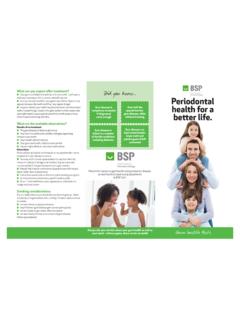
What can you expect after treatment? Periodontal …
www.bsperio.org.ukAbout gum disease Before we launch into the science of gum disease, it’s important to know that, despite it being one of the most wide-spread

Assessment and Management of the Periodontal condition …
www.bsperio.org.uk©2012 British Society of Periodontology and The British Society of Paediatric Dentistry 2 The aims of these guidelines are two fold:

The Good Practitioner’s Guide to Periodontology
www.bsperio.org.uk4 Copyright © 2016 British Society of Periodontology FOREWORD Welcome to the third version of the Good Practitioner’s Guide. We hope that you will find it a ...
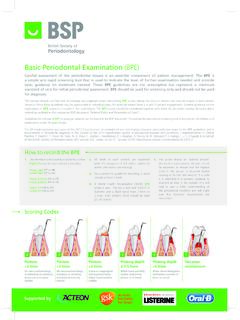
Basic Periodontal Examination (BPE)
www.bsperio.org.ukBasic Periodontal Examination (BPE) Careful assessment of the periodontal tissues is an essential component of patient management. The BPE is a simple and rapid screening tool that is used to indicate the level of further examination needed and provide basic guidance on treatment needed.

The Good Practitioner’s Guide to Periodontology
www.bsperio.org.ukorder to aid successful treatment. Thoroughly assessing and diagnosing the type of periodontal disease using the current classification system is essential. The aim of this guide is to review each step of the periodontal assessment and treatment process using an evidence based approach to the management of patients in practice. Key references
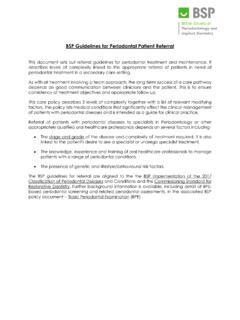
BSP Guidelines for Periodontal Patient Referral
www.bsperio.org.uksystemic diseases and syndromes, under specialist guidance. − With peri-implant mucositis. Level 3 Complexity - Patients are usually referred once the lifestyle or behavioural risk factors have been addressed and appropriate non-surgical treatment undertaken in general

BASIC PERIODONTAL EXAMINATION (BPE)
www.bsperio.org.ukBASIC PERIODONTAL EXAMINATION (BPE) Careful assessment of the periodontal tissues is an essential component of patient management. The BPE is a simple and rapid screening tool that is used to indicate the level of examination needed and to provide basic guidance on treatment need. Please note; the BPE does not provide a diagnosis. How to record ...
Related documents
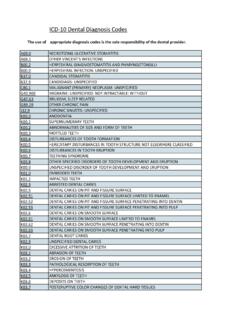
ICD-10 Dental Diagnosis Codes
dental.nv.govk05.00 acute gingivitis, plaque induced k05.01 acute gingivitis, non-plaque induced k05.1 chronic gingivitis k05.10 chronic gingivitis, plaque induced k05.11 chronic gingivitis, non-plaque induced k05.2 aggressive periodontitis k05.20 unspecified aggressive periodontitis k05.21 aggressive periodontitis, localized
Asymptomatic carotid stenosis: screening and management
rimed.orglevel induced by statin therapy than to the medication itself.10 Another more recent study found that statin use in symptom-atic carotid patients was associated with a decreased incidence of negative plaque features on MR imaging. These negative plaque features are thought to be predic-tive of future cerebrovascular events and
Transcriptomic signatures induced by the Ebola virus ...
www.thelancet.comDec 06, 2021 · aimed to identify transcriptomic immune response biomarker signatures induced by vaccination and associated signatures with its immunogenicity and reactogenicity to better understand the potential mechanisms of action of the ... of 3 × 10⁵ − 1 × 10⁸ plaque-forming units [pfu]; figure 1). RNA was isolated using the PAXgene blood miRNA . 2.
Definition of Early Childhood Caries (ECC)
www.aapd.orgCaries is a biofilm (plaque)-induced acid demineralization of enamel or dentin, mediated by saliva. The disease of early childhood caries (ECC) is the presence of 1 or more decayed (noncavitated or cavitated lesions), missing (due to caries), or filled tooth surfaces in any primary tooth in a child 71

ECG in STEMI
www.heart.orgplaque rupture or erosion with associated thrombosis –STEMI –NSTEMI –Unstable angina • STEMI is a true medical emergency. Time is Muscle. ... Stress Induced Cardiomyopathy • Patients usually have ECG changes including T wave inversions, ST depression or ST elevation
Oral and dental diseases: Causes, prevention and treatment ...
screening.iarc.frglobulin (Ig)A, which can inhibit plaque bacteria. Dental plaque9– 12 Dental plaque is a thin, tenacious microbial film that forms on the tooth surfaces. Microorganisms in the dental plaque ferment carbohydrate foodstuffs, especially the disaccharide sucrose, to produce acids that cause demineralization of
Cell Contraction Assay
www.cellbiolabs.comPlatelet-Induced Mesothelial-Mesenchymal Transition. J Clin Endocrinol Metab. doi: 10.1210/clinem/dgaa550. 14. Ilg, M.M. et al. (2020). Phosphodiesterase Type 5 Inhibitors and Selective Estrogen Receptor Modulators Can Prevent But Not Reverse Myofibroblast Transformation in Peyronie's. J Sex Med. S1743-6095(20)30727-X. doi: 10.1016/j.jsxm.2020 ...

Development of therapeutic antibodies for the treatment of ...
jbiomedsci.biomedcentral.comREVIEW Open Access Development of therapeutic antibodies for the treatment of diseases Ruei-Min Lu1, Yu-Chyi Hwang1, I-Ju Liu1†, Chi-Chiu Lee1†, Han-Zen Tsai1†, Hsin-Jung Li1 and Han-Chung Wu1,2* Abstract It has been more than three decades since the first monoclonal antibody was approved by the United States Food