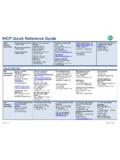
Transcription of Quick Reference Guide: Radiation Risk Information for ...
1 December 2016 Quick Reference guide : Radiation Risk Information for Responders Following a Nuclear Detonation 1 Quick Reference guide This document supports the Planning Guidance for Response to a Nuclear Detonation and was designed to provide responders with specific guidance and recommendations about the Radiation risk associated with responding to an improvised nuclear device (IND) event, in order for them to protect themselves from the IND effects. It is intended to be part of preparation training with the Health and Safety Planning guide For Planners and Supervisors For Protecting First Responders Following A Nuclear Detonation . This provides basic Information responders will need for the first 24 -72 hours after an extreme event -- a nuclear detonation.
2 These guidelines are not designed to apply to other, less extreme, radiological events. Specific Information /training should be sought for those. Some of this guidance will be counterintuitive to those trained in emergency response; however, it is critical that responders remain as safe and healthy as possible, not only for their own safety, but also to remain available for the ongoing mission of saving lives. Responders involved in an IND event need to be prepared to see numerous victims with serious traumatic injuries and illness including: severe burns, blindness, deafness, amputations, Radiation sickness, etc. What would a nuclear detonation be like and what can you expect? The Nuclear Flash would come in the form of an intense burst of light and extreme heat potentially creating a firestorm.
3 Injuries: flash burns, flame burns, flash blindness, and retina burns. Prompt Radiation would be delivered, resulting in high Radiation doses close to the detonation. Injuries: possibility of immediate or delayed (weeks or months) illness or death. The Nuclear Blast would include an initial fireball, overpressure wave, and extreme high winds. Injuries: crushing, fractures, lacerations, rupture of the viscera, and pulmonary hemorrhage and edema. All of this would take place in mere moments. The Mushroom Cloud/Fallout radioactive material mixed with debris is carried up and spread by winds for miles. Delayed Injuries: Radiation exposures, potentially lethal exposures closer to the detonation. The Electromagnetic Pulse (EMP) produces a high-voltage surge that poses no direct health threat, but may damage electronic equipment two to five miles from ground zero and disrupt communications.
4 Quick Reference guide : Radiation Risk Information for Responders Following a Nuclear Detonation 2 Zoned Response There will be two different kinds of zones: Damage & Fallout zones Response organizations will use these terms to establish official zones (These distance estimates are for a 10 KT IND, ground burst) Severe Damage 0 to mi: Buildings completely destroyed, Radiation is too high to enter for 72 hours, survivors unlikely Moderate Damage to 1 mi: Significant building damage, rubble, downed power lines, overturned vehicles, limited visibility for the first hour or more due to dust and smoke, serious injuries, best lifesaving opportunities. Light Damage 1 to 3 mi: Windows mostly broken, injuries not expected to be life-threatening Fallout zones change with time.
5 As the fallout is spread by wind the area expands. After the initial distribution, the zones shrink as the radioactivity decays. Dangerous Fallout zone up to 20 mi from ground zero: Radioactive dust from the explosion create Radiation levels exceeding 10 R/hr (see table)( Gy/h), not limited to damage zones, actions taken here must be justified, planned and always kept As Low As Reasonably Achievable (ALARA); time-sensitive, mission-critical activities such as rescuing identified injured survivors. Advise other survivors to shelter in place. Elevated Radiation area up to several hundreds of miles: from R/hr to 10 R/hr ( to ), potentially hazardous, and cumulative Radiation exposure should be monitored. Quick Reference guide : Radiation Risk Information for Responders Following a Nuclear Detonation 3 Key Points for Zoned Response Most people in the LD zone will survive on their own, but critical injuries may still exist.
6 MD zone outside of the DF zone - Area with the most survivable victims and therefore the maximum rescue potential. Rescue efforts should be concentrated in this area. Many people in the MD zone will survive only if they are rescued and treated. Most people in the SD zone will not survive, even if they can be rescued. The DF zone is extremely hazardous and should not be entered without justification. Responders should approach the area from upwind, outside of the fallout zones. Responders should assess the surroundings to determine if rescue measures are immediately needed or can wait until Radiation levels can be accurately determined and the responders are formally dispatched through the Incident Command System.
7 Responders should not rush into the most damaged areas, without a thorough hazard and mission assessment. What happens to the body when exposed to Radiation ? There are two ways to be affected by Radiation ; exposure and contamination (see protective gear) There are two types of effects on the body; acute and long-term. 1. Acute: This is when the body gets a large dose of Radiation quickly; symptoms can manifest quickly, minutes to hours. See the table below for the onset times for initial affects. Acute Radiation Syndrome ( Radiation Sickness) * Feature or Illness Effects of Whole Body Absorbed Dose from external Radiation or internal absorption, by dose range in rad/Gy 0-100 (0-1) 100-200 (1-2) 200-600 (2-6) 600-800 (6-8) >800 (>8) Nausea/Vomiting Nonea (see note) 5-50% 50-100% 75-100% 90-100% Time of Onset after Exposure 3-6 hr 2-4 hr 1-2 hr <1 hr to minutes Duration <24 hr <24 hr <48 hr <48 hr Lymphocyte Count (blood) Unaffected Minimally Decreased <1,000 at 24 hr <500 at 24 hr Decreases within hours Central Nervous System Function (brain & nerves)
8 No Impairment No Impairment Cognitive impairment for 6-20 hr Cognitive impairment for > 20 hr Rapid incapacitation Death None Minimal Low with aggressive therapy <5 to 50%b High Very High *Prompt health effects from whole-body absorbed doses received within a few hours. Quick Reference guide : Radiation Risk Information for Responders Following a Nuclear Detonation 4 a. A small number of exposed individuals may experience symptoms such as nausea and vomiting at doses between 50 and 100 rad ( and 1 Gy). b. The LD 50/60 or the lethal dose with NO medical intervention to 50% of the population after 60 days is between 320 and 450 rad ( - Gy). 2. Long-term: There is an increased risk of getting cancer later in life after a Radiation exposure.
9 Any risk of life-shortening effects from Radiation is proportional to the dose. Most cancers are not likely to occur until several decades after exposure; although leukemia has a shorter latency period (<5 yr), NCRP Commentary Key Elements of Preparing for Nuclear and Radiological Terrorism (2005). Fatal Cancer Effects of Whole Body Absorbed Dose from external Radiation or internal absorption, by dose range in rad (Gy) 0-100 (0-1) 100-200 (1-2) 200-600 (2-6) Percentage of Increased Lifetime Risk1 1 rad = 10 rad = 50 rad = 3% 100 rad = 8% 100 rad = 8% 150 rad = 9% 200 rad = 16% 200 rad = 16% 300 rad = 24% 600 rad = >40% 1 Derived from EPA Radiogenic Cancer Risk Models and Projections for the Population, April 2011 and from NCRP Commentary 19.
10 Incidents involving Radiation or radioactive material usually will require responders to be aware of the potential for health effects associated with various levels of Radiation exposure. Any whole-body Radiation dose can increase a person s lifetime risk of fatal cancer. As the dose increases, the risks also increase. High Radiation doses ( , >100 rad (1Gy)) can be potentially life-threatening, although the risk of acute death from Radiation can be mitigated through prompt medical treatment. Without proper medical assistance 50% of people with Radiation doses of ~400 rem (rad or 4 Gy) or higher will most likely die in 60 days. State and local jurisdictions may have their own guidance regarding decision dose limits.