Transcription of R-600a - Refrigerants
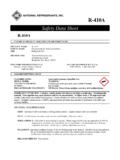
1 R- 600a Safety Data Sheet R600a ISOBUTANE 1. CHEMICAL PRODUCT AND COMPANY IDENTIFICATION PRODUCT NAME: ISOBUTANE OTHER NAME: 2-methylpropane USE: Refrigerant Gas DISTRIBUTOR: National Refrigerants , Inc. 661 Kenyon Avenue Bridgeton, New Jersey08302 FOR MORE INFORMATION CALL: IN CASE OF TRANSPORTATION EMERGENCY CALL: (Monday-Friday, 8:00am-5:00pm) CHEMTREC: 1-800-424-9300 1-800-262-0012 EMERGENCY OVERVIEW: Flammable gas. Liquid under high pressure. 2. HAZARDS IDENTIFICATION CLASSIFICATION: Flammable Gas, Gas under pressure, Compressed Gas SIGNAL WORD: DANGER HAZARD STATEMENT(S): Extremely flammable gas, Contains gas under pressure, may explode if heated SYMBOL(S): Flames, Gas Cylinder PRECAUTIONARY STATEMENT(S): Prevention: Keep away from heat, sparks, open flame, and hot surfaces.
2 No Smoking Response: Leaking gas fire: Do not extinguish unless leak can be stopped immediately. Eliminate all ignition sources if safe to do so. Storage: Protect from sunlight, store in a well ventilated place. EMERGENCY OVERVIEW: Flammable gas. Liquid under high pressure. POTENTIAL HEALTH EFFECTS Effects of Overexposure: Eye Contact Liquid can cause severe irritation, redness, tearing, blurred vision, and possible freeze burns. Skin Contact Contact with evaporating liquid can cause frostbite. R- 600a _____ SDS: ISOBUTANE Page 2 of 5 Current Issue Date: April 2015 Inhalation Inhalation of vapor may produce anesthetic effects and feeling of euphoria.
3 Prolonged overexposure can cause rapid breathing, headache, dizziness, narcosis, unconsciousness, and death from asphyxiation, depending on concentration and time of exposure. Ingestion Aspiration Hazard! 3. COMPOSITION / INFORMATION ON INGREDIENTS INGREDIENT NAME CAS NUMBER WEIGHT Liquefied Petroleum Gas 75-28-5 100 COMMON NAMES and SYNONYMS Isobutane; R600a There are no impurities or stabilizers that contribute to the classification of the material identified in Section 2 4.
4 FIRST AID MEASURES SKIN: For liquid contact, warm areas gradually and get medical attention if there is evidence of tissue damage. Flush area with plenty of water. EYES: For liquid contact, irrigate with running water for minimum of 15 minutes. Consult physician immediately if frostbite occurs. INHALATION: Remove to fresh air. If breathing has stopped, restore breathing at once. Administer oxygen and get medical help. INGESTION: Do not induce vomiting. Contact a physician immediately.
5 ADVICE TO PHYSICIAN: No special instructions 5. FIRE FIGHTING MEASURES FLAMMABLE PROPERTIES FLASH POINT (METHOD): -117 F (Open Cup) UPPER EXPLOSIVE LIMIT (vol.) gas in air): LOWER EXPLOSIVE LIMIT (vol.) gas in air): EXTINGUISHING MEDIA: Dry Chemical Extinguisher (B-C), Water UNUSUAL FIRE HAZARDS: Vapors are heavier than air and may travel along the ground or may be moved by ventilation systems and ignited by pilot lights, other flames, sparks, heaters, smoking, electric motors, static discharge, or other ignition sources at locations distant from material handling point.
6 R- 600a _____ SDS: ISOBUTANE Page 3 of 5 Current Issue Date: April 2015 FIRE FIGHTING PROCEDURES: Stop the release of materials if possible. Cool the vapor space of the storage container with water spray. Avoid accumulation of unburned materials. Remove personnel in general area. Observe maximum isolation when extinguishing fire. Expansion of liquid and change of state from liquid to vapor will allow combustible mixture to encompass a large area. 6. ACCIDENTAL RELEASE MEASURES STEPS TO BE TAKEN IF MATERIAL IS RELEASED OR SPILLED: Avoid sources of ignition-Ventilate area.
7 Use water fog to evaporate or ventilate. Protect body against contact with liquid. If confined space Use self-contained breathing apparatus. Consult local fire authorities. 7. HANDLING AND STORAGE NORMAL HANDLING: Comply with state and local regulations covering liquefied petroleum gases. Comply with NFPA Pamphlet #58. STORAGE RECCOMENDATIONS: Store small containers in well-ventilated areas, away from heat or sources of ignition. Prohibit smoking in areas of storage or use. 8. EXPOSURE CONTROLS / PERSONAL PROTECTION VENTILATION Mechanical: Provide as needed to keep concentration in air below TLV and LEL Local Exhaust: Continuous ventilation recommended Special: Explosion proof fans and motors SKIN PROTECTION: Impervious, insulated gloves recommended.
8 Impervious clothing for prolonged or repeated contact EYE PROTECTION: Face shield or goggles recommended RESPIRATORY PROTECTION: NIOSH approved self-contained breathing apparatus in confined areas EXPOSURE GUIDELINES (Exposure Limits) INGREDIENT NAME ACGIH TLV OSHA PEL OTHER LIMIT Liquefied Petroleum Gas 1000 ppm 9. PHYSICAL AND CHEMICAL PROPERTIES APPEARANCE: Clear, colorless liquefied gas PHYSICAL STATE: Gas at ambient temperature ODOR: Sweet petroleum odor SOLUBILITY IN WATER @ 70 Deg.
9 F BOILING RANGE: F R- 600a _____ SDS: ISOBUTANE Page 4 of 5 Current Issue Date: April 2015 VAPOR PRESSURE @ 70 Deg. F: 31 psig FLASH POINT: -85 C (-18 F) EVAPORATION RATE: > 1 (Ethyl Ether = ) FLAMMABILITY: Extremely flammable in the presence of ignition sources or oxidizing materials LEL/UEL: / PARTITION COEFFICIENT n-OCTANOL/WATER: Log Pow: AUTO IGNITION TEMPERATURE: 460 C / 860 F DECOMPOSITION TEMPERATURE: Data not available VISCOSITY: Not applicable VAPOR DENSITY (air = ): % VOLATILES BY VOLUME: 100% DENSITY: gas lb / cu ft pH: Not applicable MELTING POINT: -160 C / -256 F SPECIFIC GRAVITY (H2O= ): MOLECULAR FORMULA: C4H10 MOLECULAR WEIGHT: 10.
10 STABILITY AND REACTIVITY CHEMICAL STABILITY: This product is stable REACTIVITY: Not reactive under normal conditions. INCOMPATIBILITY WITH OTHER MATERIALS: None CONDITIONS TO AVOID: High Heat, Sparks & Open Flames 11. TOXICOLOGICAL INFORMATION Rat inhalation LC50 (4 hr.): 658,000ppm POTENTIAL HEALTH EFFECTS Effects of Overexposure: Eye Contact Eye contact with the rapidly evaporation liquid may cause frostbite. Skin Contact Skin contact with the rapidly evaporation liquid may cause frostbite. Frostbite effects are a change in color of the skin to gray or white, followed by blistering.