Transcription of RabAvert Package Insert - CTVIA
1 CHIRON. Rabies Vaccine RabAvert . Rabies Vaccine for Human Use Description RabAvert , rabies vaccine, produced by Chiron Behring GmbH & Co is a sterile freeze-dried vaccine obtained by growing the fixed-virus strain Flury LEP in primary cultures of chicken fibroblasts. The strain Flury LEP was obtained from American Type Culture Collection as the 59th egg passage. The growth medium for propagation of the virus is a synthetic cell culture medium with the addition of human albumin, polygeline (processed bovine gelatin) and antibiotics. The virus is inactivated with beta-propiolactone, and further processed by zonal centrifugation in a sucrose density-gradient. The vaccine is lyophilized after addition of a stabilizer solution, which consists of buffered polygeline and potassium glutamate.
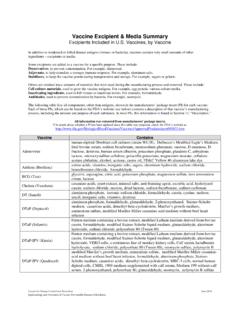
2 One dose of reconstituted vaccine contains less than 12 mg polygeline (processed bovine gelatin), 1 mg potassium glutamate and mg sodium EDTA. Small quantities of bovine serum are used in the cell culture process. Testing of the product components and excipients using currently available methods has not detected any adventitious agents. Further, bovine components originate only from source countries known to be free of bovine spongioform encephalopathy. Minimal amounts of chicken protein may be present in the final product; ovalbumin content is less than 3 ng/dose (1 mL), based on ELISA. Antibiotics (neomycin, chlortetracycline, amphotericin B) added during cell and virus propagation are largely removed during subsequent steps in the manufacturing process. In the final vaccine, neomycin is present at < 1 mcg, chlortetracycline at < 20 ng, and amphotericin B at < 2 ng per dose.
3 RabAvert is intended for intramuscular (IM). injection. The vaccine contains no preservative and should be used immediately after reconstitution with the supplied diluent (Water For Injection, USP). The potency of the final product is determined by the NIH mouse potency test using the US reference standard. The potency of one dose ( mL). RabAvert is at least IU of rabies antigen. RabAvert is a white, freeze-dried vaccine for reconstitution with the diluent prior to use; the reconstituted vaccine is a clear to slightly opaque, colorless suspension. Clinical Pharmacology Rabies in the United States Over the last 100 years, the epidemiology of rabies in animals in the United States has changed dramatically. More than 90% of all animal rabies cases reported annually to the Centers for Disease Control and Prevention (CDC) now occur in wildlife, whereas before 1960 the majority were in domestic animals.
4 The principal rabies hosts today are wild carnivores and bats. Annual human deaths have fallen from more than a hundred at the turn of the century to one to two per year despite major outbreaks of animal rabies in several geographic areas. Within the United States, only Hawaii has remained rabies free. Although rabies among humans is rare in the United States, every year tens of thousands of people receive rabies vaccine for post-exposure prophylaxis. Rabies is almost invariably fatal due to encephalomyelitis. Modern day prophylaxis has proven nearly 100% successful; most human fatalities now occur in people who fail to seek medical treatment, usually because they do not recognize a risk in the animal contact leading to the infection. Inappropriate post-exposure prophylaxis may also result in clinical rabies.
5 Survival after clinical rabies is extremely rare, and is associated with severe brain damage and permanent disability. RabAvert (in combination with passive immunization with Human Rabies Immune Globulin (HRIG). and local wound treatment) in post-exposure immunization against rabies has been shown to protect, patients of all age groups from rabies, when the vaccine was administered according to the World Health Organization (WHO) guidelines and as soon as possible after rabid animal contact. Anti-rabies antibody titers after immunization have been shown to reach levels well above the minimal protective level of IU/mL within 14 days after initiating the immunization series. The minimal antibody titer accepted as seroconversion is IU, measured by the rapid fluorescent inhibition test (RFFIT) as CHIRON.
6 Specified by the WHO (1, 2) or a 1:5 titer (complete inhibition in RFFIT at 1:5 dilution) as specified by the CDC. Vaccine failure has only been reported when key elements of rabies post-exposure regimens were omitted or when the vaccine has been incorrectly administered. Pre-exposure Immunization The immunogenicity of RabAvert has been demonstrated in clinical trials conducted in different countries such as the USA (3, 4), UK (5), Croatia (6), and Thailand (7, 8, 9). When administered according to the recommended immunization schedule (days 0, 7, 21), 100% of subjects attained a protective titer. Two studies carried out in the USA in 101 subjects antibody titers > IU/mL were obtained by day 28 in all subjects. In studies carried out in Thailand in 22 subjects, and in Croatia in 25 subjects, antibody titers of > IU/mL were obtained by day 14 (injections on days 0, 7, 21) in all subjects.
7 The ability of RabAvert to boost previously immunized subjects was evaluated in three clinical trials. In the Thailand study, pre-exposure booster doses were administered to 10 individuals. Antibody titers of > IU/mL were present at baseline on day 0 in all subjects (8). Titers after a booster dose were enhanced from geometric mean titers (GMT) of IU/mL to IU/mL on day 30. In an additional booster study, individuals known to have been immunized with Human Diploid Cell Vaccine (HDCV). were boosted with RabAvert . In this study, a booster response was observed on day 14 for all (22/22). individuals (10). In a trial carried out in the USA (3), a RabAvert IM booster dose resulted in a significant increase in titers in all (35/35) subjects, regardless of whether they had received RabAvert or HDCV as the primary vaccine.
8 Persistence of antibody after immunization with RabAvert has been evaluated. In a trial performed in the UK, neutralizing antibody titers > IU/mL were present 2 years after immunization in all sera (6/6) tested. Post-exposure Immunization RabAvert , when used in the recommended post-exposure WHO program of 5 to 6 IM injections of 1 mL. (days 0, 3, 7, 14, 30, and one optionally on day 90) provided protective titers of neutralizing antibody (> IU/mL) in 158/160 patients (7, 8, 11-14) within 14 days and in 215/216 patients by day 28 - 38. Of these, 203 were followed for at least 10 months. No case of rabies was observed (7, 8, 11-18). Some patients received HRIG, 20 - 30 IU per kg body weight, or Equine Rabies Immune Globulin (ERIG), 40 IU per kg body weight, at the time of the first dose.
9 In most studies (7, 8, 11, 15), the addition of either HRIG or ERIG caused a slight decrease in GMTs which was neither clinically relevant nor statistically significant. In one study (14), patients receiving HRIG had significantly lower (p < ). GMTs on day 14; however, again this was not clinically relevant. After day 14 there was no statistical significance. The results of several studies of normal volunteers who have been given the WHO regimen of vaccine for post-exposure use (10, 19-22), , "simulated" post-exposure use, show that with sampling by day 28 - 30, 205/208 vaccinees had protective titers > IU/mL. Over a 10 year (7/85 - 6/95) period, 46 reports of suspected post-exposure vaccine failure have been evaluated ( million doses distributed). In each case, post-exposure treatment had not been in compliance with WHO recommendations.
10 CHIRON. Indications and Usage RabAvert is indicated for pre-exposure immunization, in both primary series and booster dose, and for post-exposure prophylaxis against rabies. There are no data on the interchangeable use of different rabies vaccines in a single pre- or post- exposure series. Therefore the vaccine from a single manufacturer should be used for the complete series whenever possible. If vaccines from other manufacturers are administered during the immunization series, an adequate antibody response should be confirmed by appropriate serologic tests. However, for booster immunization, RabAvert was shown to elicit satisfactory antibody level responses in 41 persons who received a primary series with HDCV (3, 10). A. Pre-exposure Immunization - See Table 1. Pre-exposure Immunization Schedule Pre-exposure immunization consists of three doses of RabAvert mL, intramuscularly (deltoid region), one each on days 0, 7, and 21 or 28 ([23] see also Table 1 for criteria for pre-exposure immunization).