Transcription of RADICAL WORKSHOP Index or Root Radicand
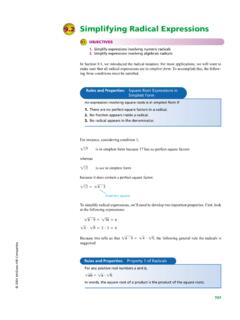
1 RADICAL WORKSHOP PARTS OF RADICALS: PROPERTIES OF RADICALS: A. Example: B. Example: C. Examples: D. Examples: 1. 36 36 6 2. 72 36 2 6 2 3. 48 8 6 2 6 4. 64 16 4 2 4 5. 64 32 2 2 2 E. 0 Examples: 1. 2. 3. Rationalizing the Denominator: When simplifying fractions with radicals, you need to rationalize the denominator by multiplying the numerator and the denominator by the smallest value that will allow you to eliminate the RADICAL in the denominator, as shown below.
2 Examples: 1. 2. 3. 4. Rules for Simplifying Radicals: 1. There should be no factor in the Radicand that has a power greater than or equal to the Index . 2. There should be no fractions under the RADICAL sign. 3. There should be no radicals in the denominator ( the denominator should be rationalized). Index or Root Radicand ADDITION AND SUBTRACTION: Radicals may be added or subtracted when they have the same Index and the same Radicand (just like combining like terms). Note: When adding or subtracting radicals, the Index and Radicand do not change.
3 Examples: a. 5 2 8 2 3 2 b. 6 3 2 3 8 3 c. 5 6 11 d. 7 9 4 7 5 e. 75 2 12 5 3 25 3 2 4 3 5 3 5 3 4 3 5 3 4 3 MULTIPLICATION OF RADICALS: To multiply radicals, just multiply using the same rules as multiplying polynomials (Distributive Property, FOIL, and Exponent Rules) except NEVER multiply values outside the RADICAL times values inside the RADICAL . Examples: a. 20 4 80 16 5 4 5 b. 2 3 4 2 8 6 8 6 8 6 c. 2 5 3 2 5 6 10 2 25 6 10 10 d. 2 2 3 2 6 2 6 2 8 6 Note: When multiplying radicals with different indexes, change to rational exponents first, find a common denominator in order to add the exponents, then rewrite in RADICAL notation as shown below: Example: MORE RATIONALIZING THE DENOMINATOR: (DIVISION) If the denominator contains two terms such that at least one term has a RADICAL , multiply the numerator and the denominator by the conjugate of the denominator: Conjugate the conjugate of a binomial of the form is.
4 Example: the conjugate of 3 is 3 . Note: Since , eliminating the middle term, multiplying by the conjugate eliminates the middle term that would still have a RADICAL in it, thus removing the RADICAL from the denominator. Examples: a. b. 2 5 2 RADICAL OPERATIONS PRACTICE Simplify the following radicals (assume all variables represent positive real numbers). 1. 18 2. 76 3. 128 4. 1250 5. 6. 100 7. 144 8. 9. 7 10. 24 11. 150 12. 16 13. 32 14.
5 128 15. 16. 8 17. 125 18. 75 19. 8 20. 16 Add or subtract the following radicals. Write answers in simplified form. 21. 4 3 2 3 22. 4 10 6 10 10 2 23. 4 24. 3 6 25. 3 26. 4 6 3 2 27. 6 7 8 7 28. 12 15 5 15 8 15 29. 6 2 30. 3 5 4 5 3 31. 3 4 6 32. 8 12 33. 75 108 34. 4 50 72 8 35. 4 80 75 36. 8 64 96 37. 200 72 38. 60 135 39. 6 75 4 125 40. 7 108 6 180 Multiply and simplify (assume all variables represent positive real numbers). 41. 15 5 42. 10 14 43. 2 4 44. 18 18 45. 75 75 46.
6 5 2 47. 3 15 48. 5 15 49. 50. 5 5 51. 52. Rationalize the denominators and simplify (assume all variables represent positive real numbers). 53. 54. 55. 56. 57. 58. 59. 60. 61. 62. 63. 64. 65. 66. 67. 68. 69. 70. RADICAL OPERATIONS PRACTICE ANSWERS 1. 3 2 2. 2 19 3. 4 2 4. 5 2 5. 6. 10 7. 12 8. 9. 7 10. 2 3 11. 5 6 12. 2 2 13. 2 2 14.
7 2 4 15. 16. 2 17. 5 18. 5 3 19. 2 20. 2 21. 2 3 22. 9 10 2 23. 5 24. 3 25. 4 26. 7 2 27. 2 7 28. 9 15 29. 3 30. 7 5 2 31. 3 2 32. 2 2 2 3 33. 11 3 34. 16 2 35. 16 5 5 3 36. 64 4 6 37. 4 2 38. 15 39. 30 3 20 5 40. 42 3 36 5 41. 5 3 42. 2 35 43. 2 44. 18 45. 75 46. 10 47. 3 5 48. 5 3 49. 50. 5 51. 52. 53. 3 5 54. 55. 56. 57. 58. 4 59. 6 60. 5 61. 3 62. 6 63. 3 5 64. 65. 66. 67. 1 68. 69. 70.
8