Transcription of RAY OPTICS Introduction
1 1 LESSON RAY OPTICS Introduction Electromagnetic radiation belonging to the region of the electromagnetic spectrum (wavelength of about 400 nm to 750 nm) is called light . Nature has endowed the human eye (retina) with the sensitivity to detect electromagnetic waves within this small range of the electromagnetic spectrum. It is mainly through light and the sense of vision that we know and interpret the world around us. There are two things that is easily identifiable with light 1. light travels with enormous speed and 2. light travels in a straight line. Its presently accepted value in vacuum is c = 108ms 1. For many purposes, it suffices to take c = 3 108ms 1. Note: (i). The speed of light in vacuum is the highest speed attainable in nature.
2 (ii). The wavelength of light is very small compared to the size of ordinary objects that we encounter commonly, hence, it can be taken to be moving in a straight line Ray of light - A light wave can be considered to travel from one point to another, along a straight line joining them. The path is called a ray of light , Beam of light - A bundle of such rays constitutes a beam of light . In this chapter, we consider the phenomena of reflection, refraction and dispersion of light , using the ray picture of light . Using the basic laws of reflection and refraction , we shall study the image formation by plane and spherical reflecting and refracting surfaces.
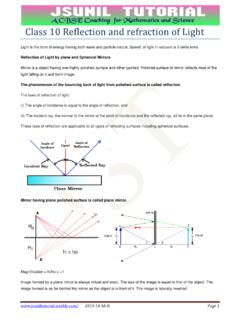
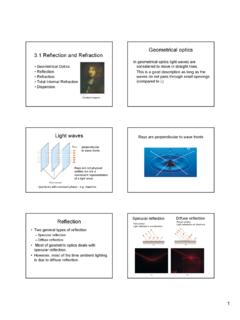
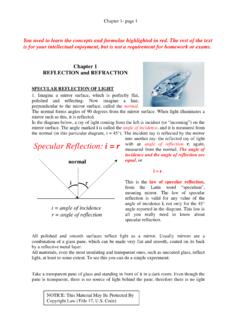
3 We then go on to describe the construction and working of some important optical instruments, including the human eye. Reflection of light by Spherical Mirrors Law of reflection - The law of reflection by a plane mirror states that: (i) the angle of incidence (angle between incident ray and the normal to the mirror) equals the angle of reflection (angle between reflected ray and the normal). This law is also applied at every point on the surface of a spherical mirror. (ii) the incident ray, reflected ray and the normal to the reflecting surface at the point of incidence lie in the same plane. Note: These laws are valid at each point on any reflecting surface whether plane or curved.
4 The normal in this case is to be taken as normal to the tangent to surface at the point of incidence. That is, the normal is along the radius, the line joining the centre of curvature of the mirror to the point of incidence. Terms associated with spherical mirrors Pole- The geometric centre of a spherical mirror is called its pole. Principal axis- The line joining the pole and the centre of curvature of the spherical mirror is known as the principal axis. Paraxial Rays- The rays that are incident at points close to the pole P of the mirror and make small angles with the principal axis are called paraxial rays. Focus For Concave mirror When a parallel beam of light is incident on a concave mirror, at points close to the pole of the mirror, P, the Ray OPTICS 2reflected rays converge at a point F(principal focus of the mirror) on the axis for a concave mirror.
5 For Convex mirror When a parallel beam of light is incident on a convex mirror, the reflected rays appear to diverge from a point F (principal focus of the mirror).The point F is called the principal focus of the mirror. Focal Length The distance between the focus F and the pole P of the mirror is called the focal length of the mirror. Focal Plane If the parallel paraxial (close to the principal axis) beam were incident making some angle with the axis, the reflected rays would converge (or appear to diverge) from a point in a plane through F normal to the axis. This is called the focal plane of the mirror. Derivation for focal length The distance between the focus F and the pole P of the mirror is called the focal length of the mirror, denoted by f.
6 We now show that f = R/2, where R is the radius of curvature of the mirror. The geometry of reflection of an incident ray is shown in figure. At the point of incidence M, applying the laws of reflection MCP and MFP = 2 = Now MDMDtan =, tan2 =CDFD (for small , tan = and tan 2 = 2 ); thus we have MDMD=2 FDCD or CDFD = 2 (1) Also for small the point D is very close to the point P. Therefore, FD = f and CD = R; Equation (1) then gives F = R/2 Note: In this section V is the pole of the mirror Sign Convention New Cartesian sign convention. (see figure) The distances measured in the same direction as the incident light are taken as positive The distances measured in the direction opposite to the direction of incident light are taken as negative.
7 The heights measured upwards (above x-axis) and normal to the principal axis of the mirror/lens are taken as positive. The heights measured downwards are taken as negative. 3 The Mirror Equation Image of a point If the rays starting from a point meet at another point after reflection and or refraction , the point is called the image of the first point. Real Image The image is real if the rays actually converges at the point Virtual image - The image is virtual if the rays do not actually meet but appear to diverge from the point when produced backwards. Image of an object Take any two rays coming from an object, trace their paths, find their point of intersection and thus, obtain the image of the point.
8 For convenience in application of geometry the following rays could be considered (i) The ray which is parallel to the principal axis. The reflected ray goes through the focus of the mirror. (ii) The ray passing through the centre of curvature of a concave mirror or appearing to pass through it for a convex mirror. The reflected ray simply retraces the path. (iii) The ray passing through the focus of the concave mirror or appearing to pass through (or directed towards) the focus of a convex mirror. The reflected ray is parallel to the principal axis. Figure gives the ray diagram showing the image (in this case, real) of an object formed by a concave mirror. Derivation of Mirror equation Mirror equation is the relation between the object distance (u), image distance (v) and the focal length (f).
9 Using geometry the two right-angled triangles A'B'F and MPF are similar. (For paraxial rays, MP can be considered to be a straight line perpendicular to CP). Therefore, A'B'B'FMPPF= orA'B' B'FABPF= (1) The right angled triangles A B P and ABP are also similar. Therefore, A'B'B'PABBP= (2) Comparing Eqs. (1) and (2), we get B'P PFB'PPFBP = (3) Equation (3) is a relation involving magnitudes of the distance. Applying sign conventions: B V = -v, VF = -f, BV = -u (4) we get vfvfu + = (5) or vf vfu = 111vu f+= (6) This relation is known as the mirror equation Magnification (m) In triangles A'B'P & ABP, we have Ray OPTICS 4B'A'B'PBABP= with sign convention, this becomes h'vh'vhuh u = = Image formation for different cases In this section we have derived the mirror equation, and the magnification formula, for the case of real, inverted image formed by a concave mirror only.
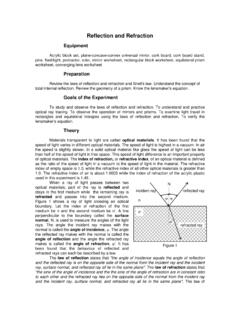
10 It is to be noted here that with the proper use of sign convention, these equations are valid for all the cases of reflection by a spherical mirror (concave or convex) whether the image formed is real or virtual. Ray diagrams for image formations The figures here show the ray diagrams for virtual image formed by a concave and convex mirror. It can be easily verified that the equations derived above are valid for these cases also refraction When light travels from one medium to another, it changes the direction of its path at the interface of the two media. This is called refraction of light . Laws of refraction The following are the laws of refraction (i). The incident ray, the refracted ray and the normal to the interface at the point of incidence, all lie in the same plane.