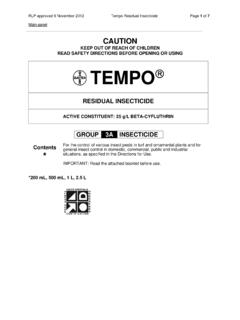
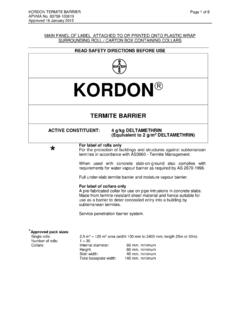
Transcription of READ SAFETY DIRECTIONS BEFORE OPENING OR USING Coopex
1 RLP Approved 22 January 2003 Coopex Insecticidal Dusting Powder Page 1 of 6 Main panel read SAFETY DIRECTIONS BEFORE OPENING OR USING Coopex INSECTICIDAL DUSTING POWDER INDUSTRIAL STRENGTH ACTIVE CONSTITUENT: 10 g/kg PERMETHRIN 25:75 GROUP 3A INSECTICIDE * Net For the control of various insect pests in domestic and industrial situations as per the DIRECTIONS FOR USE table. IMPORTANT: read the attached booklet BEFORE use. * 1 kg, 10 kgRLP Approved 22 January 2003 Coopex Insecticidal Dusting Powder Page 2 of 6 Front page of booklet / ancillary label read SAFETY DIRECTIONS BEFORE OPENING OR USING Coopex INSECTICIDAL DUSTING POWDER INDUSTRIAL STRENGTH ACTIVE CONSTITUENT: 10 g/kg PERMETHRIN 25:75 For the control of various insect pests domestic and industrial situations as per the DIRECTIONS FOR USE table.
2 STORAGE AND DISPOSAL Keep out of reach of children. Store in the closed, original container in a cool, well-ventilated area. DO NOT store for prolonged periods in direct sunlight. Triple or preferably pressure rinse container BEFORE disposal. Dispose of rinsings in a disposal pit specifically marked and set up for this purpose clear of waterways, desirable vegetation and tree roots. Break, crush or puncture and bury empty containers in a local authority landfill. If no landfill is available, bury the containers below 500 mm in a disposal pit specifically marked and set up for this purpose clear of waterways, desirable vegetation and tree roots. Empty containers and product should not be burnt. SAFETY DIRECTIONS Will irritate the eyes. Avoid contact with eyes.
3 DO NOT inhale dust. When OPENING the container and USING the product wear rubber gloves, disposable dust mask. Wash hands after use. After each day s use wash gloves and contaminated clothing. FIRST AID If poisoning occurs, contact a doctor or Poisons Information Centre (phone 13 11 26). SAFETY DATA SHEET Additional Information is listed in the SAFETY Data Sheet which is available at Exclusion of Liability This product must be used strictly as directed, and in accordance with all instructions appearing on the label and in other reference material. So far as it is lawfully able to do so, Bayer CropScience Pty. Ltd. accepts no liability or responsibility for loss or damage arising from failure to follow such DIRECTIONS and instructions. IMPORTANT: read THIS BOOKLET BEFORE USE.
4 APVMA Approval No.: 33210/0103 Coopex is a Registered Trademark of the Bayer Group. Bayer CropScience Pty. Ltd. 87 000 226 022 391-393 Tooronga Rd East Hawthorn, Vic. 3123 Phone: (03) 9248 6888 Fax: (03) 9248 6803 Technical enquiries: 1800 804 479 Website: For 24 hour specialist advice in an emergency only phone 1800 033 111 Batch Number: DOM: Barcode RLP Approved 22 January 2003 Coopex Insecticidal Dusting Powder Page 3 of 6 Inside booklet / ancillary label DIRECTIONS FOR USE SITUATION PEST RATE CRITICAL COMMENTS Domestic, institutional and industrial premises - food preparation and storage areas and living and sleeping areas Cockroaches, silverfish 10 g/m2 applied with a powder duster Blow powder into all cracks and crevices.
5 Pay particular attention to warm, dark corners around cookers, fireplaces, radiators, stores, pipes, rubbish chutes and places where liquid sprays may not be used. Ants Sprinkle the powder along runs, on and around nests. If ants are invading domestic premises, apply powder to the routes by which they enter. Repeat as necessary. Fleas and carpet beetles Dust powder over floor, brushing into carpet pile and blowing into areas where larvae are found. Bedbugs Apply powder to bedsteads, bedsprings, mattresses, floor coverings, upholstered furniture, cracks in walls, behind torn wallpaper, joints in woodwork and other cracks and crevices that may provide harbourages. Roof voids, wall and floor voids, crawl spaces. Spiders, cockroaches, silverfish, ants, carpet beetles and fleas Apply dust into all void areas.
6 Ensure all surfaces are treated. Repeat as necessary if re-infestation occurs. Bird mites (Ornithonyssus spp.) Cover roof void area, paying particular attention to areas where there is evidence of bird nests. Remove nests, and bird-proof roof voids to prevent recurrence. Skin and hide preparation Hide beetles (Dermestes ater) a) Place skins on drying racks and apply dust USING a manual or motorised duster. b) Dust exposed edges of dried, baled skins. Mushroom beds Mushroom sciarid flies Dust mushroom beds no more frequently than twice a week to control adult and larval flies. Discontinue dusting when mushrooms reach the size of a 10 cent piece. Large wasp nests European wasps 125 to 250 g per nest USING hand duster apply powder through entrance holes (125 - 250 g per nest depending on size of nest and number of entrance holes).
7 Treat at night whenever possible to avoid being stung. Operators should wear clothing protective against the insects including long-sleeved overalls buttoned at wrist and throat, gloves, hat and bee-veil. Bee nests in wall cavities Feral honey bee Seed potatoes Potato moth (Phthorimaea operculella 600 g per tonne or 30 g per 50 kg bag of seed potatoes Dust thoroughly immediately after harvest while filling storage containers. Treated seed potatoes are to be used only for sowing. DO NOT use for food or feed purposes. Treated seed potatoes should be stored apart from other potatoes and bags or containers should be clearly marked to indicate that the contents have been treated. Trees and stumps in urban areas Subterranean termites (Coptotermes spp.) 250 g per tree Upon locating nest in tree or stump, drill 3 holes with a maximum diameter of 12 mm.)
8 Apply dust directly to the nest USING a carbon dioxide gas cylinder and a trigger gun. After treatment, holes should be coated carefully with a fungicide, copper naphthenate, and sealed with an appropriate caulking compound. RLP Approved 22 January 2003 Coopex Insecticidal Dusting Powder Page 4 of 6 NOT TO BE USED FOR ANY PURPOSE, OR IN ANY MANNER, CONTRARY TO THIS LABEL UNLESS AUTHORISED UNDER APPROPRIATE LEGISLATION. WITHHOLDING PERIOD Mushrooms: DO NOT HARVEST FOR 3 DAYS AFTER APPLICATION. GENERAL INSTRUCTIONS INSECTICIDE RESISTANCE WARNING GROUP 3A INSECTICIDE For insecticide resistance management, Coopex Insecticidal Dusting Powder is a Group 3A insecticide. Some naturally occurring insect biotypes resistant to Coopex Insecticidal Dusting Powder and other Group 3A insecticides may exist through normal genetic variability in any insect population.
9 The resistant individuals can eventually dominate the local insect population if Coopex Insecticidal Dusting Powder or other Group 3A insecticides are used repeatedly. The effectiveness of Coopex Insecticidal Dusting Powder on resistant individuals could be significantly reduced. Since the occurrence of resistant individuals is difficult to detect prior to use, Bayer CropScience Pty. Ltd. accepts no liability for any losses that may result from the failure of Coopex Insecticidal Dusting Powder to control resistant insects. For information about strategies for managing insecticide resistance contact your local supplier or Bayer Environmental Science representative. Application Coopex Insecticidal Dusting Powder is ready to use; no further diluent should be added.
10 Leave powder undisturbed for as long as possible after application. PRECAUTIONS Avoid contact with food, food utensils, or places where food is prepared or stored. BEFORE use, remove or cover all exposed foodstuffs. Cover all dishes and utensils, and places where food is prepared or stored. DO NOT apply dust directly on humans. Remove or cover fish bowls during treatment. PROTECTION OF WILDLIFE, FISH, CRUSTACEANS AND ENVIRONMENT Dangerous to fish and other aquatic organisms. DO NOT contaminate streams, rivers or waterways with the chemical or used containers. Dangerous to bees and reptiles. STORAGE AND DISPOSAL Keep out of reach of children. Store in the closed, original container in a cool, well-ventilated area. DO NOT store for prolonged periods in direct sunlight.