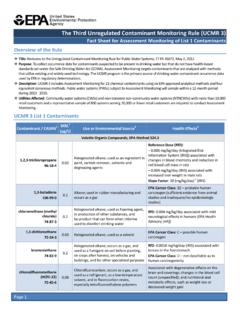
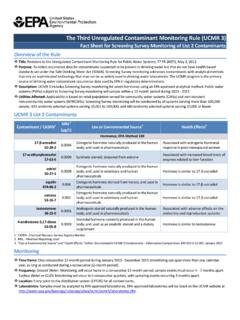
Transcription of Reference Concentrations for the Fourth Unregulated ...
1 Office of Water (MS-140) EPA 815-S-18-001 Page 1 of 8 Reference Concentrations for the Fourth Unregulated contaminant monitoring Rule (UCMR 4) Background EPA uses the Unregulated contaminant monitoring Rule (UCMR) program to collect nationally representative data for contaminants suspected to be present in drinking water, but that do not have regulatory standards. UCMR 4 requires monitoring for 30 chemicals between 2018 and 2020. This monitoring is used by EPA to understand the frequency and level of occurrence of Unregulated contaminants in the nation s public water systems (PWSs). Every five years EPA develops a new list of UCMR contaminants, largely based on the contaminant Candidate List (CCL). The Safe Drinking Water Act (SDWA) requires EPA to: Manage monitoring for no more than 30 contaminants per 5-year cycle Collect data from large PWSs ( , those that serve more than 10,000 people) Collect data from a representative sample of small PWSs ( , those serving less than or equal to 10,000 people) Store analytical results in a National contaminant Occurrence Database (NCOD) State and local officials may also use UCMR data to assess the need for actions to protect public health.
2 When evaluating UCMR data, State and local officials should consider the following limitations: UCMR monitoring generates a robust national data set that is representative of occurrence at a national level; it is not designed to be representative of occurrence at a State or local level. UCMR results are not available immediately after sample collection. EPA s regulations allow PWSs and the laboratories that support their monitoring up to six months to report results to EPA. There is limited information about health effects and treatment techniques to address a number of these Unregulated contaminants. Reference Concentrations EPA has established UCMR 4 Minimum Reporting Levels (MRLs) based on the capability of the analytical method, not based on a level established as significant or harmful. UCMR 4 results reported at or above those MRLs should be interpreted accordingly. The detection of a UCMR 4 contaminant does not represent cause for concern, in and of itself.
3 Reference Concentrations are health-based and provide context for the detection of a UCMR contaminant . They do not represent regulatory values or action levels and should not be interpreted as an indication that the Agency intends to establish a future drinking water regulation. Decisions as to whether to regulate contaminants in drinking water will be made following the Agency s Regulatory Determination process. Visit EPA s Regulatory Determination website for more information. Office of Water (MS-140) EPA 815-S-18-001 Page 2 of 8 Community water systems must inform their consumers of UCMR monitoring results (including the average and range of detections). See 40 CFR (d)(7) for Consumer Confidence Report (CCR) regulatory requirements and Section IV of EPA s guidance, Preparing Your Drinking Water Consumer Confidence Report for details on the contents of the report.
4 Non-transient, non-community water systems required to monitor for UCMR must inform their consumers of the availability of monitoring results. See 40 CFR for Tier 3 Public Notice (PN) regulatory requirements and EPA s web page for PN guidance. Some UCMR 4 contaminants have Reference Concentrations associated with short-term exposure. Therefore, large PWSs may want to request results for these contaminants early ( , before their laboratory posts the results to the UCMR web-based reporting system) so that these PWSs can inform their consumers in a timely manner. EPA manages the laboratory analysis for small PWSs and will work to communicate results in a timely manner. States may establish requirements for drinking water contaminants not yet regulated by EPA, and those requirements may be based on State-established levels that differ from EPA s Reference Concentrations . PWSs are responsible for being aware of and complying with their State s requirements, if any.
5 UCMR 4 Reference Concentrations Table The table below provides MRL and Reference concentration information for each contaminant monitored under UCMR 4. When developing the table, EPA followed these principles: (1) EPA based the Reference Concentrations on publicly-available health information found in the following EPA resources: a. 2018 Edition of Drinking Water Standards and Health Advisories Tables, b. CCL 4 contaminant Information Sheets, and c. Human Health Benchmarks for Pesticides (HHBPs). The primary sources of the health information used to derive the Reference Concentrations in the resources referenced above are the products of peer reviewed assessments from EPA or other governmental agencies. The Reference Concentrations are subject to change as new health assessments are completed. They are not legally enforceable federal standards. (2) If health information was available from more than one of the EPA resources listed above, the most recent health information was used for the Reference Concentrations .
6 (3) If both (chronic) cancer and non-cancer health endpoints were available from the most recent EPA source, the lower (more conservative) of the two Concentrations was used except for oxyfluorfen, a Group C possible human carcinogen (per 1986 Cancer Guidelines). As noted in the Regulatory Determination protocol, regulatory decision making for Group C chemicals typically considers the non-cancer health value. Please review the EPA References in the table below for additional health effects information. (4) If non-cancer health effects were the basis for the Reference concentration, and both chronic and short-term exposure values were available from the most recent EPA source, the lower concentration (associated with the chronic exposure) was used. In those cases where the chronic and short-term exposure values were the same, both are noted in the table. Please review the EPA References in the table below for health effects information ( , additional short-term or chronic values).
7 Office of Water (MS-140) EPA 815-S-18-001 Page 3 of 8 (5) For chemicals with Reference Concentrations based on a cancer endpoint, the table presents a range of Concentrations associated with risks of 10-6 (1 in 1,000,000) to 10-4 (1 in 10,000) over a lifetime. (6) For chemicals with Reference Concentrations based on a non-cancer endpoint, the exposure duration (short-term, intermediate/long-term, chronic) associated with the toxic effect is shown. EPA will periodically update the following table as new information becomes available. For more health effects information visit: EPA s Drinking Water contaminant Human Health Effects Information. Office of Water (MS-140) EPA 815-S-18-001 Page 4 of 8 UCMR 4 Reference Concentrations contaminant MRL ( g/L) Reference Concentration ( g/L) Reference Concentration based on a Cancer Endpoint (Y/N) EPA Reference (s) Germanium1 NA - - Manganese2 300 N [chronic and short -term exposure (10-day infants)] Health Advisory for Manganese Alpha-hexachlorocyclohexane3,4 to Y CCL 4 contaminant Information Sheets Chlorpyrifos5 2 N (chronic exposure) 2018 Edition of the Drinking Water Standards and Health Advisories Tables Dimethipin6 140 N (chronic exposure) Human Health Benchmarks for Pesticides (HHBPs) Ethoprop4,7 to 114 Y Human Health Benchmarks for Pesticides (HHBPs) Oxyfluorfen8 200 N (chronic exposure)
8 Human Health Benchmarks for Pesticides (HHBPs) 1 The CCL 4 contaminant Information Sheet provides a concentration for this contaminant , but it is based on a single study. Therefore, no Reference concentration is provided for UCMR 4. 2 Mn also has a non-mandatory secondary drinking water standard based on aesthetic factors (taste and color) and staining (plumbing fixtures and laundry). 3 10-6 cancer risk < MRL < 10-4 cancer risk. The MRL was established based on the capability of the analytical method. 4 Reference concentration range based on cancer risk of 10-6 to 10-4. 5 The Office of Pesticide Programs (OPP) Reregistration Eligibility Decision, 2006 is the basis for the health advisory. Additional OPP health effects information and information on subsequent regulatory actions by the pesticides program is available for chlorpyrifos. 6 Dimethipin does not currently have any actively registered pesticide products and is not scheduled for review under the registration review program, per the Agency s October 2015 Notice; dimethipin is no longer a registered pesticide under EPA s program.
9 7 Additional OPP health effects information is available for ethoprop. 8 Since oxyfluorfen is classified as Group C (possible human carcinogen), and not as Group A (human carcinogen) or Group B (probable human carcinogen), the Reference concentration is based on the non-cancer value. Office of Water (MS-140) EPA 815-S-18-001 Page 5 of 8 contaminant MRL ( g/L) Reference Concentration ( g/L) Reference Concentration based on a Cancer Endpoint (Y/N) EPA Reference (s) Profenofos9 N (chronic exposure) Human Health Benchmarks for Pesticides (HHBPs) Tebuconazole 190 N [chronic and short-term exposure (1-day children)] Human Health Benchmarks for Pesticides (HHBPs) Total permethrin4, 10 to Y Human Health Benchmarks for Pesticides (HHBPs) Tribufos11 N (chronic exposure) Human Health Benchmarks for Pesticides (HHBPs) Butylated hydroxyanisole1 NA - - o-toluidine1,12 NA - - Quinoline3,4 to 1 Y CCL 4 contaminant Information Sheets 1-butanol 700 N (chronic exposure)
10 CCL 4 contaminant Information Sheets 2-methoxyethanol1,12 NA - - 2-propen-1-ol12 (allyl alcohol) 35 N (chronic exposure) CCL 4 contaminant Information Sheets Total microcystins 13,14 (bottle-fed infants and young children); (school-age children and adults) N [Short-term exposure (10-day)] Health Advisory and Supporting Documentation for Microcystins Microcystin-LA14 (bottle-fed infants and young children); (school-age children and adults) N [Short-term exposure (10-day)] Health Advisory and Supporting Documentation for Microcystins 9 Profenofos is undergoing voluntary cancellation; see the Agency s April 2017 Notice for the cancellation order and see the Agency s April 2017 final decision/case closure. Additional OPP health effects information is available for profenofos. 10 Additional OPP health effects information is available for total permethrin.