Transcription of REFERENCE DATA SHEET ON SEWER GAS(ES) - …
1 November 1993 REFERENCE data SHEET ON SEWER GAS(ES)( hydrogen sulfide , Carbon Dioxide, Methane, Ammonia, Biological Agents)By: Gary M. Hutter, , CSP Potential Exposure Sources and Conditions: SEWER & SEWER Access PointsWastewater Treatment FacilitiesUnderground VaultsSwamps/ WetlandsActivated Sludge ReactorsSewage DigestersManure PitsLeather TanningTrenches/ Excavations Near SEWER LinesLandfillsWet & Dry WellsSeptic Tanks & SystemsAnaerobic ConditionsMethane Fermentation ReactionLift StationsCertain SoilsPetroleum & Natural GasSELECTED PHYSICAL DATAS ewer gas is a generic name for the collection of gases and airborne agents that often accompany sewage andthe natural processes and reactions associated with sewage processing and the decomposition of organicmaterials. The major components of SEWER gas can include: nitrogen (N2), hydrogen sulfide (H2S), carbon dioxide(CO2), methane (CH4), ammonia (NH3), biological organisms, water vapor, and other chemicals discharged to theeffluent ,2 The presence and concentration of any of these components can vary with time, composition ofthe sewage, temperature, and accounts for about 78% of the earth's atmosphere, and generally is not released from normallyexpected sewage reactions.
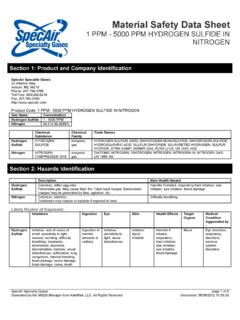
2 It is not generated from the sewage, but its concentration in SEWER gas may beeffectively increased by the removal or consumption of oxygen through other means ( , rusting, otherforms of oxidation or biological activity). hydrogen sulfide is formed by biological and chemical processes in the liquid phase and is released tothe headspace above the solution; its concentration in the gas phase is dependent upon its concentrationin the liquid phase and ambient equilibrium conditions. At non-toxic levels, H2S has the familiar odor ofrotten eggs. At acutely toxic levels, H2S quickly paralyzes an individual's ability to detect its odor, and willrapidly render a victim unconscious. Due to its relatively high toxic potential while at dilute concentrations,Meridian Engineering & Technology REFERENCE data SHEET on .. of 55/31/09 2:09 PMand normally expected air currents, the molecular gas density of H2S is often of secondary importance inpredicting its movement or H2S gas is also flammable at concentrations which are wellabove toxic levels (Lower Explosive Limit , Upper Explosive Limit 46%).
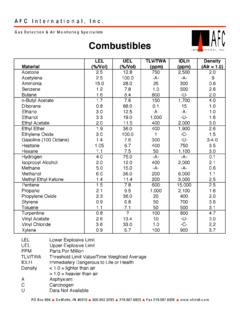
3 Carbon dioxide and methane have little or no odor characteristics and have a saturated gas densityapproximately and times that of air, respectively. Their relative gas densities compared to air andpotential for elevated concentrations may cause some gas stratification. Since both of these gases aregenerated while in solution, there may be higher concentrations at the liquid-air is extremely flammable, has a wide explosive range, and a low flash point. These characteristicsresult in a substantial fire and explosion hazard. Methane will also react with some oxidizersspontaneously. It is also possible to have other flammable gases in sewers that originate from spills andleaks of flammable has a distinct, strong odor with good warning characteristics which are present well beforeattaining toxic levels. Exposure to elevated levels of ammonia also may act as an eye and mucusmembrane irritant.
4 It is unlikely that acutely toxic levels of this material would be present from commonsewage of the above gases are colorless at the concentrations commonly encountered in sewage biological organisms and pathogens from sewage can become airborne, primarily throughagitation, or other physical actions on the accompanying liquid, but generally these microbes areshort-lived when suspended in :The materials which may occupy these locations may be variable mixtures of liquids, gases and mists. There maybe little perceptible indication of decreased oxygen levels; there may be no warning odors for the most toxic gas;and there may be a possibility for a fire or explosion hazard. Exposure to airborne biological contaminants oftenrequires the generation of mists containing these EFFECT AND HAZARD DATAThe major adverse health effects and hazards from exposure to SEWER gases are:Poisoning from H2S, Asphyxiation from displaced or consumed oxygen, vigilance or fatigue due to reduced oxygen levels (from CO2 and CH4), contamination, and explosions from methane gas, H2S or other flammable sulfide has been reported as the leading cause of sudden death in the work At concentrationsin air of approximately 300 ppm, H2S can be immediately deadly.
5 It is absorbed primarily through the lungs, butcan also be adsorbed to a limited extent through the skin and mucous membranes. Chronic health effects causedby repeated exposures have not been established. Common symptoms to non-acute exposure levels include eyeirritation, fatigue, headache, and dioxide is a simple asphyxiant (displaces oxygen) and a stimulant for the respiratory system. Aconcentration of 5% may produce headaches and shortness of breath. Background concentrations of carbondioxide in air range from 300 to 400 Engineering & Technology REFERENCE data SHEET on .. of 55/31/09 2:09 PMMethane is a simple asphyxiant (displaces oxygen), but does not itself cause significant physiological 1 contains more information on the exposure criteria for the gaseous biological agents found in SEWER systems may be bacteria, viruses, or parasites.
6 Table 2 lists a few ofthe diseases and viruses that are associated with inhalation exposure from waste water 1 - SELECTED PROPERTIES OF SEWER GASESC ompoundVapor Density(air = )ppm OdorThresholdPEL ppm 5 STEL ppm 6 hydrogen SulfideCarbon (ceiling)5,000-5050 (10 )---TABLE 2 - SELECTED WASTEWATER RELATEDDISEASES AND VIRUSES (inhalation)7 TuberculosisHistoplasmosisCoxsackie A & BPoliomyelitisAdenovirusBacillary dysenteryCommon coldEchovirusRotavirusImplications:The presence of SEWER gas at significant concentration levels may result in dangerous conditions due to its toxicnature, its suppression of life supporting oxygen levels, and its potential explosive nature. Some components ofsewer gas may result in detectable odors, but the odor warning characteristics alone may be insufficient to causeexposed individuals to leave the area.
7 Biological contaminants can become airborne and accompany mistsreleased from sewage-related FORMATION/GENERATIONH ydrogen sulfide is formed from the bio-chemical reduction reaction of naturally occurring sulfate ions in wateror from the decomposition of organic matter that contains sulfur under anaerobic conditions,8 and from reactionsof metal sulfides and strong hydrogen sulfide generally will not form if there is an abundance of availableoxygen. There is a potential for the continued biological oxidation of the hydrogen sulfide to form weakconcentrations of sulfuric acid (H2SO4) or the formation of ferrous sulfide (FeS), a blackish solid residue, if iron isavailable. If sufficient dissolved oxygen is present, H2S will not be dioxide is the natural product of respiration, including that from microbial activity, and is primarily harmfuldue to the consumption and displacement of oxygen that accompanies its generation.
8 This gas can also beproduced under some circumstances from the reaction of some acids and the carbonates in concrete. This set ofreactions is usually restricted due to such mass transfer limitations as the presence of slime and accumulation ofMeridian Engineering & Technology REFERENCE data SHEET on .. of 55/31/09 2:09 PMa precipitate layer. There also is a water-carbonate system that will naturally dissolve or release CO2 from groundand surface in sewers and similar structures generally occurs from biological activities or chemical reactions ofcertain organic materials. 12 Usually its concentration is below the lower explosive limit, and at that concentrationrange will only decrease the available oxygen concentration one percent for every five percent methane. Methanecan add to the explosive vapors that may be present from other flammable and explosive chemicals that havebeen discharged to the system.
9 The presence of elevated levels of nitrogen and carbon dioxide may alter theflammability limits normally published for methane in production of these and other gases may be altered by the presence of other chemicals, changes intemperature, and pH. The rate of gas generation may significantly affect the final :There are several chemical pathways for the formation of these gases. Their concentration may be limited byreaction kinetics, mass transfer considerations, or by dilution effects. There are several sinks and sources forthese materials. These kinds of controlling factors may substantially change the potential for Barsky et al., "Simultaneous Multi-Instrumental Monitoring of Vapors in SEWER Headspaces by SeveralDirect-Reading Instruments," Environmental Research v. 39 #2 (April 1986): "Characteristics of Common Gases Found in Sewers," in Operation of Wastewater Treatment Plants,Manual of Practice No.
10 11. Alexandria, VA, Water Pollution Control Federation, 1976, Table Garrison and M. Erig, "Ventilation to Eliminate Oxygen Deficiency in Confined Space - Part III: Heavier-than-Air Characteristics," Applied Occupational and Environmental Hygiene v. 6 #2 (February 1991) "Criteria for a Recommended Standard - Occupational Exposure to hydrogen sulfide ," DHEW Pub. ; NTIS PB 274-196. Cincinnati, National Institute for Occupational Safety and Health, Exposure Limit (29 CFR Tables Z-1 and Z-2). Exposure Limit (29 CFR Table Z-2). Hazards at Wastewater Treatment Facilities. Alexandria, VA, Water Pollution Contol Federation, Chwirka and T. Satchell, "A 1990 Guide for Treating HydrogenSulfide in Sewers," Water Engineering andManagement v. 137 #1 (January 1990): Holum, Fundamentals of General, Organic and Biological Chemistry. New York, John Wiley & Sons,1978, p.