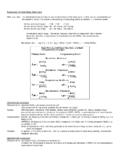
Transcription of RENAL PHYSIOLOGY LECTURES
1 RENAL PHYSIOLOGY LECTURESL awrence P. Sullivan, EmeritusKidney Institute & Dept of PhysiologyUniversity of Kansas Medical CenterLord Nephros, we pray that you willshower your wisdom upon us allHOMER W. SMITH, 1895-1962 SCIENTIST, TEACHER, EXPLORER, PHILOSOPHER, NOVELIST AND PERENNIAL STUDENT uperficially, it might be said that thefunction of the kidneys is to make urine; but in a more considered view one can say that the kidneys make the stuff of philosophy SmithMAJOR FUNCTIONS OF THE KIDNEY REGULATION OF BODY FLUID VOLUME REGULATION OF OSMOTIC BALANCE REGULATION OF ELECTROLYTE COMPOSITION REGULATION OF ACID-BASE BALANCE REGULATION OF BLOOD PRESSURE ERYTHROPOIESIS EXCRETION OF WASTE PRODUCTS AND FOREIGN SUBSTANCESSYSTEM REQUIREMENTS PROCESS LARGE VOLUME OF FLUID LARGE SURFACE TO VOLUME RATIO CLOSE CONTROL MINIMAL ENERGY COST RETAIN NUTRIENTSSYSTEM REQUIREMENTSPROCESS LARGE VOLUME OF FLUID: RENAL Blood Flow (RBF) = L/min, >1700 L/day, 20-25% of cardiac output.
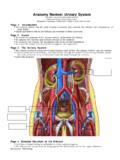
2 RENAL Plasma Flow (RPF) = 660 mL/min, 950 L/day Glomerular Filtration Rate (GFR) = 125 mL/min, 180 L/daySYSTEM REQUIREMENTSLARGE SURFACE TO VOLUME RATIO:2,000,000 nephrons in the two kidneysBlood Flow:Glomerular Filtration: 1200 mL/min125 mL/ mL/min/nephronExcretion Rate:~1 mL/min~ mL/min/nephronQUANTITIES OF SOLUTE FILTERED AND EXCRETEDP lasmaFiltered/dayExcreted/dayPercentConc . mMmmolesmmolesReabsorbedNa14025,20010399 +Cl10518,90010399+HCO3254,500299+K472010 086+Glucose 5900trace100 Urea590036060 ANATOMY OF THE NEPHRONSCORTEXMEDULLAOUTERINNER thicksegmentthinsegmentHenle s loopjuxtaglomerularapparatusJuxtamedulla rynephronCortical nephrondistaltubuleproximaltubuleglomeru lusCollectingtubuleBASIC NEPHRON FUNCTIONS 1. Filtration 2. Reabsorption 3. Secretion 4. Excretion2341 SOLUTE-NEPHRON INTERACTIONSFILTRATION ONLYI nulinIothalamateFILTRATION+REABSORPTIONN a.
3 Cl, UreaGlucoseFILTRATION+SECRETIONH ippurates, PenicillinFurosemide First to apply a magnifying lens to the kidney. Discovered that the kidney is not parenchyme but a mass of tubules..the substance of the kidneys is nothing else than an aggregate of an infinite number of vessels of a kind peculiar to itself. Having cut through any part of the kidney, certain fibresor filaments extending from the outer surface to the hollow or pelvis are quite plainly visible ..If therefore you compress these filaments from their further will find water welling up everywhere. If you are not afraid to present this to your tongue, you will discover a certain saltiness and in some the taste of may observe this if you apply a glass lens to your eye for then, when the tubules are compressed, the urine is very clearly seen welling out as if gushing forth from so many little water pipes.
4 From these things we can confidently infer that the substance of the kidney, even though they have called it parenchym, is nothing else mass of caniliculae and capillary spaces through which the urine flows into the LORENZO BELLINI, 1662 In all kidneys which up to this time I have been able to get, I have detected a number of very small glands..a black fluid mixed with spirit of wine should be injected through the RENAL artery until the whole kidney swells, and the exterior grows black..when the kidney is sectioned ..longitudinally, between the bundles of the urinary vessels and the narrow space formed by them, one will see these same innumerableglands attached like apples to the blood vessels, the latter swollen with the black liquid and stretched out into the form of a beautiful Marcello Malpighi, 1666 MARCELLO MALPIGHI WILLIAM BOWMAN, 1842 Bowman using a more powerful microscope and better dyes, was able to describe the afferent and efferent arterioles, the glomerular capillaries enclosed in a capsule and the peritubular FREIDRICH WILHELM LUDWIG, 1816-1895 In 1844 Ludwig proposed a purely mechanistic theory for urine formation.
5 Filtration occurs at the glomeruli. Blood pressure pushes fluid through the wall of the glomerular capillaries into the tubules. This fluid carries all the components of plasma except for proteins. He also proposed that part of the fluid entering the nephron is reabsorbed by an endosmotic force due to the presence of protein in the peritubularcapillary N. Richards and his associates:Developed the micropuncture that fluid entering Bowman s capsule is an ultrafiltrate of FILTRATION PATHWAYFILTRATION OF LARGE MOLECULESEFFECT OF DISEASE ON GLOMERULARPERMEABILITY TO LARGE MOLECULESM acromoleculeMolecular Radius Fractional Clearance(A)(U/P)m/(U/P)inNormal ValuesAlbumin36< Glomerular NephritisNeutral