Transcription of REPAIRING RADIANT HEATING—AN EFFECTIVE METHOD
1 REPAIRING RADIANT heating AN EFFECTIVE METHODR oland ReisleyAfter 1936 Frank Lloyd Wright specified RADIANT heating in most of his designs. Hot water circu-lated in pipes buried under the concrete floor enables a particularly comfortable winter, environ-ment marked by lower air temperature, higher humidity, less dust and the pleasantly warm , over 40 to 60 years, some of these systems developed leaks that, unlike exposeradiators, may be difficult to locate and repair. The perceived difficulty and the shibboleth, don tbother, one leak will soon be followed by more has led to premature abandonment of some radi-ant systems. Replacement, too, is difficult, expensive and often architecturally owners should note that, in many cases, leaks can be located and repaired and thatmany plumbing and heating contractors do not have the knowledge or patience for these of the aging RADIANT systems is the most serious concern that is common toso many Wright buildings.
2 This ongoing issue was discussed in 1998 Bulletins, Volume 7, , 3. Breaking into and restoring concrete floors is scary, but not very difficult or expensive. Thehard part is locating a hidden leak. With luck, it might be an easily found wet or hot spot. Or itmay be audible. The sound of escaping water or air can be detected in many ways from simplythe unaided ear to stethoscopes to sophisticated ultrasound receivers. [Commercial/industrialleak finders use high pressure to hear leaks. This METHOD however may be destructive.] Evenso, locating the leak will likely require patience and some the Reisley House (1951, 1956) the RADIANT system, Rayduct (steel) pipes, the original1951 installation has not leaked.
3 The 1956 addition however leaked in 1988 and again in2000. Both were successfully repaired. In 1988, after months on my hands and knees with astethoscope and only vaguely identifying a warm area, I gave in, increased the water pressurefrom the normal 15 pounds to 45 pounds which confirmed the the late 1990s, occasional slow leaking was stopped by infusions of Boiler Liquid (stop-leak) but soon, it was time to find the leak. One area, about 200 square feet, seemed warmerthan the rest, but nothing could be seen or heard. A knowledgeable plumberisuggested the fol-lowing system:Attach an air compressor limited to 20 psi. Then fill the system alternately with air and intervals of turbulence, noisier than a steady flow of air or water, should occur at theleak.
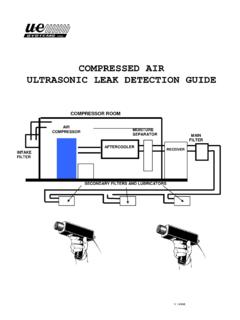
4 After some repeated cycles it was possible to confirm the sound in an area of four orfive square feet. The floor in this case was terrazzo, much more difficult to repair than con-crete. Hoping to locate the leak more precisely, a valuable new tool was , the most commonly used leak detectors, frequently are not EFFECTIVE . Theyare intended for low pitched sounds, heartbeats, etc. Leaking water quietly makes many soundsthat are ultrasonic, that is beyond the range of human hearing. Sensitive electronic instrumentshowever can detect them. UE Systems, a variety of ultrasound detectors.[ ] Their Marketing VP, Alan Bandes, agreed to demonstrate the equipmentin our efforts to locate the leak, exactly.
5 Illustrating its sensitivity, the blink of an eye at a distanceof 10 feet was received as a loud our plumber expert,Mark, Alan moved the Ultraprobe around the suspect area [Figure1], stopping at the loudest attacked at that point[Figure 2]and soon uncoveredthe leak. It was in a bend, perhapsa weakened stress point. [Figure3]The pipe was replaced, sur-rounded with gravel and coveredwith concrete to an inch belowthe surface leaving room toreplace the terrazzo. [Figure 4]Correctly locating the leak limiteddamage of the floor to a singlemodule and the heating systemis working detection is prob-ably the most EFFECTIVE and practi-cal METHOD for locating hiddenleaks, but it should not be consid-ered a magic wand.
6 The instru-ments are now in the hands of anumber of franchised practition-ers. Nevertheless, diagnostic art and patience will almost always bekey to Roberto, of Richard Bell Plumbing & heating , Millwood, NYiiUE Systems, Inc., 14 Hayes Street, Elmsford, NY 10523 Fig. 1. Searching in the suspect 3. The bend that leaked (external corrosion).Fig. 4. Accurate location limited damage to a single 2. Breaking in.