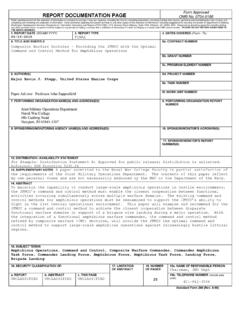
Transcription of Report Documentation Page Form Approved OMB …
1 Report Documentation PageForm ApprovedOMB No. 0704-0188 Public reporting burden for the collection of information is estimated to average 1 hour per response, including the time for reviewing instructions, searching existing data sources, gathering andmaintaining the data needed, and completing and reviewing the collection of information. Send comments regarding this burden estimate or any other aspect of this collection of information,including suggestions for reducing this burden, to Washington Headquarters Services, Directorate for Information Operations and Reports, 1215 Jefferson Davis Highway, Suite 1204, ArlingtonVA 22202-4302. Respondents should be aware that notwithstanding any other provision of law, no person shall be subject to a penalty for failing to comply with a collection of information if itdoes not display a currently valid OMB control number.
2 1. Report DATE 2008 2. Report TYPE 3. DATES COVERED 00-00-2008 to 00-00-2008 4. TITLE AND SUBTITLE Understanding the Posse Comitatus Act and the Insurrection Act 5a. CONTRACT NUMBER 5b. GRANT NUMBER 5c. PROGRAM ELEMENT NUMBER 6. AUTHOR(S) 5d. PROJECT NUMBER 5e. TASK NUMBER 5f. WORK UNIT NUMBER 7. PERFORMING ORGANIZATION NAME(S) AND ADDRESS(ES) State Defense Force Publication Center,19819 Maycrest Way,Germantown,MD,20876-6339 8. PERFORMING ORGANIZATIONREPORT NUMBER 9. SPONSORING/MONITORING AGENCY NAME(S) AND ADDRESS(ES) 10. SPONSOR/MONITOR S ACRONYM(S) 11. SPONSOR/MONITOR S Report NUMBER(S) 12. DISTRIBUTION/AVAILABILITY STATEMENT Approved for public release; distribution unlimited 13. SUPPLEMENTARY NOTES See also ADA494583. Pub in: State Defense Force Journal, Vol. 4, Issue 1, Fall 2008. 2008 State DefenseForces Publications Center. Creative Commons Attribution License.
3 14. ABSTRACT 15. SUBJECT TERMS 16. SECURITY CLASSIFICATION OF: 17. LIMITATION OF ABSTRACT Same asReport (SAR) 18. NUMBEROF pages 3 19a. NAME OFRESPONSIBLE PERSON a. Report unclassified b. ABSTRACT unclassified c. THIS PAGE unclassified Standard form 298 (Rev. 8-98) Prescribed by ANSI Std Z39-18 Understanding the Posse Comitatus Act and the Insurrection Act3 Reprinted courtesy of Freedom Foundation, all rights UNDERSTANDING THE POSSE COMITATUS ACTAND THE INSURRECTION ACT1 John R. Brinkerhoff, Colonel USA RetiredMost Americans believe that the Posse Comitatus Act prohibits the use of federal troops toenforce the law in the United States. They also believe that the President has to wait until a governorasks for help before he can send federal troops to help and even only to quell an insurrection. Thesebeliefs are erroneous. They are based on complete misunderstanding of the two major laws that pertainto this issue.
4 This is important, for understanding the true status of the laws and authorities is essentialif we are to provide for the security of the homeland in an age of terrorism and catastrophic this article, I will address both the Posse Comitatus Act and the Insurrection Act, usingdifferent approaches to help you understand what each really means. I will parse the Posse ComitatusAct to allow you to understand what it really means. I will tell the story of the Insurrection Act to allowyou to understand how it came to be is important, for the true status of the laws and authorities are essential if we are to providefor the security of the homeland in an age of terrorism and catastrophic natural lot of people are talking about the Posse Comitatus Act, and almost all of them get it , if any, of the media and academia po ntificators have even read the law itself.
5 Well, here itis-United States Code Title 18, Section , except in cases and under circumstances expressly authorized by theConstitution or Act of Congress, willfully uses any part of the Army or the Air Forces asa posse comitatus or otherwise to execute the laws shall be fined under this title orimprisoned not more than two years or order to help the readers understand what this one-sentence law means, I am going to parseit. That is, I am going to examine its meaning by determining the parts of speech in the sentence. Asolder readers will remember, this is known as diagraming a should be noted at the outset that the law does not contain the word "prohibited." The law saysnothing about the provision of relief or support from or by the federal government. It pertains to the useof the Army or Air Force to execute the laws as a member of a "posse comitatus" formed by a , marshal, a sheriff, law enforcement officer, or other public official or private sentence has to contain a subject, verb, and an object.
6 The subject in this sentence is the word:"Whoever." The verb is "uses." The object is "part of the Army and Air Force." The rest of thesentence consists of clauses that modify the subject, the verb, or the object. Stripped of the modifiers,the sentence reads: Whoever uses part of the Army and Air Defense Force Journal, Vol. 3, No. 1, Fall 2007 Next we will address the modifiers of the verb. The first modifier is the adverb "willfully." Thismeans that the using is done on purpose and not accidentally. The second modifier explains the kindof the use to which the verb applies. In this law, this use is "as a posse comitatus or otherwise to executethe laws." The sentence now reads, "whoever willfully uses any part of the Army and Air Force as aposse comitatus or otherwise to execute the laws."Note that the offender under this law would not be the Army or Air Force, or members of theArmy or Air Force but the person who uses them in violation of the law.
7 This may explain why noperson has been convicted of violating the Posse Comitatus Act since it was enacted in know you are waiting eagerly to find out what happens to those "whoevers" that do this badthing willfully, so we next add the consequences of such an action, and now the law reads as follows:Whoever willfully uses any part of the Army or the Air Force as a posse comitatus orotherwise to execute the laws shall be fined under this title or imprisoned not more thantwo years or is almost the complete law. If it were the complete law, the pontificators would be correctin asserting that the law prohibits the use of the Army and Air Force from enforcing the law in theUnited Sates. However, Congress included an important qualification in the sentence that is oftenoverlooked by those who prefer an absolute prohibition.
8 The important exception is the followingclause that modifies the subject: Except in cases and under circumstances expressly authorized by theConstitution or Act of is clear that Congress has so meone in mind that could lawfully authorize the Army and AirForce to execute the laws. Who is this person or persons to whom Congress grants that authority? Congress has on several occasions enacted laws that authorize one person-and one person only-toauthorize the Army and Air Force to execute the laws. That person is the President of the United make it clear what the sentence really says, I will substitute this meaning of the exception clause inthe parsed version of the Posse Comitatus , except the Congress or the President of the United States, willfully uses anypart of the Army or the Air Force as a posse comitatus of otherwise to execute the lawsshall be fined under this title or imprisoned or even more clearly, the intent of this law reads as follows: Only the Congress or thePresident of the United States may authorize the use of the Army and Air Force to execute the is what t he Posse Comitatus Act means-or at least what it meant when it was enacted in1878.
9 Unfortunately for the Nation, the meaning of the law was completely revised by activist judgesin the 1970s, so recent case law is the opposite of the law itself. That modern revised version of thePosse Comitatus Act is what most people are citing when they assert that federal troops are prohibitedfrom enforcing the law in the United States. Fortunately, the Insurrection Act stands, and it permits thePresident to use federal troops to enforce the laws either at the request of a governor or on the initiativeof the the Posse Comitatus Act and the Insurrection Act5 The Insurrection Act consists of four statutes enacted at different times for different reasons that,when considered as a whole, provide the power that Presidents have used many times as the legal basisfor using troops to enforce the law. The four sections of law are as follows. Title 10, Section 334 was enacted in 1792 as the Calling Forth Act to give President GeorgeWashington authority to call forth the militia when in his judgment they were needed to repel invasions,suppress insurrections, or enforce the laws.
10 To assure that this authority was not abused, a reluctantCongress specified that before using the troops, the President would have to issue a proclamation callingon the insurgents to disperse in a limited time. Title 10, Section 331 is a combination of two laws. One was enacted in 1795 to correctweaknesses in the Calling Forth Act (1792) when it was used to suppress the Whisky Rebellion in law gave the President specific authority to call forth the militia upon the request of a governor orstate legislature, if the governor were unable to apply for the assistance. The second law was enactedin 1807 at the request of President Thomas Jefferson to extend Presidential authority to call forth thestanding army as well at the militia. This section allows the President to use the armed forces to enforcethe laws or suppress a rebellion whenever, in his opinion, unlawful obstructions, combinations, orassemblages or rebellion against the authority of the United States make it impractical to enforce thelaws using the course of judicial 10, Section 332 was enacted in 1861 at the request of President Abraham Lincoln toincrease Presidential authority to use the militia and the regular army to suppress insurrections andenforce the laws.