Transcription of REPUBLIC ACT 9003 - Solid Waste Management Division
1 REPUBLIC ACT9003H. No. 10651S. No. 1595 REPUBLIC of the PhilippinesCongress of the PhilippinesMetro ManilaEleventh CongressThird Regular SessionBegun and held in Metro Manila, on Monday, the twenty-fourth day of July, twothousand.[ REPUBLIC ACT NO. 9003 ]AN ACT PROVIDING FOR AN ECOLOGICAL Solid Waste MANAGEMENTPROGRAM, CREATING THE NECESSARY INSTITUTIONAL MECHANISMS ANDINCENTIVES, DECLARING CERTAIN ACTS PROHIBITED AND PROVIDINGPENALTIES, APPROPRIATING FUNDS THEREFOR, AND FOR it enacted by the Senate and House of Representatives of the Philippines inCongress assembled:CHAPTER IBASIC POLICIESA rticle 1 General ProvisionsSection Title. This Act shall be known as the Ecological Solid WasteManagement Act of 2000 .Section of Policies. It is hereby declared the policy of the State toadopt a systematic, comprehensive and ecological Solid Waste Management program which shall:(a)Ensure the protection of public health and environment;1(b)Utilize environmentally-sound methods that maximize the utilization of valuableresources and encourage resources conservation and recovery;(c)Set guidelines and targets for Solid Waste avoidance and volume reduction throughsource reduction and Waste minimization measures, including composing, recycling,re-use, recovery, green charcoal process, and others, before collection, treatmentand disposal in appropriate and environmentally-sound Solid Waste managementfacilities in accordance with ecologically sustainable development principles.
2 (d)Ensure the proper segregation, collection, transport, storage, treatment anddisposal of Solid Waste through the formulation and adoption of the best environmentalpractices in ecological Waste Management excluding incineration;(e)Promote national research and development programs for improved Solid wastemanagement and resource conservation techniques, more effective institutionalarrangement and indigenous and improved methods of Waste reduction, collection,separation and recovery.(f)Encourage greater private sector participation in Solid Waste Management ;(g)Retain primary enforcement and responsibility of Solid Waste Management withlocal government units while establishing a cooperative effort among the nationalgovernment, other local government units, non-government organizations, andthe private sector;(h)Encourage cooperation and self-regulation among Waste generators through theapplication of market-based instruments;(i)Institutionalize public participation in the development and implementation ofnational and local integrated, comprehensive and ecological Waste managementprograms; and(j)Strengthen the integration of ecological Solid Waste Management and resourceconservation and recovery topics into the academic curricula of formal and non-formal education in order to promote environmental awareness and action amongthe 2 Definitions of TermsSection of Terms.
3 For the purpose of this Act:(a)Agricultural Waste shall refer to Waste generated from planting or harvestingof crops, trimming or pruning of plants and wastes or run-off materials fromfarms or fields;2(b)Bulky wastes shall refer to Waste materials which cannot be appropriately placedin separate containers because of either its bulky size, shape or other physicalattributes. These include large worn-out or broken household, commercial,and industrial items such as furniture, lamps, bookcases, filing cabinets, andother similar items;(c)Bureau shall refer to the Environmental Management Bureau;(d)Buy-back center shall refer to a recycling center that purchases or otherwiseaccepts recyclable materials from the public for the purpose of recycling suchmaterials;(e)Collection shall refer to the act of removing Solid Waste from the source or from acommunal storage point;(f)Composting shall refer to the controlled decomposition of organic matter bymicro-organisms, mainly bacteria and fungi, into a humus-like product;(g)Consumer electronics shall refer to special wastes that include worn-out,broken, and other discarded items such as radios, stereos, and TV sets.
4 (h)Controlled dump shall refer to a disposal site at which Solid Waste is depositedin accordance with the minimum prescribed standards of site operation;(i)Department shall refer to the Department of Environment and Natural Resources;(j)Disposal shall refer to the discharge, deposit, dumping, spilling, leaking orplacing of any Solid Waste into or in any land;(k)Disposal site shall refer to a site where Solid Waste is finally discharged anddeposited;(l)Ecological Solid Waste Management shall refer to the systematic administration ofactivities which provide for segregation at source, segregated transportation,storage, transfer, processing, treatment, and disposal of Solid Waste and allother Waste Management activities which do not harm the environment;(m)Environmentally acceptable shall refer to the quality of being re-usable,biodegradable or compostable, recyclable and not toxic or hazardous tothe environment;(n)Generation shall refer to the act or process of producing Solid Waste ;3(o)Generator shall refer to a person, natural or juridical, who last uses a materialand makes it available for disposal or recycling;(p)Hazardous Waste shall refer to Solid Waste or combination of Solid Waste whichbecause of its quantity, concentration, or physical, chemical or infectiouscharacteristics may:(1) cause, or significantly contribute to an increase in mortality or an increase inserious irreversible, or incapacitating reversible, illness; or(2) pose a substantial present or potential hazard to human health or theenvironment when improperly treated, stored, transported, or disposed of, orotherwise managed;(q)Leachate shall refer to the liquid produced when Waste undergo decomposition,and when water percolate through Solid Waste undergoing decomposition.
5 It isa contaminated liquid that contains dissolved and suspended materials;(r)Materials recovery facility includes a Solid Waste transfer station or sortingstation, drop-off center, a composting facility, and a recycling facility;(s)Municipal Waste shall refer to wastes produced from activities within localgovernment units which include a combination of domestic, commercial, institutionaland industrial wastes and street litters;(t)Open dump shall refer to a disposal area wherein the Solid wastes areindiscriminately thrown or disposed of without due planning and consideration forenvironmental and health standards;(u)Opportunity to recycle shall refer to the act of providing a place for collectingsource-separated recyclable material, located either at a disposal site or atanother location more convenient to the population being served, and collectionat least once a month of source-separated recyclable material from collectionservice customers and to providing a public education and promotion programthat gives notice to each person of the opportunity to recycle and encouragesource separation of recyclable material;(v)Person(s) shall refer to any being, natural or juridical, susceptible of rights andobligations, or of being the subject of legal relations.
6 (w)Post-consumer material shall refer only to those materials or products generatedby a business or consumer which have served their intended end use, and whichhave been separated or diverted from Solid Waste for the purpose of beingcollected, processed and used as a raw material in the manufacturing ofrecycled product, excluding materials and by-products generated from, andcommonly used within an original manufacturing process, such as mill scrap;4(x)Receptacles shall refer to individual containers used for the source separationand the collection of recyclable materials;(y)Recovered material shall refer to material and by-products that have been recoveredor diverted from Solid Waste for the purpose of being collected, processed and usedas a raw material in the manufacture of a recycled product;(z)Recyclable material shall refer to any Waste material retrieved from the wastestream and free from contamination that can still be converted into suitablebeneficial use or for other purposes, including, but not limited to, newspaper,ferrous scrap metal, non-ferrous scrap metal, used oil, corrugated cardboard,aluminum, glass, office paper, tin cans and other materials as may be determinedby the Commission;(aa)Recycled material shall refer to post-consumer material that has been recycledand returned to the economy.
7 (bb)Recycling shall refer to the treating of used or Waste materials through a process ofmaking them suitable for beneficial use and for other purposes, and includesany process by which Solid Waste materials are transformed into new productsin such a manner that the original products may lose their identity, and whichmay be used as raw materials for the production of other goods or services:Provided, That the collection, segregation and re-use of previously usedpackaging material shall be deemed recycling under this Act;(cc)Resource conservation shall refer to the reduction of the amount of Solid wastethat are generated or the reduction of overall resource consumption, and utilization ofrecovered resources;(dd)Resource recovery shall refer to the collection, extraction or recovery ofrecyclable materials from the Waste stream for the purpose of recycling, generatingenergy or producing a product suitable for beneficial use: Provided, That, suchresource recovery facilities exclude incineration;(ee)Re-use shall refer to the process of recovering materials intended for thesame or different purpose without the alteration of physical and chemicalcharacteristics;(ff)Sanitary landfill shall refer to a Waste disposal site designed, constructed,operated and maintained in a manner that exerts engineering control oversignificant potential environmental impacts arising from the developmentand operation of the facility.
8 5 (gg)Schedule of Compliance shall refer to an enforceable sequence of actionsor operations to be accomplished within a stipulated time frame leading tocompliance with a limitation, prohibition, or standard set forth in this Act orany rule or regulation issued pursuant thereto;(hh)Secretary shall refer to the Secretary of the Department of Environment andNatural Resources;(ii)Segregation shall refer to a Solid Waste Management practice of separatingdifferent materials found in Solid Waste in order to promote recycling and re-use ofresources and to reduce the volume of Waste for collection and disposal.
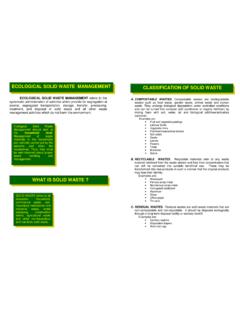
9 (jj)Segregation at source shall refer to a Solid Waste Management practice ofseparating, at the point of origin, different materials found in Solid Waste in orderto promote recycling and re-use of resources and to reduce the volume of wastefor collection and disposal;(kk) Solid Waste shall refer to all discarded household, commercial Waste , non-hazardous institutional and industrial Waste , street sweepings, constructiondebris, agriculture Waste , and other non-hazardous/non-toxic Solid specifically noted otherwise, the term Solid Waste as used in thisAct shall not include:(1) Waste identified or listed as hazardous Waste of a Solid , liquid, containedgaseous or semisolid form which may cause or contribute to an increase inmortality or in serious or incapacitating reversible illness, or acute/chroniceffect on the health of persons and other organisms;(2) infectious Waste from hospitals such as equipment, instruments, utensils,and fomites of a disposable nature from patients who are suspected to haveor have been diagnosed as having communicable diseases and musttherefore be isolated as required by public health agencies, laboratorywastes such as pathological specimens ( , all tissues, specimens ofblood elements, excreta, and secretions obtained from patients or laboratoryanimals), and disposable fomites that may harbor or transmit pathogenicorganisms, and surgical operating room pathologic specimens and disposablefomites attendant thereto, and similar disposable materials from outpatientareas and emergency rooms; and6(3) Waste resulting from mining activities, including contaminated soil anddebris.
10 (ll) Solid Waste Management shall refer to the discipline associated with thecontrol of generation, storage, collection, transfer and transport, processing,and disposal of Solid wastes in a manner that is in accord with the best principlesof public health, economics, engineering, conservation, aesthetics, and otherenvironmental considerations, and that is also responsive to public attitudes;(mm) Solid Waste Management facility shall refer to any resource recovery system orcomponent thereof; any system, program, or facility for resource conservation;any facility for the collection, source separation, storage, transportation, transfer,processing, treatment, or disposal of Solid Waste ;(nn)Source reduction shall refer to the reduction of Solid Waste before it enters thesolid Waste stream by methods such as product design, materials