Transcription of Research in Organizational Behavior
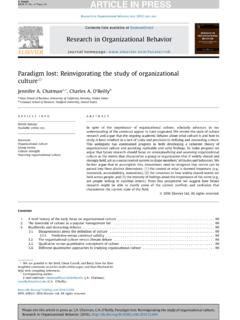
1 The energizing nature of work engagement: Toward a newneed-based theory of work motivationPaul I. Green ,*, Eli J. Finkelb, Grainne M. Fitzsimonsc, Francesca GinoaaHarvard University, United StatesbNorthwestern University, United StatescDuke University, United StatesA R T I C L E I N F OArticle history:Available online 22 November 2017 Keywords:NeedsMotivationWork engagementDisengagementAuthenticitySelf- expressionA B S T R A C TWe present theory suggesting that experiences at work that meet employees expectationsof need fulfillment drive work engagement. Employees have needs ( , a desire to beauthentic) and they also have expectations for how their job or their organization will fulfillthem. We argue that experiences at work that confirm employees need fulfillmentexpectations yield a positive emotional state that is energizing, and that this energy ismanifested in employees behaviors at work.
2 Our theorizing draws on a review of the workengagement literature, in which we identify three core characteristics of workengagement: (a) a positive emotional state that (b) yields a feeling of energy and (c)leads to positive work-oriented behaviors. These key themes provide the foundation forfurther theorizing suggesting that interactions at work confirm or disconfirm employees need fulfillment expectations, leading to different levels of engagement. We extend ourtheorizing to argue that confirmation, or disconfirmation, of different need expectationswill yield emotional experience of varying magnitudes, with confirmation of approach-oriented need expectations exerting stronger effects than the confirmation of avoidance-oriented need expectations. We close with a review suggesting that organizationalcontextual features influence the expression of these needs, sustaining or undermining thepositive emotional experiences that fuel work engagement.
3 2017 Elsevier Ltd. All rights needs at work .. 4 Work engagement .. 4A history of the study of work engagement .. 4 The whole self .. 5A sequential perspective on work engagement .. 5 Affective events and the experience of energy .. 6 Emotion as energy vs. satiation .. 6 Work engagement vs. disengagement .. 7 The benefits and antecedents of work engagement .. 8 The benefits of work engagement .. 8* Corresponding address: ( Green). 2017 Elsevier Ltd. All rights in Organizational Behavior 37 (2017) 1 18 Contents lists available at ScienceDirectResearch in Organizational Behaviorjournal homepage: vie e/riobAntecedents of work engagement .. 8 Need fulfillment expectations and the sustenance of work engagement .. 9 Employees expectations as counterfactual realities.
4 9 Normative as socially granted .. 9 Normative as general and abstract expectations .. 9 Psychological contracts .. 9 Need fulfillment expectations and work engagement .. 10 Approach and avoidance needs .. 11 Differential emotional responses to disconfirmed and confirmed approach and avoidance need expectations .. 11 Between-individual expectation differences .. 12 Organizational features and confirmation or disconfirmation of approach-oriented expectations .. 12 Authentic self-expression .. 12 Organizational characteristics and authentic self-expression .. 13 Discussion .. 13 Conclusion .. 15 Acknowledgments .. 15 References .. 15 The popular business press has grown increasinglyenamored with the idea that the modern workplace is, insome structural and meaningful way, inadequate (Hamel,2009, 2012; Laloux, 2014).
5 Popular articles point toalarming statistics suggesting a meaningful proportionof employees in organizations report a complete lackof engagement, and even report knowingly engaging inbehaviors harmful to their employer (O Boyle & Harter,2013). This same literature points to myriad prescriptivemeasures, often in the form of case studies depictingorganizations where employees seem so passionate andenthusiastically motivated at work that they seem toapproach euphoria (Fortune, 2016; Hamel, 2011; Laloux,2014; Rich, Lepine, & Crawford, 2010).These case studies vary in the ways by whichorganizations purport to motivate their employee popula-tion. Numerous lists of great companies to work for haveemerged, most leveraging measures of employee engage-ment and Organizational performance as evidence of theefficacy of the various practices these organizationsimplement to motivate employees.
6 The Fortune 100 BestCompanies to Work For (Fortune, 2016), for example,points to companies whose practices include payinghigher than standard wages, providing free health cover-age for employees, and offering flexible and autonomouswork arrangements. These companies offer various perksand benefits, ranging from bringing pets to work, offeringon-campus dining and childcare, wellness programs, andeven in-office recreational activities. Employees at some ofthese companies report that inclusive practices thatembrace their distinctive characteristics make their workmotivating. At some level, these organizations all engendera highly motivated workforce by creating an environmentthat provides fulfillment of their employees various practices in the organizations described inthese case studies help to fulfill fundamental humanneeds.
7 Some speak to enhanced safety and securitythrough higher wages and family health coverage. Othersspeak to the need for self-actualization or authentic self-expression ( inclusive workplaces that celebrate differ-ences). These stories suggest that the ongoing fulfillmentof needs at work is a source of , employees come to work with a set of needs,and those needs influence their Behavior at work insignificant ways. Organizational scholarship has longtheorized some relationship between human needs, whichare generally thought to be fundamental and universal, andemployee Behavior , most notably in the domain of workmotivation (Alderfer, 1969, 1972; Argyris, 1957; Kanfer &Heggestad, 1997; Maslow, 1943; McGregor, 1960). In fact,many existing theories of work motivation have assumedthat individuals work in order to fulfill fundamental theories build on the basic logic of humans aswanting, as Pinder (2014: 67) suggested in his review ofneeds and motivation.
8 Maslow (1943: 370) went so far asto postulate that Any motivated Behavior , must beunderstood to be a channel through which many basicneeds may be simultaneously expressed or satisfied. Mostsubsequent need-based theories of work motivation alsohave begun with the basic proposition that needs are amotivational force and often, with an emphasis on theidea that pain or displeasure associated with unmet needsleads to motivation ( Alderfer, 1972; Locke, 1991;Maslow, 1943; McGregor, 1960; Pinder, 2014). For example,McGregor (1960) argued that a satisfied need is not amotivator for Behavior . But the case studies reported above point to needfulfillment, rather than unmet needs, as the source ofemployee motivation. More fulfilling environments seemto be a major source of motivation in these cases.
9 Further,these case studies seem to suggest that organizationalpractices that go beyond providing safety and security foremployees, and also fulfill needs for self-expression andauthenticity, have particularly powerful motivationalpotential. The overarching implication behind these linesof study is that positive experiences, in addition to therelatively negative experiences associated with unfulfilledor obstructed need pursuits, carry motivational is, need fulfillment (as opposed to unsatiated needs)may also have motivating central question presented by these case studies ishow do positive experiences at work, or, more specifically,need fulfillment experiences, lead to increases in motiva-tion? This paper offers a foundation for a new approach to2 Green et al. / Research in Organizational Behavior 37 (2017) 1 18the study of needs at work, one that specifically aims toaddress this question.
10 We present a set of theoreticalarguments suggesting that experiences at work thatconfirm need fulfillment expectations are energizing,providing fuel for motivated Behavior . The work engage-ment literature, which emphasizes the experience ofenergy as core to engagement, provides our starting a brief review of the study of work motivationand needs, we turn to an in-depth review and summary ofthe work engagement literature. In clarifying the keyattributes of work engagement present in the literature,we make the case that the experience of work engagementis key to describing the relationship between positive needfulfillment experiences and motivated Behavior at engagement is commonly defined as a positive,fulfilling, work-related state characterized by vigor,dedication, and absorption (Schaufeli, Salanova, Gonz -lez-Rom , & Bakker, 2002).