Example: barber
Research Papers - NCCA
feeling, what they understand and can do. The adult uses the assessment information to plan future learning experiences, and to make learning interesting and successful for children. According to the paper assessment should focus on children’s development of dispositions, attitudes and values as well as their skills, knowledge and understandings.
Tags:
Information
Domain:
Source:
Link to this page:
Documents from same domain

A Framework for the Junior Cycle - NCCA
ncca.ieof assessment approaches, both formative and summative, that generate evidence of this learning by students. The approach to reporting will facilitate provision of assessment information based on the following elements: Ongoing formative assessments, including routine teacher-designed tasks and tests
G uidelines f or g od p r a c t i c e - NCCA
ncca.ieAistear: the Early Childhood Curriculum Framework Introduction Aistear is the curriculum framework for children from birth to six years in Ireland. It describes learning and development through the four interconnected themes of Well-being, Identity and Belonging, Communicating, and Exploring and Thinking

Curriculum reform: An education change perspective
ncca.ieThe National Quality Framework for Early Childhood Education and Care (NQF) National Foundation Skills Strategy for Adults Advancing Quality in Higher Education The Australian Workforce and Productivity Agency My University website National Partnership Agreement on Skills Reform 2013 National Partnership Agreement on Universal Access to Early
Helping young children to develop positive learning ...
ncca.ieHelping young children to develop positive learning dispositions Tip sheet (3-6 years) Aistear’s themes describe what children need to learn from birth onwards and outlines learning in four interconnected aspects: skills, attitudes and values, knowledge and …
Mathematics in Early Childhood and Primary Education (3-8 ...
ncca.ieThe literature offers a range of perspectives, and advice, as to the issues for educators in integrating these elements into their practices. In doing so, the vision of ‘mathematics for all’ is supported. ... Mathematics in Early Childhood and Primary Education (3–8 years) 18.

Literacy in Early Childhood and Primary Education (3-8 years)
ncca.ieFinally, theoretical perspectives emphasising the key role in literacy learning of children’s motivation, engagement and sense of self efficacy are reviewed. Disposition and a sense of being able emerge as crucial components in young children’s literacy development.
Primary Mathematics Curriculum - NCCA
ncca.ieMeasures 4 - Measuring 46 Measures 5 – Time 48 Measures 6 – Money 50 ... that is, communicating, reasoning, argumentation, justifying, generalising, representing, problem-solving, and connecting, ... Children’s progress towards Learning Outcomes will be influenced by their varying circumstances, experiences and abilities. ...

Junior Cycle Wellbeing Guidelines
ncca.ie3.7 Assessment practices and student wellbeing 31 3.8 School policies 32 ... 4.5 Providing a Wellbeing programme for students engaging with ... 5 OECD (2017), PISA 2015 Results (Volume III): Students’ Well-Being, OECD Publishing, Paris. 6 Weare, K. (2000).
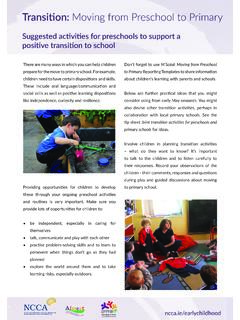
Transition: Moving from Preschool to Primary
ncca.iesome of the enjoyable activities they will be able to do in the yard when they start school. • a bus tour and simply ‘drive-by’ the local schools. This is a good idea if the children are moving on to a number of schools. • a virtual visit - use skype/facetime sessions with the school/s. The children in the infant class might show
Key Elements of Good Practice to Support the ... - NCCA
ncca.ieprovide resources to support early childhood educators in enhancing the learning and development of children from birth to three years old. The NSAI was established to support the co-ordinated roll out of Síolta (Centre for Early Childhood Development and Education [CECDE], 2006) and Aistear (National Council for Curriculum and Assessment, 2009).
Related documents

Appraisals and KDF made simple - a practical guide FINAL ...
www.nhsemployers.orgThe NHS Knowledge and Skills Framework (KSF) is designed to provide a consistent and comprehensive framework of NHS-wide knowledge and skills on which to base the development planning and review of all staff. Not all of it needs to be used. It can be used alongside other relevant frameworks, such as specific organisational values and behaviours.

Three Houses Booklet Updated - Partnering for Safety - Home
www.partneringforsafety.comto duplicate and share this booklet. For further information, please contact sonja.parker@iinet.net.au, ... framework, or strategy, and the strengths based practice principles provide a way to do this. Strengths based practice ... and might include behaviours both within people and from others that