Transcription of Resilient Modulus Buchanan - Vulcan Innovations
1 1 Resilient Modulus : WHAT, WHY, AND HOW? Shane Buchanan , Vulcan Materials Company, 08/31/07 Resilient Modulus (Mr) continues to be a key design parameter for pavement systems. Accurate knowledge of the Resilient Modulus of pavement layer materials allows determination of how the pavement system will respond to traffic loadings. While Resilient Modulus has been used by many for years, much of its use has been without accurately understanding many key items. Among these items are 1) what is Resilient Modulus ?, 2) how is it determined?, 3) what are typical values?, 4) what influences Resilient Modulus ?, and 5) how is it used in the design of pavement systems? This document will attempt to provide answers to these key questions.
2 WHAT IS Resilient Modulus ? Most pavement engineering or engineering mechanics textbooks will have a similar definition for Resilient Modulus . Generally, it is described as the ratio of applied deviator stress to recoverable or Resilient strain. This definition is correct, but what exactly does it mean in easy to understand terms? To gain a better, more practical understanding of stress and strain consider the following. Stress If a given load is applied to a material a contact stress will occur. This stress is equal to the load divided by the loading object s contact area. Stress essentially provides a method of normalizing load and area for testing and design purposes. For example, a 12 x 12 x 12 in. block weighing 200 lbs resting on a soil yields an average contact stress of 200 lbs / (12 x 12 in.)
3 = lbs/in2 or psi. As long as the block remains in full contact with the soil, stress will be equal, regardless of soil type. When a wheel load is applied to a pavement, locations under the load experience different levels of stress based on their depth from the surface and distance from the applied loading. Deviator stress is the axial or vertical stress at a point in the pavement system due to the applied load. Deformation and Strain While the stress remains constant, the observed magnitude of soil deformation as a result of loading will likely vary. This deformation may be significant ( , block resting on soft soil) or slight ( , block resting on stiff soil). In both cases, load has remained constant; however, it is the soil properties that influence deformation.
4 A portion of the deformation may be recoverable or Resilient while the remainder is unrecoverable or plastic . Deformation discussion leads to the critical design variable of strain. Strain is often described as the ratio of an object s deformation to its original dimension in the same direction. Strain can be calculated for any desired direction ( , vertical, horizontal, longitudinal, etc.) Consider the block discussed previously. If the block is placed on a 6 inch thick layer of soil and sinks inches, the total vertical strain in the soil would be ( in. / 6 in.) = or percent. If upon removing the block, the soil rebounds to a thickness of inches, the recoverable or Resilient strain would be ( in. in.) / 6 in. = or percent.
5 Non- 2 recoverable or plastic strain would be equal to (6 in. in.) / 6 in. = or percent. Figure 1 illustrates a typical specimen response during a loading and unloading cycle. Deviator Stress, 1- 3 Axial Strain ( )Total Strain ( t) Resilient Strain ( r)Plastic Strain ( p) t= r+ p Deviator Stress, 1- 3 Axial Strain ( )Total Strain ( t) Resilient Strain ( r)Plastic Strain ( p)Deviator Stress, 1- 3 Axial Strain ( )Total Strain ( t) Resilient Strain ( r)Plastic Strain ( p) t= r+ p Figure 1 Specimen Response During Axial Loading Confinement Pavement materials experience different levels of confinement stress, based upon their position with the pavement structure. Confinement is a result of the surrounding materials and the depth of the material within the pavement structure.
6 This is important because the ability of a granular material to resist loading is, in part, a function of confining stress magnitude. Stiffness, not Strength One important item to remember is that Resilient Modulus is a stiffness measurement, not the strength, of a material. Ultimate shear strength for granular material is typically determined using a triaxial shear procedure. Resilient Modulus can be determined at many combinations of applied loading and confinement. Ultimate strength or stress is the point where failure occurs under loading. A good example of the difference between stiffness and strength can be seen with concrete. Up to a given failure stress, a concrete can withstand stress with very slight deformation.
7 However, at some stress, the concrete fails or breaks and the ultimate strength is determined. Resilient Modulus is used to characterize pavement materials under loading conditions that will not result in failure of the pavement system. Pavements are designed to withstand various magnitudes of design axle (single, tandem, tridem, and quadem) load applications. By varying layer thicknesses and stiffness, the pavement system can be designed to carry the design axle load applications during its service life. 3 HOW IS Resilient Modulus MEASURED? Determination of Resilient Modulus is generally accomplished through laboratory testing . One commonly used procedure for laboratory testing of soil and aggregate materials is AASHTO T307, Determining the Resilient Modulus of Soil and Aggregate Materials (1).
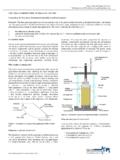
8 During testing , an axial stress is applied for second followed by a second rest period. Load and rest period together constitutes 1 loading cycle. Note: The T307 procedure requires aggregate particles greater than 25 percent of the mold diameter (generally 6 inches) be scalped prior to testing . Scalping of oversize aggregate may influence the obtained test results. One important test procedure aspect is the testing sequences specified for subgrade and subbase/base materials. Different testing sequences, with varying applied and confinement stress, are specified for subgrade and subbase/base materials because the varying stress states experienced under field wheel loading. An illustration of the Resilient Modulus stress states is provided in Figure 2.
9 Granular material is generally referred to as stress hardening material, which means under increased applied stress the material exhibits less deformation and therefore a greater stiffness or Resilient Modulus . Fine-grained or subgrade soils are referred to as stress softening , meaning that with increased stress, deformation increases and stiffness or Modulus decreases. Figure 2 Resilient Modulus Stress States Prior to actual Resilient Modulus testing sequence, prepared specimens are conditioned as shown for Sequence 0 in Table 1. Per T307 this conditioning step is for elimination of the effects of the interval between compaction and loading and the elimination of initial loading versus 3= All Around Confinement Pressure 3 3 1 - 3= Deviator Stress 1 = Total Axial Stress 3= All Around Confinement Pressure 3 3 1 - 3= Deviator Stress 1 = Total Axial Stress 4 reloading.
10 Additionally, this loading serves to minimize the impact of improper contact between the specimen ends and the sample cap and base plate. After conditioning, specified testing sequences from T307 for subgrade and subbase/base materials are shown in Table 1. Subgrade soils are tested at three decreasing levels of confinement (6, 4, and 2 psi) at 5 increasing levels of axial stress (2, 4, 6, 8, and 10 psi) within each confinement stress level. Granular materials are tested at five levels of confinement (3, 5, 10, 15, and 20 psi) with varying levels of axial stress for each confinement level as shown in Table 1. Bulk stress is calculated for each test sequence and represents total specimen stress state.