Example: tourism industry
Restricted invasive plant Lantana
Larvae feed in leaves causing blotches to spread across the leaf. This beetle reduces plant vigour and can suppress flowering. • leaf-mining beetle (Octotoma scabripennis) Found in most lantana infestations from Atherton to Wollongong. Adults of this species feed on the upper leaf surface, while larvae feed and mine the centre
Tags:
Information
Domain:
Source:
Link to this page:
Documents from same domain
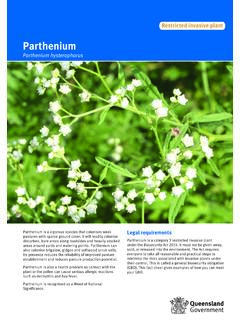
Parthenium
www.daf.qld.gov.aualbocinereus (stem-galling weevil from Argentina) produces small galls and is still becoming established in Queensland. Bucculatrix parthenica (leaf mining moth from Mexico) larvae feed on leaves, leaving clear windows in the leaf. Carmentia ithacae is a stem boring moth from Mexico which is becoming established at favourable sites in the
Annual Report 2016 – 17: Department of …
www.daf.qld.gov.auDepartment of Agriculture and Fisheries GPO Box 46 Brisbane Qld 4001 Australia Interpreter statement
Accepted development requirements for operational work ...
www.daf.qld.gov.auplant or operational work completely or partly within in a declared fish habitat area or a material change of use for aquaculture, see the accepted development requirements in the following documents: Accepted development requirements for operational work that is the removal, destruction or damage of marine plants
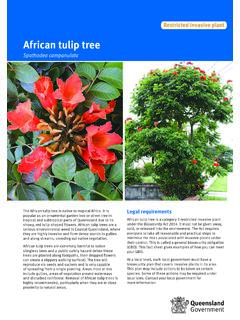
African tulip tree
www.daf.qld.gov.auTriclopyr 200 g/L + Picloram 100 g/L (e.g. Slasher) 50 mL per 1 L water : Cut stumps to less than 10 cm above the ground and immediately: • paint stump after cutting • spot spray cut stump Follow-up treatment needed on suckers : Triclopyr 240 g/L + Picloram 120 g/L (e.g. Access) 1 L per 60 L diesel ; Either paint stump immediately after cutting
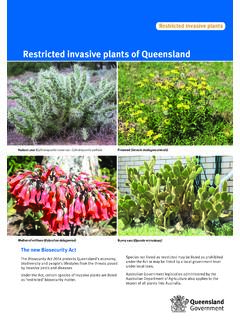
Restricted invasive plants of Queensland
www.daf.qld.gov.au• salvinia (Salvinia molesta) • Senegal tea (Gymnocoronis spilanthoides) • Siam weed (Chromolaena odorata and Chromolaena squalida) • Sicklepods: – foetid cassia (Senna tora) – hairy cassia (Senna hirsuta) – sicklepod (Senna obtusifolia) • Silver …
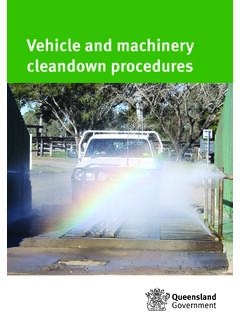
Vehicle and machinery cleandown procedures
www.daf.qld.gov.auknowledge (e.g. landholders, local and state government officers). 1.6 Tips for reducing the risk of spread • Avoid driving off-road in areas known to contain declared plants (e.g. giant rat’s-tail grass, parthenium weed) or in other areas that present a risk of vehicle or machinery contamination. • Do not drive through infested paddocks.
Queensland biosecurity manual - Department of Agriculture ...
www.daf.qld.gov.auBiosecurity is important to Queensland, as pests and diseases can have a long-term impact on our community, primary industries and unique biodiversity. The Queensland Biosecurity Act 2014 (the Act) and the Biosecurity Regulation 2016 (the Regulation) aim to protect Queensland from biosecurity threats that could adversely impact the State.
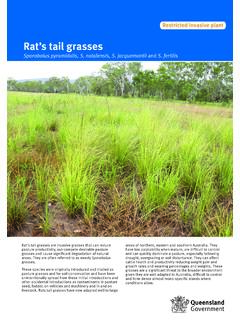
Rat's tail grasses
www.daf.qld.gov.auYork (Queensland) to the Central Coast of New South Wales including the Central Highlands of Queensland. American rat’s tail grass American rat’s tail grass grows to 50−75 cm tall, with a seed head of up to 25 cm long and 0.5−3 cm wide. Distribution: Coastal and sub-coastal areas from Cape York to South East Queensland. Giant Parramatta ...
The prickly pear story - Department of Agriculture and ...
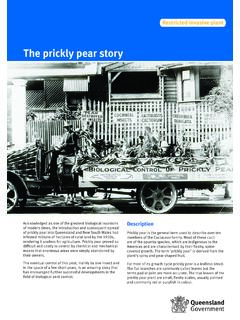
www.daf.qld.gov.auin the correct method of release. A fleet of seven trucks and 100 men distributed packed eggs across the state. This insect proved to be spectacularly successful in destroying the weed. By 1932, the stem-boring cactoblastis larvae had caused the general collapse and destruction of most of the original, thick stands of prickly pear.
Wandering jew or trad - Department of Agriculture and ...
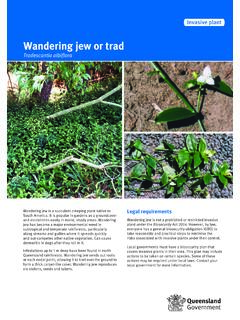
www.daf.qld.gov.auWandering jew is a ground cover succulent. Stems are soft and easily broken. The fleshy stems root at any node that is on the surface. Leaves are oval dark green, and shiny 5–10 mm long, leaf blades 3–6.5 cm long, 1–3 cm wide, with parallel veins covered with small hairs. Flowers are small white and three-petalled flowers with yellow tipped
Related documents

Insect Identification Guide - Orkin
cdn.orkin.comDIET: Do not eat wood; feed on a variety of both plant and animal food; prefer sweets and meats; also feed on other insects. REPRODUCTION: Queen lays 15 to 20 eggs the first year, and up to 30 eggs the second year; eggs complete their life cycle in about 60
INDUSTRIAL WELFARE COMMISSION ORDER NO. 14-2001 …
www.dir.ca.gov(6) The raising, feeding and management of livestock, fur bearing animals, poultry, fish, mollusks, and insects, including but not limited to herding, housing, hatching, milking, shearing, handling eggs, and extracting honey; (7) The harvesting of fish, as defined by Section 45 of the Fish and Game Code, for commercial sale;
ALLERGY ORDER FORM
f.hubspotusercontent10.netCOMPREHENSIVE FOOD PANEL (small animal only) 24 Most common commercial pet food ingredients SPOT PLATINUM+ TEST ONLY Includes weeds, trees, grasses, epidermals, foods, mites, molds, staph, insects, Malassezia, indoor (or barn) allergens BEST VALUE TEST & TREAT PACKAGE SubQ Injections Sublingual Drops Wait for Results

Lumpy Skin Disease (LSD) field manual
www.fao.orgFAO ANIMAL PRODUCTION AND HEALTH Lumpy skin disease (LSD) is a viral disease of cattle. Characterized by nodules on the skin, it is mostly transmitted by mosquitoes, by other hematophagous insects, and flies. The disease has dramatic effects …