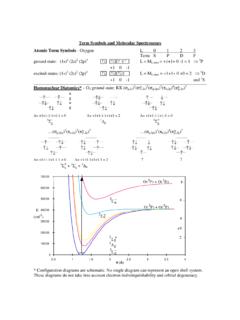
Transcription of Review Sheet on Determining Term Symbols
1 Review Sheet on Determining Term SymbolsTerm Symbols for electronic configurations are useful not only to thespectroscopist but also to the inorganic chemist interested in understanding electronic andmagnetic properties of molecules. We will concentrate on the method of Douglas andMcDaniel (p. 26ff); however, you may find other treatments equal or superior to the D &M Symbols are a shorthand method used to describe the energy, angularmomentum, and spin multiplicity of an atom in any particular state. The general form isgiven as aTj where T is a capital letter corresponding to the value of L (the angularmomentum quantum number) and may be assigned as S, P, D, F, G, .. for |L| = 0, 1, 2, 3,4.
2 Respectively. The superscript a is called the spin multiplicity and can beevaluated as a = 2S +1 where S is the spin quantum number. The subscript j is thenumerical value of J, a new quantum number defined as: J = l +S, which corresponds tothe total orbital and spin angular momentum of the system. The term symbol 3P is readas triplet Pee state and indicates that there are two unpaired electrons in a state withmaximum orbital angular momentum, L= number of microstates (N) of a system corresponds to the total number ofdistinct arrangements for e number of electrons to be placed in n number of possibleorbital = # of microstates = n!/(e!(n-e)!)For a set of p orbitals n = 6 since there are 2 positions in each orbital.
3 Therefore, p2 (e =2 and n = 6) so,N = 6!/(2!(6-2)!) = (6*5*4*3*2*1)/((2*1) * (4*3*2*1)) = 15We can introduce the idea of a hole formalism which states that for manyelectronic properties one may consider systems with e or (n-e), the number of unoccupiedsites or holes , to be equivalent. Thus,P4 (e = 4 and n = 6)N = 6!/(4!(6-4)!) = 15so P4 (2 holes) and P2 (4 holes) give equivalent values of N. The same is true for all p, d,f, .. systems such as d1/d9 or f2 one should consider an atom with multiple unoccupied orbitals, the totalnumber of microstates will equal the product of the microstates for the individual orbitals.(N = N*a; a = 1 to i where a = orbital index). For an s1p2 configuration N = 2 (from S1)* 15 (from p2) = can define component ML in two ways.
4 First,ML = m1 + m2 + m3 + ..where ml corresponds to the l angular momentum quantum number for each electronin a given orientation. Second,ML = L, L-1, .., 0, .., -Lwhere L is the atomic orbital angular momentum. Thus, ML has 2L + 1 definitions for MS, representing the spin of the system may be made withallowable values of MS = 2S+1 The total angular momentum quantum number, J, is given as J = L+S, L+S 1,.., |L-S|. It is the absolute magnitude of J that determines the total angular of Spectroscopic Terms1. Determine total number of microstates2. Determine the possible values of ML and MS3. Determine the Pauli allowed microstates4. Set up a chart of microstates5. Resolve this group of microstates into atomic statesThe following steps will be illustrated for a d2 1 (Number of Microstates)N = n!
5 /(e!(n-e)! = 10!/(2!*8!) = 45 STEP 2 (Values of ML and MS)For a d orbital, ml may range from +2 through 2 so there are 5 acceptable mlvalues. The maximum value of ML for 2 electrons is when m1 = +2 and when m2 = +2 orML = 4 (this can only occur if MS = 0. Therefore, ML will range +4, +3, .., allowed values for MS are 1, 0, -1 since two electrons may be spin aligned(up or down) or 3 The Pauli allowed microstates can be drawn as shown on the followingpages. Remember that certain combinations of quantum numbers are not allowed ( ,ML = -4 and MS = +1 since this would require two parallel spins in the same orbital).ms=+1/2ms=-1/2 MLMSml=+2+10-1-2 Msml=+2+10-1-23+1 -1 2+1 -1 1+1 -1 0+1 -1 1+1 -1 0+1 -1 -1+1 -1 -1+1 -1 -2+1 -1 -3+1 -1 By symmetry an equivalent pattern must be observed for ms = -1/2 and MS = microstates for MS = +110 microstates for MS = -1ms=+1/2ms=-1/2 MLMSml=+2+10-1-2ml=+2+10-1-240 30 20 10 00 30 20 10 00 -10 20 10 00 -10 -20 10 00 -10 -20 -30 00 -10 -20 -30 -40 These are the 25 microstates for MS = 0 Therefore, 10 (MS = +1) + 10 (MS = -1) + 25 (MS = 0) = 45 microstates as required by Step 1 STEP 4.))
6 Chart MicrostatesOn left column put range of ML valuesOn bottom row put range of MS valuesThen enter the total number of microstates that have equivalent ML and MS valuesTable 1.+41+3121+2131+1242ML0252-1242-2131-312 1-41+10-1 MSThe sum of the values in this chart must total 45, the total number of 5. Resolve MicrostatesWe can immediately see that there is a microstate which must correspond to ML =-4 and MS = 0. This must be a G state since L = 4 and it must be an orbital singlet sinceMS = 0. Therefore, the first term is 1G (We will assign J values later.). A 1 Grepresentation corresponds to a 9 x 1 matrix (ML x MS) since L can range from +4through 4 (9 elements) and S can only equal 0 (1 element).
7 Removing 9 microstatesfrom Table 1 yields Table 2.+3111+2121+1232ML0242-1232-2121-3111+1 0-1 MSElements Removed: 1G (9 microstates)(Notice that the elements removed for 1G came from the MS = 0 column, with one fromeach ML row as required.)Now go to the upper left corner (italicized and red) element. The ML and MS value forthis element yield the next microstate representation. ML=3 therefore F, MS =1 thereforetriplet, so the element is is a 7 x 3 matrix = 21 microstates that are removed to give Table 3.+21+1121ML0131-1121-21+10-1 MSElements Removed: 1G, 3F (30 microstates)Now got to the single element in row +2 (red) which gives 1D (ML = 2, MS = 0).This is a 5 x 1 matrix yielding Table 4.
8 +1111ML0121-1111+10-1 MSElements Removed: 1G, 3F, 1D (35 microstates)Upper left gives ML = 1, MS = 1 or a 3P which is a 3 x 3 matrix. This leaves table Removed: 1G, 3F, 1D, 3P (44 microstates)This table must correspond to 1S so the d2 configuration gives:1G, 3F, 1D, 3P, 1S (45 microstates)Assigning J ValuesJ = L + S: number of microstates = 2J + 1 For 1G ! 1G4 (L = 4, S = 0)9 microstates1S ! 1S0(L = 0, S = 0)1 microstate1D ! 1D2(L = 2, S = 0)5 microstates3F ! 3F4(L = 3, S = 1)9 microstates3P ! 3P2(L = 1, S = 1)5 microstatesNotice that the total number of microstates does not equal 45 at this point! All of themicrostates associated with 1G, 1S, and 1D are accounted for, while 12 3F microstates and4 3P microstates are missing.
9 This is because we have only calculated the state ofmaximum multiplicity! Both the 3F and 3P states can be factored. We do this by loweringthe J value by one until all microstates have been accounted for. Thus,3F4 (9 microstates)3F3 (7 microstates)21 microstates3F2 (5 microstates)3P2 (5 microstates)3P1 (3 microstates)9 microstates3P0 (1 microstate)We now have accounted for all 45 microstates:1G4, 1S0, 1D2, 3F4, 3F3, 3F2, 3P2, 3P1, 3P0We must now arrange these in a predicted orbital energy for Assigning Energies (Hund s Rules)1. Ground state will have the largest spin multiplicity 3P is lower in energy than1P2. Two states with the same spin multiplicity can be distinguished by L values.
10 Thestate with the largest L is of lowest energy, 1D < 1S3. After checking 1 and 2 above: If the subshell is less than 1/2 full, the lowest Jcorresponds to the lowest energy. If the subshell is greater than 1/2 full, thehighest J corresponds to the lowest ground state is ! The energy difference between levels can be less than or equal to thesplitting of states . Therefore, the only configuration we are certain of is the ground actual order is give at the far Information:1. It usually is not productive to associative a particular electron configuration with aspecific term symbol since there can be considerable Orbitals with L = odd number have odd parity (ungerade). Orbitals with L = evennumber have even parity (gerade).