Transcription of Right to Know Hazardous Substance Fact Sheet
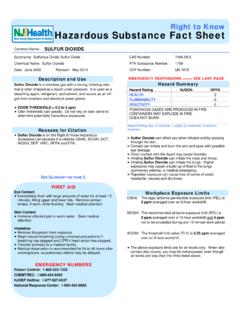
1 Right to know Hazardous Substance fact Sheet Common Name: HYDROGEN CYANIDE Synonyms: Formonitrile; Prussic Acid Chemical Name: Hydrocyanic Acid Date: June 1998 Revision: January 2011 CAS Number: 74-90-8 RTK Substance Number: 1013 DOT Number: UN 1051 (Anhydrous; Stabilized) Description and Use Hydrogen Cyanide is a colorless to pale blue liquid below 78oF (26oC) and a colorless gas at higher temperatures. It has a distinct bitter almond or stinky sneaker odor. Hydrogen Cyanide is used to kill insects and rodents, in making other chemicals, synthetic fibers, plastics and dyes, and as a chemical warfare agent.
2 F ODOR THRESHOLD = 2 to 10 ppm f Odor thresholds vary greatly. Do not rely on odor alone to determine potentially Hazardous exposures. Reasons for Citation f Hydrogen Cyanide is on the Right to know Hazardous Substance List because it is cited by OSHA, ACGIH, DOT, NIOSH, DEP, IRIS, NFPA and EPA. f This chemical is on the Special Health Hazard Substance List. SEE GLOSSARY ON PAGE 5. FIRST AID Eye Contact f Immediately flush with large amounts of water for at least 15 minutes, lifting upper and lower lids. Remove contact lenses, if worn, while rinsing. Skin Contact f Quickly remove contaminated clothing.
3 Immediately wash contaminated skin with large amounts of soap and water. Seek medical attention. Inhalation f Remove the person from exposure. f Begin rescue breathing (using universal precautions) if breathing has stopped and CPR if heart action has stopped. f Transfer promptly to a medical facility. Antidotes and Special Procedures f Use Amyl Nitrite capsules if symptoms develop. All area employees should be trained regularly in emergency treatment of Cyanide poisoning and in CPR. A Cyanide antidote kit MUST be rapidly available and ingredients replaced every 1 to 2 years to ensure freshness.
4 EMERGENCY NUMBERS Poison Control: 1-800-222-1222 CHEMTREC: 1-800-424-9300 NJDEP Hotline: 1-877-927-6337 National Response Center: 1-800-424-8802 EMERGENCY RESPONDERS >>>> SEE LAST PAGE Hazard Summary Hazard Rating NJDOH NFPA HEALTH - 4 FLAMMABILITY - 4 REACTIVITY - 1 FLAMMABLE POISONOUS GASES ARE PRODUCED IN FIRE CONTAINERS MAY EXPLODE IN FIRE Hazard Rating Key: 0=minimal; 1=slight; 2=moderate; 3=serious; 4=severe f Hydrogen Cyanide can affect you when inhaled and by passing through the skin.
5 F Contact can irritate and burn the skin and eyes. f Inhaling Hydrogen Cyanide can irritate the nose and throat. f High exposure can cause Cyanide poisoning. Symptoms include headache, weakness, confusion, and pounding of the heart. This can rapidly lead to convulsions and death. f Hydrogen Cyanide may affect the nervous system. f Repeated exposure may interfere with thyroid function and enlarge the thyroid gland (goiter), and cause nosebleeds. f Hydrogen Cyanide is a FLAMMABLE LIQUID and GAS and a DANGEROUS FIRE HAZARD. f Anhydrous and Unstabilized Hydrogen Cyanide are severe explosion hazards and can polymerize violently, resulting in fires and explosions.
6 Workplace Exposure Limits OSHA: The legal airborne permissible exposure limit (PEL) is 10 ppm averaged over an 8-hour workshift. NIOSH: The recommended airborne exposure limit (REL) is ppm, which should not be exceeded at any time. ACGIH: The threshold limit value (TLV) is ppm, which should not be exceeded at any time. f The above exposure limits are for air levels only. When skin contact also occurs, you may be overexposed, even though air levels are less than the limits listed above. HYDROGEN CYANIDE Page 2 of 6 Determining Your Exposure f Read the product manufacturer s Material Safety Data Sheet (MSDS) and the label to determine product ingredients and important safety and health information about the product mixture.
7 F For each individual Hazardous ingredient, read the New Jersey Department of Health Hazardous Substance fact Sheet , available on the RTK website ( ) or in your facility s RTK Central File or Hazard Communication Standard file. f You have a Right to this information under the New Jersey Worker and Community Right to know Act and the Public Employees Occupational Safety and Health (PEOSH) Act if you are a public worker in New Jersey, and under the federal Occupational Safety and Health Act (OSHA) if you are a private worker. f The New Jersey Right to know Act requires most employers to label chemicals in the workplace and requires public employers to provide their employees with information concerning chemical hazards and controls.
8 The federal OSHA Hazard Communication Standard (29 CFR ) and the PEOSH Hazard Communication Standard ( 12:100-7) require employers to provide similar information and training to their employees. This fact Sheet is a summary of available information regarding the health hazards that may result from exposure. Duration of exposure, concentration of the Substance and other factors will affect your susceptibility to any of the potential effects described below. Health Hazard Information Acute Health Effects The following acute (short-term) health effects may occur immediately or shortly after exposure to Hydrogen Cyanide: f Contact can irritate and burn the skin and eyes with skin rash and itching.
9 F Inhaling Hydrogen Cyanide can irritate the nose and throat causing coughing and wheezing. f High exposure can cause Cyanide poisoning. Symptoms include flushing of the face, chest tightness, headache, nausea and vomiting, weakness, confusion, pounding of the heart, and trouble breathing. This can rapidly lead to convulsions and death. Chronic Health Effects The following chronic (long-term) health effects can occur at some time after exposure to Hydrogen Cyanide and can last for months or years: Cancer Hazard f According to the information presently available to the New Jersey Department of Health, Hydrogen Cyanide has not been tested for its ability to cause cancer in animals.
10 Reproductive Hazard f According to the information presently available to the New Jersey Department of Health, Hydrogen Cyanide has not been tested for its ability to affect reproduction. Other Effects f Hydrogen Cyanide may affect the nervous system. f Repeated exposure may interfere with thyroid function and enlarge the thyroid gland (goiter), and cause nosebleeds. Medical Medical Testing For frequent or potentially high exposure (half the TLV or greater), the following is recommended before beginning work and at regular times after that: f Urine thiocyanate test (most accurate if done soon after exposure).