Transcription of Rubber Splicing Tape 23
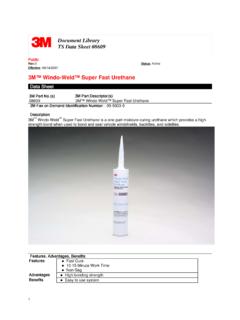
1 1 of 5 3M Scotch Rubber Splicing tape 23 Data Sheet February 2017 Description Scotch Rubber Splicing tape 23 is a highly conformable, self-fusing EPR (Ethylene Propylene Rubber ) based, high-voltage Splicing tape . It is a non-vulcanizing, shelf-stable tape with excellent electrical properties. Scotch 23 tape can be used as an insulation for low-voltage applications as well as an insulation for splices up to 69,000 volts. Agency Approvals & Self Certifications For RoHS information, please visit tape Features Can be used to splice and terminate cables whose emergency overload temperatures can reach 266 F (130 C) Based on Ethylene Propylene Rubber (EPR) Physical and electrical properties are unaffected by the degree of stretch Self-fusing tape Excellent electrical properties A special polyester liner which will not stick to the tape upon unwind Compatible with all solid dielectric cable Insulation: 1.
2 Polyethylene (high and low density) 2. Cross-linked Polyethylene (XLP) 3. Polyvinyl Chloride (PVC) 4. Butyl Rubber 5. Ethylene Propylene Rubber (EPR) 6. Oil-based Rubber Applications Primary electrical insulation for Splicing cable from 600 volts through 69,000 volts on all solid dielectric cables Primary insulation for building stress cones on cables up to 35,000 volts on all solid dielectric cables Jacketing on high-voltage splices and terminations Moisture sealing electrical connections Bus bar insulations End sealing high-voltage cables Scotch Rubber Splicing tape 23 2 of 5 Typical Properties Not for specifications.
3 Values are typical, not to be considered minimum or maximum. Properties measured at room temperature 73 F (23 C) unless otherwise stated. Physical Property (Test Method ASTM D-4325*) Typical Value US units (metric) Color Black Thickness* 30 mils ( mm) Tensile Strength* 8 lbs/in (1,4 KN/m) Ultimate Elongation* 1000% Operating Temperature 194 F (90 C) Emergency Operating Temperature 266 F (130 C) Fusion (ASTM D-4388) Passes Thermal Conductivity (ASTM D-1518) .1208 Btu (hr)(sq ft) Modulus @ 266 F (130 C) See Characteristics & Test Data Ozone Resistance (ASTM D-4388) Passes Electrical Property (Test Method ASTM D-4325*) Typical Value US units (metric) Dielectric Strength* After Standard Conditioning After 96 hrs @ 96% RH 800 V/mil (31,5 Mv/m) >90% of Std Condition Value Insulation Resistance (ASTM D-1000) (Indirect Method of Electrolytic Corrosion)
4 >1 x 10⁶ megohms Dissipation Factor See Characteristics & Test Data Dielectric Constant See Characteristics & Test Data Dielectric Strength at Elevated Temperature See Characteristics & Test Data Product Specifications The high-voltage corona-resistant tape is based on Ethylene Propylene Rubber and is capable of operation at the emergency cable temperature of 266 F (130 C). Scotch Rubber Splicing 23 tape may be applied in either the stretched or unstretched condition without resulting in loss in either physical or electrical properties. The tape is split resistant, crack resistant, slip resistant and flag resistant when exposed to various environments (indoor or outdoor).
5 It is compatible with synthetic cable insulations. Scotch 23 tape has a dissipation factor of less than 5% at 266 F (130 C), and a shelf life of 5 years. Scotch Rubber Splicing tape 23 3 of 5 Engineering/ Architectural Specifications Splicing and terminating solid dielectric cables shall be done in accordance with drawings engineered by the splice material manufacturer such as the 2047 Series available from 3M Company. Splices and terminations may be insulated using Scotch Rubber Splicing tape 23. Characteristics and Test Data Modulus at 266 F (130 C): A high-voltage tape that constantly maintains a Rubber -like consistency throughout the life of a splice.
6 One method of determining a Rubber material consistency is by measuring the modulus of the material. The modulus of a material is the stress required to elongate the material to a given elongation. Figure 1 shows the 100% modulus (stress required to elongate Scotch 23 tape to 100% elongation) after heat aging the samples at 266 F (130 C) for a varying number of days. The results indicate a very stable product with excellent body or elasticity after oven aging at 266 F (130 C). Dissipation Factor: Figure 2 shows the dissipation of Scotch 23 tape . This test was run according to ASTM D-150 at a stress of 50 V/mil (2,0 MV/m) and a frequency of 60 cycles per second.
7 Scotch Rubber Splicing tape 23 4 of 5 Characteristics and Test Data, continued Dielectric Constant: Figure 3 shows the dielectric constant versus temperature of Scotch Rubber Splicing tape 23. This test was run according to ASTM D-150 at a stress of 50 V/mil (2,0 MV/m) and a frequency of 60 cycles per second. Dissipation Strength at Elevated Temperatures: A high-voltage splice has a high dielectric strength at room temperature, but also good values at the temperature at which it is expected to operate. Figure 4 shows a plot of dielectric strength versus temperature. This test was run according to ASTM D-1000.
8 Dielectric Strength Versus Thickness: Figure 5 shows a plot of dielectric strength in volts per mil versus thickness. As can be seen by the curve, the dielectric strength in the original thickness of .030 (,76 mm) is 800 V/mil (31,5 MV/m). However, the dielectric strength of a .020 (,51 mm) thickness of Scotch 23 tape is 1200 V/mil (47,2 MV/m). This test was run according to ASTM D-1000. Scotch Rubber Splicing tape 23 5 of 5 3M and Scotch are trademarks of 3M Company. Installation Techniques Scotch Rubber Splicing tape 23 should be applied in successive half-lapped, level-wound layers until desired buildup is reached.
9 To eliminate voids in critical areas, highly elongate the tape . Stretch tape in these critical areas just short of its breaking point. Doing so will not alter its physical or electrical properties. In less critical areas, less elongation may be used. Normally, the tape is stretched to of its original width in these less critical areas. Always attempt to half-lap to produce a uniform buildup. When using Scotch 23 tape for Splicing cables from 35 kV to 69 kV, always elongate the tape throughout the entire splice. Techniques for the proper use of this tape are contained in standard and special prints available through the 3M systems for Splicing and terminating program.
10 These are available through the local 3M Electrical Markets Division representative. Availability Please contact your local distributor; available from [Where to Buy] or call 1-800-245-3573. Shelf Life & Storage This product has a 5-year shelf life from date of manufacture when stored in a humidity controlled storage (10 C/50 F to 27 C/80 F and <75% relative humidity). The tape is not impaired by freezing or by overheated storage up to the point of flow, which prevents removal from the package. Important Notice All statements, technical information, and recommendations related to 3M s products are based on information believed to be reliable, but the accuracy or completeness is not guaranteed.