Transcription of RULES OF ENGAGEMENT REFERENCE
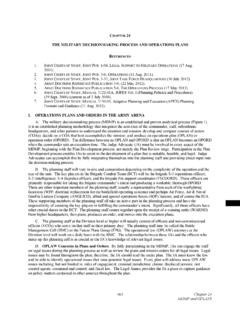
1 CHAPTER 5 RULES OF ENGAGEMENT REFERENCE 1. CHAIRMAN OF THE JOINT CHIEFS OF STAFF INSTR. , STANDING RULES OF ENGAGEMENT (SROE)/STANDING RULES FOR THE USE OF FORCE (SRUF) FOR FORCES (13 June 2005). ** NOTE: The current SROE is under revision - JAs should obtain the latest version. ** I. INTRODUCTION A. RULES of ENGAGEMENT (ROE) are the commanders tools for regulating the use of force, making them a cornerstone of the Operational Law discipline.
2 The legal sources that provide the foundation for ROE are complex and include customary and treaty law principles from the laws of war. As a result, Judge Advocates (JA) participate significantly in the preparation, dissemination, and training of ROE; however, international law is not the sole basis for ROE. Political objectives and military mission limitations are necessary to the construction and application of ROE. Therefore, despite the important role of the JA, commanders bear ultimate responsibility for the ROE B. To ensure that ROE are versatile, understandable, easily executable, and legally and tactically sound, JAs and operators alike must understand the full breadth of policy, legal, and mission concerns that shape the ROE, and collaborate closely in their development, implementation, and training.
3 JAs must become familiar with mission and operational concepts, force and weapons systems capabilities and constraints, War-fighting Functions (WF), and the Military Decision Making Process (MDMP) and Joint Operations Planning and Execution System (JOPES). Operators must familiarize themselves with the international and domestic legal limitations on the use of force and the laws of armed conflict. Above all, JAs and operators must talk the same language to provide effective ROE to the fighting forces. C. This chapter provides an overview of basic ROE concepts.
4 In addition, it surveys Chairman of the Joint Chiefs of Staff Instruction (CJCSI) , Standing RULES of ENGAGEMENT /Standing RULES for the Use of Force for Forces, and reviews the JA s role in the ROE process. Finally, this chapter provides unclassified extracts from both the Standing RULES of ENGAGEMENT (SROE) and other operations in order to highlight critical issues and demonstrate effective implementation of ROE. NOTE: This chapter is NOT a substitute for the SROE. The SROE are classified SECRET, and as such, important concepts within it may not be reproduced in this handbook.
5 Operational law attorneys must ensure they have ready access to the complete SROE and study it thoroughly to understand the key concepts and provisions. JAs play an important role in the ROE process because of our expertise in the laws of war, but one cannot gain ROE knowledge without a solid understanding of the actual SROE. II. OVERVIEW A. Definition of ROE. Joint Pub 1-02, Dictionary of Military and Associated Terms: ROE are directives issued by competent military authority that delineate the circumstances and limitations under which [naval, ground, and air] forces will initiate and/or continue combat ENGAGEMENT with other forces encountered.
6 B. Purposes of ROE. As a practical matter, ROE serve three purposes: (1) provide guidance from the President and Secretary of Defense (SECDEF), as well as subordinate commanders, to deployed units on the use of force; (2) act as a control mechanism for the transition from peacetime to combat operations (war); and (3) provide a mechanism to facilitate planning. ROE provide a framework that encompasses national policy goals, mission requirements, and the law. 1. Political Purposes. ROE ensure that national policies and objectives are reflected in the actions of commanders in the field, particularly under circumstances in which communication with higher authority may not be possible.
7 For example, in reflecting national political and diplomatic purposes, ROE may restrict the ENGAGEMENT of certain targets, or the use of particular weapons systems, out of a desire to tilt world opinion in a particular direction, place a positive limit on the escalation of hostilities, or avoid antagonizing the enemy. Falling within the array of political concerns are issues such as the influence of international public opinion (particularly how it is 81 Chapter 5 RULES of ENGAGEMENT affected by media coverage of a specific operation), the effect of host country law, and the content of status of forces agreements (SOFA)
8 With the United States. 2. Military Purposes. ROE provide parameters within which the commander must operate to accomplish his or her assigned mission: a. ROE provide a limit on operations and ensure that actions do not trigger undesired escalation, , forcing a potential opponent into a self-defense response. b. ROE may regulate a commander s capability to influence a military action by granting or withholding the authority to use particular weapons systems or tactics . c. ROE may also reemphasize the scope of a mission. Units deployed overseas for training exercises may be limited to use of force only in self-defense, reinforcing the training rather than combat nature of the mission.
9 3. Legal Purposes. ROE provide restraints on a commander s actions, consistent with both domestic and international laws, and may, under certain circumstances, impose greater restrictions than those required by the law. For many missions, particularly peace operations, the mission is stated in a document such as a UN Security Council Resolution (UNSCR), , UNSCR 940 in Haiti, UNSCR 1031 in Bosnia, or UNSCR 1973 in Libya. These Security Council Resolutions also detail the scope of force authorized to accomplish the purpose stated therein. Mission limits or constraints may also be contained in mission warning or execute orders.
10 Accordingly, commanders must be intimately familiar with the legal basis for their mission. Commanders may also issue ROE to reinforce certain principles of the Law of Armed Conflict (LOAC), such as prohibitions on the destruction of religious or cultural property or minimization of injury to civilians and civilian property. III. CJCS STANDING RULES OF ENGAGEMENT A. Overview. The current SROE went into effect on 13 June 2005, the result of a review and revision of the previous 2000 and 1994 editions. They provide implementation guidance on the inherent right of self-defense and the application of force for mission accomplishment.