Transcription of Safe-t-brake - Kleen-Flo
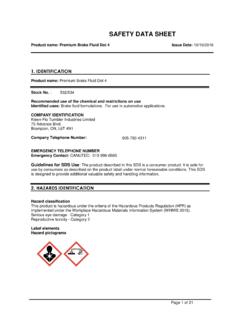
1 Safe-t-brake Safety Data Sheet according to the Hazardous Products Regulation (February 11, 2015) Date of issue: 01/04/2017 Revision date: 01/04/2017 Version: 01/04/2017 EN (English) Page 1 SECTION 1: Identification Product identifier Product form : Mixtures Product name : Safe-t-brake Product code : 509/510/511/513 Recommended use and restrictions on use Recommended use : Air brake antifreeze Supplier Manufacturer Kleen-Flo Tumbler ind. Ltd. 75 Advance Boulevard L6T 4N1 Brampton - CANADA T 905-793-4311 Emergency telephone number Emergency number : CANUTEC (613) 996-6666 SECTION 2: Hazards identification Classification of the substance or mixture Classification (GHS-CA) Flammable liquids, Category 2 H225 Acute toxicity (oral), Category 3 H301 Acute toxicity (dermal), Category 3 H311 Acute toxicity (inhalation.)
2 Vapour) Category 3 H331 Serious eye damage/eye irritation, Category 2 H319 Carcinogenicity, Category 2 H351 Reproductive toxicity, Category 1B H360 Specific target organ/systemic toxicity (single exposure) Category 2 H371 Specific target organ/systemic toxicity (single exposure) Category 3 H336 GHS Label elements, including precautionary statements GHS-CA labelling Hazard pictograms (GHS-CA) : GHS02 GHS06 GHS07 GHS08 Signal word (GHS-CA) : Danger Hazard statements (GHS-CA) : H225 - Highly flammable liquid and vapour H301+H311+H331 - Toxic if swallowed, in contact with skin or if inhaled H319 - Causes serious eye irritation H336 - May cause drowsiness or dizziness H351 - Suspected of causing cancer H360 - May damage fertility or the unborn child H371 - May cause damage to organs Precautionary statements (GHS-CA) : P201 - Obtain special instructions before use P202 - Do not handle until all safety precautions have been read and understood.
3 P210 - Keep away from heat, hot surfaces, sparks, open flames and other ignition sources. No smoking P233 - Keep container tightly closed P240 - Ground/bond container and receiving equipment P241 - Use explosion-proof electrical/ventilating/lighting equipment P242 - Use only non-sparking tools P243 - Take action to prevent static discharges P260 - Do not breathe dust/fume/gas/mist/vapours/spray P264 - Wash hands, forearms and face thoroughly after handling P270 - Do not eat, drink or smoke when using this product P271 - Use only outdoors or in a well-ventilated area P280 - Wear protective gloves/protective clothing/eye protection/face protection P301+P310 - IF SWALLOWED.
4 Immediately call a POISON CENTER or doctor P330 - Rinse mouth P303+P361+P353 - IF ON SKIN (or hair): Take off immediately all contaminated clothing. Rinse skin with water P361+P364 - Take off immediately all contaminated clothing and wash it before reuse P312 - Call a POISON CENTER or doctor if you feel unwell P304+P340 - IF INHALED: Remove person to fresh air and keep comfortable for breathing P311 - Call a POISON CENTER or doctor Safe-t-brake Safety Data Sheet according to the Hazardous Products Regulation (February 11, 2015) 01/04/2017 EN (English) 2/6 P305+P351+P338 - IF IN EYES: Rinse cautiously with water for several minutes. Remove contact lenses, if present and easy to do.
5 Continue rinsing P337+P313 - If eye irritation persists: Get medical advice/attention P308+P313 - IF exposed or concerned: Get medical advice/attention P403+P235 - Store in a well-ventilated place. Keep cool P405 - Store locked up P501 - Dispose of contents/container to hazardous or special waste collection point, in accordance with local, regional, national and/or international regulation Other hazards No additional information available Unknown acute toxicity (GHS-CA) Not applicable SECTION 3: Composition/information on ingredients Substances Not applicable Mixtures Name Product identifier % Methyl alcohol (CAS No) 67-56-1 80-100 Diethanolamine (CAS No) 111-42-2 SECTION 4: First-aid measures Description of first aid measures First-aid measures after inhalation.
6 If inhaled and if breathing is difficult, remove victim to fresh air and keep at rest in a position comfortable for breathing. Call a POISON CENTER or doctor/physician. If not breathing, give artificial respiration. First-aid measures after skin contact : If on skin (or hair): Take off immediately all contaminated clothing. Rinse skin with water/shower. Wash contaminated clothing before reuse. Call a poison center or a doctor if you feel unwell. First-aid measures after eye contact : IF IN EYES: Rinse cautiously with water for several minutes. Remove contact lenses, if present and easy to do. Continue rinsing. If eye irritation persists: Get medical advice/attention.
7 First-aid measures after ingestion : IF SWALLOWED: Rinse mouth. Never give anything by mouth to an unconscious person. Do not induce vomiting without medical advice. Immediately call a POISON CENTER or doctor/physician. Most important symptoms and effects (acute and delayed) Symptoms/injuries after inhalation : Toxic if inhaled. Vapors may cause narcosis with headache, difficulty breathing, lightheadedness, drowsiness, unconsciousness and possibly death. Symptoms/injuries after skin contact : Toxic in contact with skin. Symptoms may include redness, edema, drying, defatting and cracking of the skin. Other symptoms are similar to those experienced through inhalation and ingestion.
8 Symptoms/injuries after eye contact : Causes serious eye irritation. Symptoms may include discomfort or pain, excess blinking and tear production, with marked redness and swelling of the conjunctiva. Symptoms/injuries after ingestion : Toxic if swallowed. May cause gastrointestinal irritation, nausea, vomiting and diarrhoea. May be fatal or cause blindness if swallowed. Ingestion may cause headache, dizziness, drowsiness, metabolic acidosis, coma, seizures. Immediate medical attention and special treatment, if necessary Other medical advice or treatment : Symptoms may be delayed. In case of accident or if you feel unwell, seek medical advice immediately (show the label where possible).
9 SECTION 5: Fire-fighting measures Suitable extinguishing media Suitable extinguishing media : Use extinguishing media appropriate for surrounding fire. Unsuitable extinguishing media Unsuitable extinguishing media : None known. Specific hazards arising from the hazardous product Fire hazard : Products of combustion may include, and are not limited to: oxides of carbon. Highly flammable liquid and vapour. Burns with a colorless invisible flame. In case of fire and/or explosion do not breathe fumes. Explosion hazard : May form flammable/explosive vapour-air mixture. Special protective equipment and precautions for fire-fighters Protection during firefighting : Keep upwind of fire.
10 Wear full fire fighting turn-out gear (full Bunker gear) and respiratory protection (SCBA). SECTION 6: Accidental release measures Personal precautions, protective equipment and emergency procedures General measures : Use personal protection recommended in Section 8. Isolate the hazard area and deny entry to unnecessary and unprotected personnel. Use special care to avoid static electric charges. Remove all sources of ignition. Safe-t-brake Safety Data Sheet according to the Hazardous Products Regulation (February 11, 2015) 01/04/2017 EN (English) 3/6 Methods and materials for containment and cleaning up For containment : Absorb and/or contain spill with inert material (sand, vermiculite or other appropriate material), then place in suitable container.