Transcription of SAFETY DATA SHEET - …
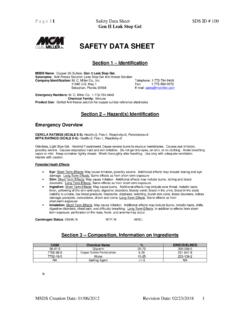
1 p a g e | 1 safety data sheet sds ID # 50 Copper Sulfate, Anti Freeze Solution MSDS Creation Date: 05/09/2001 Revision Date: 02/23/2018 (1) SAFETY data SHEET Section 1 - Identification MSDS Name: Copper (II) Sulfate, Anti-Freeze Solution, Synonyms: Anti-Freeze Solution; MCMNA998, MCM#17105 & 17207 Company Identification: M. C. Miller Co., Inc. Telephone: 1-772-794-9448 11640 Hwy 1 Fax: 1-772-589-9172 Sebastian, Florida 32958 E-mail: Emergency Numbers: M. C. Miller Co. 1-772-794-9448 Chemical Family: Mixture Product Use: Anti-freeze solution for copper sulfate electrodes Section 2 Hazard(s) Identification Emergency Overview CERCLA RATINGS (SCALE 0-3): Health=3, Fire=1, Reactivity=0, Persistence=3 NFPA RATINGS (SCALE 0-4): Health=3, Fire=1, Reactivity=0 Odorless, Light Blue Liquid.
2 Harmful if swallowed. Cause severe burns to mucous membranes. Causes eye irritation, possibly severe. Causes respiratory tract and skin irritation. Do not get into eyes, on skin, or on clothing. Avoid breathing vapor or mist. Keep container tightly closed. Wash thoroughly after handling. Use only with adequate ventilation. Handle with caution. Potential Heath Effects Eye: Short Term Effects: May cause irritation, possibly severe. Additional effects may include tearing and eye damage. Long Term Effects: Same effects as from short-term exposure Skin: Short Term Effects: May cause irritation. Additional effects may include burns, itching and blood disorders. Long Term Effects: Same effects as from short-term exposure. Ingestion: Short Term Effects: May cause burns. Additional effects may include sore throat, metallic taste, fever, yellowing of the skin and eyes, digestive disorders, bloody vomit, blood in the urine, blood in the stool, inability to urinate, low blood pressure, headache, dizziness, twitching, bluish skin color, blood disorders, kidney damage, paralysis, convulsions, shock and coma.
3 Long Term Effects: Same effects as from short-term exposure. Inhalation: Short Term Effects: May cause irritation. Additional effects may include burns, metallic taste, chills, digestive disorders, chest pain, and difficulty breathing. Long Term Effects: In addition to effects from short term exposure, perforation of the nose, fever, and anemia may occur. Carcinogen Status: OSHA: N NTP: N IARC: N Section 3 Composition, Information on Ingredients CAS# Chemical Name % EINECS/ELINCS 56-81-5 Glycerin 25-75 200-289-5 7758-99-8 Copper Sulfate Pentahydrate 5-25 231-847-6 7732-18-5 Water 10-25 233-139-2 p a g e | 2 SAFETY data SHEET SDS ID # 50 Copper Sulfate, Anti Freeze Solution MSDS Creation Date: 05/09/2001 Revision Date: 02/23/2018 (2) Section 4 First Aid Measures Eyes: Wash eyes immediately with large amounts of water or normal saline, occasionally lifting upper and lower lids, until no evidence of chemical remains (at least 15-20 minutes).
4 Get medical attention. Skin: Remove contaminated clothing and shoes immediately. Wash with soap or mild detergent and large amounts of water until no evidence of chemical remains (at least 15-20 minutes). Get medical attention. Ingestion: Treat symptomatically and supportively. Induce vomiting. Get medical attention immediately. Inhalation: Remove from exposure area to fresh air immediately. Perform artificial respiration if necessary. Keep person warm and at rest. Treat symptomatically and supportively. Get medical attention immediately. Section 5 Fire Fighting Measures Fire and Explosion Hazard: Slight fire hazard when exposed to heat or flame. Extinguishing Media: Dry chemical, carbon dioxide, water spray or regular foam (1993 Emergency Response Guidebook, RSPA P ). For larger fires, use water spray, fog, or regular foam (1993 Emergency Response Guidebook, RSPA P ). Firefighting: Move the container from fire area if you can do so without risk.
5 Do not scatter spilled material with high-pressure water streams. Dike fire-control water for later disposal (1993 Emergency Response Guidebook, RSPA P , Guide Page 31). Use agents suitable for type of surrounding fire. Avoid breathing hazardous vapors, keep upwind. Flash Point, Lower Flammable Limit, and Auto Ignition: No data Available. Hazardous Combustion Products: Thermal decomposition may release toxic and/or hazardous gases. Section 6 Accidental Release Measures Occupational Spill: Stop the leak if you can without risk. For small spills, take up with sand or other absorbent material and place into clean, dry containers for later disposal. Keep unnecessary people away. Isolate hazard area and deny entry. Reportable Quantity (RQ): The Superfund Amendments and Reauthorization Act (SARA) Section 304 requires that a release equal to or greater than the reportable quantity established for that substance be immediately reported to the local emergency planning committee and the state emergency response commission (40 CFR ).
6 If the release of this substance is reportable under CERCLA Section 103, the National Response Center must be notified immediately at (800) 424-8802 or (202) 426-2675 in the metropolitan Washington area (40 CFR ). Section 7 Handling and Storage Handling: Observe all federal, state, and local regulations when storing this substance. Store away from incompatible substances. Section 8 Exposure Controls, Personal Protection Exposure Limits: Glycerin (Mist): 5mg/m3 OSHA TWA (respiratory fraction); 10mg/m3 OSHA TWA (total mist); 10mgm3 ACGIH TWA. Note: OSHA revoked the final rule limits of January 19, 1989 in response to the 11th Circuit Court of Appeals decision (AFL-CIO v. OSHA) effective June 30, 1993. See 29 CFR (58 FR 35338). Copper Dust and Mist (AS CU): 1mg/m3 OSHA TWA 1mg/m3 ACGIH TWA 1mg/m3 NIOSH recommended TWA 1mg/m3 DFG MAK TWA (total dust) 2mg/m3 DFG MAK 30 minute peak, average value, 4 times/shift. Measurement method: Particulate filter; acid; atomic absorption spectrometry; (NIOSH Vol.)
7 III #7029). Cupric Sulfate: 10 pounds CERCLA Section 103 Reportable Quantity Subject to SARA Section 313 Annual Toxic Chemical Release Reporting. Ventilation: Provide local exhaust ventilation system to meet published exposure limits. Personal Protective Equipment Eyes: The use of chemical splash goggles is recommended. Emergency Eye Wash: Where there is any possibility that an employee s eye(s) may be exposed to this substance, the employer should provide an eye wash fountain within the immediate work area for emergency use. Gloves: Employee must wear appropriate protective gloves to prevent contact with this substance. Clothing: Employee must wear appropriate protective (impervious) clothing and equipment to prevent repeated or prolonged skin contact with this substance. Respirators: Based on the components present and/or information in physical data , health effects or toxicity sections, no respirator would be required under normal conditions of use.
8 However, air p a g e | 3 SAFETY data SHEET SDS ID # 50 Copper Sulfate, Anti Freeze Solution MSDS Creation Date: 05/09/2001 Revision Date: 02/23/2018 (3)contamination monitoring should be carried out to assure that the employees are not exposed to harmful concentrations of any of the above-mentioned components. If respiratory protection is required, it must be based on the National Institute for Occupational SAFETY and Health and the Mine SAFETY and Health Administration (NIOSH-MSHA). For Firefighting and Other Immediately Dangerous to Life or Health Conditions: Any self-contained respirator that has a full facepiece and is operated in a pressure-demand or other positive-pressure mode. Any supply-air respirator that has a full facepiece and is operated in a pressure-demand or other positive-pressure mode in combination with an auxiliary self-contained breathing apparatus operated in pressure-demand or other positive-pressure mode.
9 Section 9 Physical and Chemical Properties Odor: Odorless Odor Threshold: No data Available Appearance: Light Blue Liquid Volatility: 0% pH: Vapor Pressure: No data Available Vapor Density: No data Available Evaporation Rate: No data Available Boiling Point: 212 F (100 C) Freezing Point: No data Available Specific Gravity: Water Solubility: miscible Section 10 Stability and Reactivity Reactivity: Stable under normal temperatures and pressures. Conditions to Avoid: May burn, but does not ignite readily. Avoid contact with strong oxidizers, excessive heat, sparks, or open flame. Incompatibilities: o Glycerin: Acetic Anhydride: Violent reaction catalyzed by phosphorus oxychloride Acids (Strong): Incompatible Bases (Strong): Incompatible Calcium Hypochlorite: May ignite spontaneously on mixing Chlorine (Liquid): Explosive reaction Chromium (III) Oxide: Explosive reaction Chromium Trioxide: Violent reaction Hydrofluoric Acid, Nitric Acid: Unstable mixture Hydrogen Peroxide: Explosive hazard Lead Oxide, Perchloric Acid: Explosive hazard Nitric Acid, Sulfuric Acid: Explosive hazard Oxidizers (Strong): Explosive reaction Potassium Chlorate: Explosive reaction Potassium Permanganate: Explosive reaction on contact Potassium Peroxide: Fire and explosion hazard Sodium Hydride: Intense exothermic reaction Silver Perchlorate.
10 Formation of shock-sensitive solvated salt p a g e | 4 SAFETY data SHEET SDS ID # 50 Copper Sulfate, Anti Freeze Solution MSDS Creation Date: 05/09/2001 Revision Date: 02/23/2018 (4) Sodium Peroxide: Fire and explosion hazard o Cupric Sulfate (Copper Sulfate): Hydroxylamine: May ignite Magnesium: Produces hydrogen Metals: Corrosive Oxidizers (Strong): Incompatible Reducing Agents: Reacts vigorously Sodium Hypobromite: Solutions of sodium hypobromite are decomposed by powerful catalytic action of cupric ions o Copper Salts: Acetylene: May form explosive acetylides Hydrazine: Decomposes Nitromethane: Forms explosive mixtures o Hazardous Decomposition: Thermal decomposition may release toxic and/or hazardous gases o Polymerization: Hazardous polymerization has not been reported to occur under normal temperature and pressures Section 11 Toxicological Information Glycerin: o Irritation data : 500 mg/24 hours skin-rabbit mild; 126 mg eye-rabbit mild; 500 mg//24 hours eye-rabbit mild o Toxicity data : 1428 mg/kg oral-human TDLo; 12600 mg/kg oral-rat LD50; 4090 mg/kg oral-mouse LD50; 27 gm/kg oral-rabbit LD50; 7750 mg/kg oral-guinea pig LD50; 100 mg/kg subcutaneous-rat LD50; 91 mg/kg subcutaneous-mouse LD50; 5566 mg/kg intravenous-rat LD50; 4250 mg/kg intravenous-mouse LD50; 53 gm/kg intravenous-rabbit LD50; 4420 mg/kg Intraperitoneal-rat LD50; 8700 mg/kg Intraperitoneal-mouse LD50; mutagenic data (RTECS); reproductive effects data (RTECS) o Carcinogen Status: None o Acute Toxicity Level: Slightly toxic by ingestion o Target Effects: Poisoning may affect the kidneys and central nervous system Cupric Sulfate (Copper Sulfate): o Toxicity data : 50 mg/kg oral-human TDLo.