Transcription of Safety Data Sheet - Fisher Sci
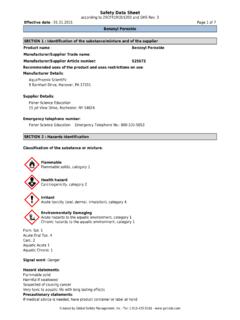
1 Safety data Sheetaccording to 29 CFR1910/1200 and GHS Rev. 3 Effective date : 1 of 7 Titanium Dioxide PowderCreated by Global Safety Management, Inc. -Tel: 1-813-435-5161 - 1 : Identification of the substance/mixture and of the supplierProduct name :Titanium Dioxide PowderManufacturer/Supplier Trade name:Manufacturer/Supplier Article number:S25818 Recommended uses of the product and uses restrictions on use:Manufacturer Details:AquaPhoenix Scientific9 Barnhart Drive, Hanover, PA 17331 Supplier Details: Fisher Science Education15 Jet View Drive, Rochester, NY 14624 Emergency telephone number: Fisher Science Education Emergency Telephone No.: 800-535-5053 SECTION 2 : Hazards identificationClassification of the substance or mixture:Health hazardCarcinogenicity, category 2 Carcinogenicity, category 2 Hazards Not Otherwise Classified - Combustible DustSignal word :WarningHazard statements:Suspected of causing cancerPrecautionary statements:Obtain special instructions before useDo not handle until all Safety precautions have been read and understoodUse personal protective equipment as requiredIF exposed or concerned: Get medical advice/attentionStore locked upDispose of contents/container to.
2 Combustible Dust Hazard: :May form combustible dust concentrations in air (during processing).Other Non-GHS Classification:WHMISD2 ASafety data Sheetaccording to 29 CFR1910/1200 and GHS Rev. 3 Effective date : 2 of 7 Titanium Dioxide PowderCreated by Global Safety Management, Inc. -Tel: 1-813-435-5161 - SCALE (0-4)HMIS RATINGS (0-4)SECTION 3 : Composition/information on ingredientsIngredients:CAS 13463-67-7 Titanium dioxide100 %Percentages are by weightSECTION 4 : First aid measuresDescription of first aid measuresAfter inhalation: Move exposed individual to fresh air. Loosen clothing as necessary and position individual ina comfortable medical advice if discomfort or irritation breathing difficult, give skin contact: Wash affected area with soap and water. Rinse/flush exposed skin gently using water for15-20 minutes. Seek medical advice if discomfort or irritation eye contact: Protect unexposed eye.
3 Rinse/flush exposed eye(s) gently using water for 15-20 contact lens(es) if able to do so during rinsing. Seek medical attention if irritation persists or swallowing: Rinse mouth thoroughly. Do not induce vomiting. Have exposed individual drink sips ofwater. Seek medical attention if irritation, discomfort or vomiting important symptoms and effects, both acute and delayed:Irritation, Nausea,Headache, Shortness of breath.;Indication of any immediate medical attention and special treatment needed:If seeking medical attention, provide SDS document to 5 : Firefighting measuresExtinguishing mediaSuitable extinguishing agents: If in laboratory setting, follow laboratory fire suppression procedures. Useappropriate fire suppression agents for adjacent combustible materials or sources of ignitionFor Safety reasons unsuitable extinguishing agents:Special hazards arising from the substance or mixture:Combustion products may include carbon oxides or other toxic decomposition can lead torelease of irritating gases and generating dust; fine dust dispersed in air in sufficientconcentrations, and in the presence of an ignition source is a potential dust explosion for firefighters:Protective equipment: Use NIOSH-approved respiratory protection/breathing data Sheetaccording to 29 CFR1910/1200 and GHS Rev.
4 3 Effective date : 3 of 7 Titanium Dioxide PowderCreated by Global Safety Management, Inc. -Tel: 1-813-435-5161 - information (precautions): Move product containers away from fire or keep cool with waterspray as a protective measure, where spark-proof tools and explosion-proof 6 : Accidental release measuresPersonal precautions, protective equipment and emergency procedures:Wear protective equipment. Transfer to a disposal or recovery spark-proof tools and explosion-proof respiratory protective device against the effects of fumes/dust/aerosol. Keep unprotectedpersons away. Ensure adequate away from ignition sources. Protect from the spill, ifpossible. Contain spilled material by diking or using inert precautions:Prevent from reaching drains, sewer or waterway. Collect contaminated soil for characterization per Section 13 Methods and material for containment and cleaning up:If in a laboratory setting, follow Chemical Hygiene Plan into properly labeled containers forrecovery or disposal.
5 If necessary, use trained response deposits should not be allowed toaccumulate on surfaces, as these may form an explosive mixture if they are released into the atmosphere insufficient concentration. Avoid dispersal of dust in the air ( , clearing dust surfaces with compressed air).Collect solids in powder form using vacuum with (HEPA filter)Reference to other sections:SECTION 7 : Handling and storagePrecautions for safe handling:Minimize dust generation and accumulation. Wash hands after handling. Avoid dispersal of dust in the air ( ,clearing dust surfaces with compressed air). Routine housekeeping should be instituted to ensure that dusts donot accumulate on surfaces. Dry powders can build static electricity charges when subjected to the friction oftransfer and mixing operations. Follow good hygiene procedures when handling chemical materials. Do not eat,drink, smoke, or use personal products when handling chemical substances.
6 If in a laboratory setting, followChemical Hygiene only in well ventilated generation of dust or fine with eyes, skin, and for safe storage, including any incompatibilities:Store in a cool location. Provide ventilation for containers. Avoid storage near extreme heat, ignition sources oropen flame. Store away from foodstuffs. Store away from oxidizing in cool, dry conditions in wellsealed containers. Keep container tightly with like hazardsSECTION 8 : Exposure controls/personal protectionControl Parameters:13463-67-7, Titanium dioxide, ACGIH TLV: 10, OSHA PEL: 10, , OSHA PEL TWA (Total Dust) 15 mg/m3 (50 mppcf*), , ACGIH TLV TWA (inhalable particles) 10 mg/m3 Safety data Sheetaccording to 29 CFR1910/1200 and GHS Rev. 3 Effective date : 4 of 7 Titanium Dioxide PowderCreated by Global Safety Management, Inc. -Tel: 1-813-435-5161 - Engineering controls:Emergency eye wash fountains and Safety showers should be available inthe immediate vicinity of exhaust ventilation orother engineering controls to keep the airborne concentrations of vaporor dusts (total/respirable) below the applicable workplace exposure limits (Occupational Exposure limits -OELs) indicated under a fumehood.
7 It is recommended that all dust control equipment such as localexhaust ventilation and material transport systems involved in handlingof this product contain explosion relief vents or an explosion suppressionsystem or an oxygen deficient that dust-handlingsystems (such as exhaust ducts, dust collectors, vessels, and processingequipment) are designed in a manner to prevent the escape of dust intothe work area ( , there is no leakage from the equipment).Respiratory protection:Not required under normal conditions of use. Use suitable respiratoryprotective device when high concentrations are present. Use suitablerespiratory protective device when aerosol or mist is formed. For spills,respiratory protection may be of skin:The glove material has to be impermeable and resistant to the product/the substance/ the preparation being of the glovematerial on consideration of the penetration times, rates of diffusion andthe protection: Safety glasses with side shields or hygienic measures:The usual precautionary measures are to be adhered to when handlingchemicals.
8 Keep away from food, beverages and feed remove all soiled and contaminated clothing. Wash handsbefore breaks and at the end of work. Do not inhalegases/fumes/dust/mist/vapor/aeroso ls. Avoid contact with the eyes 9 : Physical and chemical propertiesAppearance (physicalstate,color):White solidExplosion limit lower:Explosion limit upper:Not DeterminedNot DeterminedOdor:OdorlessVapor pressure:Not DeterminedOdor threshold:Not DeterminedVapor density:Not DeterminedpH-value:Not DeterminedRelative density:3. 84 point:1855 CSolubilities:ND = Not Determined. N/A = NotApplicable. Insoluble in point/Boilingrange:2900 CPartition coefficient (n-octanol/water):Not DeterminedFlash point (closedcup):Not DeterminedAuto/Self-ignitiontemperature: Not DeterminedEvaporation rate:Not DeterminedDecompositiontemperature:Not DeterminedFlammability(solid,gaseous):No t DeterminedViscosity:a. Kinematic:Not Determinedb.
9 Dynamic: Not DeterminedDensity: Not DeterminedSECTION 10 : Stability and reactivitySafety data Sheetaccording to 29 CFR1910/1200 and GHS Rev. 3 Effective date : 5 of 7 Titanium Dioxide PowderCreated by Global Safety Management, Inc. -Tel: 1-813-435-5161 - :Chemical stability:No decomposition if used and stored according to hazardous reactions:Conditions to avoid:Store away from oxidizing agents, strong acids or materials:Strong decomposition products:Carbon oxides (CO, CO2).SECTION 11 : Toxicological informationAcute Toxicity:Oral:>10,000 mg/kgLD50 RatDermal:>10,000 mg/kgLD50 RabbitChronic Toxicity: No additional Irritation: No additional :Will not occurSingle Target Organ (STOT):No additional Measures:No additional :IARC:: group 2B - Possibly carcinogenic tohumansMutagenicity:Hamster Lungs DNA inhibition. Hamsterovary Sister chromatid exchangeReproductive Toxicity:No additional 12 : Ecological informationEcotoxicityFish: LC50 - other fish - > 1,000 mg/l - 96 hInvertebrates: EC50 - Daphnia magna (Water flea) - > 1,000 mg/l - 48 hPersistence and degradability: Readily degradable in the potential:Mobility in soil:Other adverse effects:SECTION 13 : Disposal considerationsWaste disposal recommendations:Product/containers must not be disposed together with household garbage.
10 Do not allow product to reachsewage system or open is the responsibility of the waste generator to properly characterize all wastematerials according to applicable regulatory entities (US ). Consult federal state/ provincial andlocal regulations regarding the proper disposal of waste material that may incorporate some amount of 14 : Transport informationSafety data Sheetaccording to 29 CFR1910/1200 and GHS Rev. 3 Effective date : 6 of 7 Titanium Dioxide PowderCreated by Global Safety Management, Inc. -Tel: 1-813-435-5161 - Dangerous GoodsUN proper shipping nameNot Dangerous GoodsTransport hazard class(es)Packing group:Not Dangerous GoodsEnvironmental hazard:Transport in bulk:Special precautions for user:SECTION 15 : Regulatory informationUnited States (USA)SARA Section 311/312 (Specific toxic chemical listings):Acute, ChronicSARA Section 313 (Specific toxic chemical listings):None of the ingredients is listedRCRA (hazardous waste code):None of the ingredients is listedTSCA (Toxic Substances Control Act):All ingredients are (Comprehensive Environmental Response, Compensation, and Liability Act):None of the ingredients is listedProposition 65 (California):Chemicals known to cause cancer:None of the ingredients is listedChemicals known to cause reproductive toxicity for females:None of the ingredients is listedChemicals known to cause reproductive toxicity for males.