Transcription of Safety Data Sheet - Fisher Sci
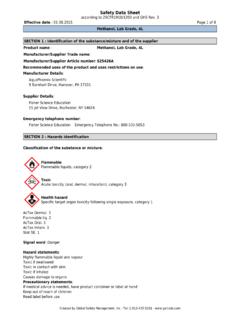
1 Safety data Sheetaccording to 29 CFR1910/1200 and GHS Rev. 3 Effective date : 1 of 7 sodium Carbonate,AnhydrousCreated by Global Safety Management, Inc. -Tel: 1-813-435-5161 - 1 : Identification of the substance/mixture and of the supplierProduct name : sodium Carbonate,AnhydrousManufacturer/Supplier Trade name:Manufacturer/Supplier Article number:S25539 DRecommended uses of the product and uses restrictions on use:Manufacturer Details:AquaPhoenix Scientific9 Barnhart Drive, Hanover, PA 17331 Supplier Details: Fisher Science Education15 Jet View Drive, Rochester, NY 14624 Emergency telephone number: Fisher Science Education Emergency Telephone No.: 800-535-5053 SECTION 2 : Hazards identificationClassification of the substance or mixture:IrritantEye irritation, category 2 AEye Irritation 2 Signal word :WarningHazard statements:Causes serious eye irritationPrecautionary statements:If medical advice is needed, have product container or label at handKeep out of reach of childrenRead label before useDo not eat, drink or smoke when using this productWear protective gloves/protective clothing/eye protection/face protectionWash skin thoroughly after handlingIF IN EYES: Rinse cautiously with water for several minutes.
2 Remove contact lenses if present and easy to rinsingIf eye irritation persists get medical advice/attentionOther Non-GHS Classification:WHMISD2 BESafety data Sheetaccording to 29 CFR1910/1200 and GHS Rev. 3 Effective date : 2 of 7 sodium Carbonate,AnhydrousCreated by Global Safety Management, Inc. -Tel: 1-813-435-5161 - SCALE (0-4)HMIS RATINGS (0-4)SECTION 3 : Composition/information on ingredientsIngredients:CAS 497-19-8 sodium Carbonate, Anhydrous100 %Percentages are by weightSECTION 4 : First aid measuresDescription of first aid measuresAfter inhalation: Move exposed individual to fresh air. Loosen clothing as necessary and position individual ina comfortable medical advice if discomfort or irritation breathing difficult, give skin contact: Wash affected area with soap and water.
3 Rinse thoroughly. Seek medical attention ifirritation, discomfort or vomiting eye contact: Protect unexposed eye. Rinse/flush exposed eye(s) gently using water for 15-20 contact lens(es) if able to do so during rinsing. Seek medical attention if irritation persists or swallowing: Rinse mouth thoroughly. Do not induce vomiting. Have exposed individual drink sips ofwater. Seek medical attention if irritation, discomfort or vomiting important symptoms and effects, both acute and delayed:Irritation, Nausea,Headache, Shortness of (substance which increases flow of tears).;Indication of any immediate medical attention and special treatment needed:If seeking medical attention, provide SDS document to 5 : Firefighting measuresExtinguishing mediaSuitable extinguishing agents: If in laboratory setting, follow laboratory fire suppression procedures.
4 Useappropriate fire suppression agents for adjacent combustible materials or sources of ignitionFor Safety reasons unsuitable extinguishing agents:Special hazards arising from the substance or mixture:Combustion products may include carbon oxides or other toxic decomposition can lead torelease of irritating gases and for firefighters:Protective equipment: Use NIOSH-approved respiratory protection/breathing information (precautions): Move product containers away from fire or keep cool with waterSafety data Sheetaccording to 29 CFR1910/1200 and GHS Rev. 3 Effective date : 3 of 7 sodium Carbonate,AnhydrousCreated by Global Safety Management, Inc. -Tel: 1-813-435-5161 - as a protective measure, where 6 : Accidental release measuresPersonal precautions, protective equipment and emergency procedures:Wear protective equipment.
5 Avoid dispersal of dust in the air ( , clearing dust surfaces with compressed air).Follow good hygiene procedures when handling chemical materials. Use respiratory protective device againstthe effects of fumes/dust/aerosol. Keep unprotected persons away. Ensure adequate awayfrom ignition sources. Protect from the spill, if possible. Contain spilled material by diking or usinginert absorbent. Transfer to a disposal or recovery precautions:Prevent from reaching drains, sewer or waterway. Collect contaminated soil for characterization per Section 13 Methods and material for containment and cleaning up:If in a laboratory setting, follow Chemical Hygiene Plan into properly labeled containers forrecovery or disposal.
6 If necessary, use trained response and containerize for generating dust. Collect solids in powder form using vacuum with (HEPA filter)Reference to other sections:SECTION 7 : Handling and storagePrecautions for safe handling:Follow good hygiene procedures when handling chemical materials. Do not eat, drink, smoke, or use personalproducts when handling chemical substances. If in a laboratory setting, follow Chemical Hygiene onlyin well ventilated generation of dust or fine contact with eyes, skin, and hands after handling. Avoid dispersal of dust in the air ( , clearing dust surfaces with compressed air).Conditions for safe storage, including any incompatibilities:Store in a cool location. Provide ventilation for containers.
7 Avoid storage near extreme heat, ignition sources oropen flame. Store away from foodstuffs. Store away from oxidizing in cool, dry conditions in wellsealed containers. Keep container tightly 8 : Exposure controls/personal protectionControl Parameters:No applicable occupational exposure limitsAppropriate Engineering controls:Emergency eye wash fountains and Safety showers should be available inthe immediate vicinity of exhaust ventilation orother engineering controls to keep the airborne concentrations of vaporor dusts (total/respirable) below the applicable workplace exposure limits(Occupational Exposure Limits-OELs) indicated under a fumehoodRespiratory protection:Not required under normal conditions of use.
8 Use suitable respiratoryprotective device when high concentrations are present. Use suitablerespiratory protective device when aerosol or mist is formed. For spills,respiratory protection may be data Sheetaccording to 29 CFR1910/1200 and GHS Rev. 3 Effective date : 4 of 7 sodium Carbonate,AnhydrousCreated by Global Safety Management, Inc. -Tel: 1-813-435-5161 - of skin:The glove material has to be impermeable and resistant to the product/the substance/ the preparation being of the glovematerial on consideration of the penetration times, rates of diffusion andthe protection: Safety glasses with side shields or hygienic measures:The usual precautionary measures are to be adhered to when handlingchemicals.
9 Keep away from food, beverages and feed remove all soiled and contaminated clothing. Wash handsbefore breaks and at the end of work. Do not inhalegases/fumes/dust/mist/vapor/aeroso ls. Avoid contact with the eyes 9 : Physical and chemical propertiesAppearance (physicalstate,color):White solidExplosion limit lower:Explosion limit upper:Not determinedNot determinedOdor:OdorlessVapor pressure:1 mmHg @ 865 COdor threshold:Not determinedVapor density:Not determinedpH-value:Not determinedRelative density:Not determinedMelting/Freezing point:851 CSolubilities:Partly soluble in water. 220 g/l at20 CBoiling point/Boilingrange:1600 C @760mmHgPartition coefficient (n-octanol/water):Not determinedFlash point (closedcup):Not determinedAuto/Self-ignitiontemperature: Not determinedEvaporation rate:Not determinedDecompositiontemperature:Not determinedFlammability(solid,gaseous):No t determinedViscosity:a.
10 Kinematic:Not determinedb. Dynamic: Not determinedDensity: Not determinedSpecific 10 : Stability and reactivityReactivity:Chemical stability:No decomposition if used and stored according to hazardous reactions:Conditions to avoid:Store away from oxidizing agents, strong acids or materials:Strong oxidizers, strong acids, fluorineHazardous decomposition products:Carbon oxides (CO, CO2).Oxides of sodiumSECTION 11 : Toxicological informationAcute Toxicity:Oral:4090mg/kgLD50 oral-rat: Safety data Sheetaccording to 29 CFR1910/1200 and GHS Rev. 3 Effective date : 5 of 7 sodium Carbonate,AnhydrousCreated by Global Safety Management, Inc. -Tel: 1-813-435-5161 - :2300 mg/m3LC50 (2h) RatDermal:2210 mg/kgLD50 MouseChronic Toxicity: No additional Irritation:Ocular:Section 2 Classified as an eye irritantSensitization:No additional Target Organ (STOT):No additional Measures:No additional :No additional :No additional Toxicity:No additional 12 : Ecological informationEcotoxicityFish: LC50 (96h) L.