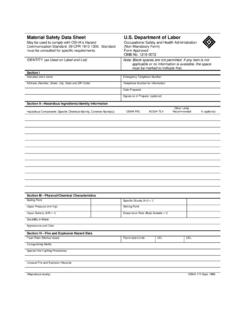
Transcription of SAFETY DATA SHEET - ilpi.com
1 SAFETY DATA SHEETC reation Date 01-May-2012 Revision Date 23-Jan-2015 Revision Number 21. IdentificationProduct NameBenzoic acidCat No. :A63-500; A65-500; A68-30 SynonymsBenzenecarboxylic acid; Benzenemethanoic acid; Phenylcarboxylic acid; Phenylformic acid;Benzeneformic acid; CarboxybenzeneRecommended UseLaboratory advised againstNo Information availableDetails of the supplier of the SAFETY data SHEET 2. Hazard(s) identificationClassification This chemical is considered hazardous by the 2012 OSHA Hazard Communication Standard (29 CFR )Label Elements Signal WordDangerHazard StatementsCauses skin irritationCauses serious eye damageCauses damage to organs through prolonged or repeated exposureCompanyFisher ScientificOne Reagent LaneFair Lawn, NJ 07410 Tel: (201) 796-7100 Emergency Telephone NumberCHEMTREC , Inside the USA: 800-424-9300 CHEMTREC , Outside the USA.
2 001-703-527-3887 Skin Corrosion/irritationCategory 2 Serious Eye Damage/Eye IrritationCategory 1_____Specific target organ toxicity - (repeated exposure)Category 1 Target Organs - 1 / 7_____Benzoic acidRevision Date 23-Jan-2015 Precautionary StatementsPreventionWash face, hands and any exposed skin thoroughly after handlingWear protective gloves/protective clothing/eye protection/face protectionDo not breathe dust/fume/gas/mist/vapors/sprayDo not eat, drink or smoke when using this productResponseGet medical attention/advice if you feel unwellSkinIF ON SKIN: Wash with plenty of soap and waterIf skin irritation occurs: Get medical advice/attentionTake off contaminated clothing and wash before reuseEyesIF IN EYES: Rinse cautiously with water for several minutes.
3 Remove contact lenses, if present and easy to do. Continue rinsingImmediately call a POISON CENTER or doctor/physicianDisposalDispose of contents/container to an approved waste disposal plantHazards not otherwise classified (HNOC) May form combustible dust concentrations in air3. Composition / information on ingredientsComponentCAS-NoWeight %Benzoic acid65-85-0>954. First-aid measuresEye ContactRinse immediately with plenty of water, also under the eyelids, for at least 15 medical attention is ContactWash off immediately with plenty of water for at least 15 minutes. Obtain medical from exposure, lie down. Move to fresh air.
4 If breathing is difficult, give oxygen. Ifnot breathing, give artificial respiration. Obtain medical not induce vomiting. Obtain medical important symptoms/effectsCauses eye burns. Repeated or prolonged skin contact may cause allergic reactions withsusceptible to PhysicianTreat symptomatically5. Fire-fighting measuresSuitable Extinguishing MediaWater spray. Carbon dioxide (CO 2). Dry chemical. chemical Extinguishing MediaNo information availableFlash Point 121 C / FMethod -No information availableAutoignition TemperatureNot applicable 570 C / 1058 FExplosion LimitsUpperNo data availableLower_____No data availableSensitivity to Mechanical ImpactNo information availablePage 2 / 7 Sensitivity to Static DischargeNo information available_____Benzoic acidRevision Date 23-Jan-2015 Specific Hazards Arising from the ChemicalDust can form an explosive mixture in Combustion ProductsCarbon monoxide (CO) Carbon dioxide (CO2)
5 Protective Equipment and Precautions for FirefightersAs in any fire, wear self-contained breathing apparatus pressure-demand, MSHA/NIOSH (approved or equivalent) and fullprotective 6. Accidental release measuresPersonal PrecautionsUse personal protective equipment. Ensure adequate PrecautionsSee Section 12 for additional ecological for Containment and CleanUpSweep up or vacuum up spillage and collect in suitable container for disposal. Avoid Handling and storageHandlingAvoid contact with skin and eyes. Avoid ingestion and inhalation. Do not breathe in a dry, cool and well-ventilated place. Keep container tightly closed.
6 Keep awayfrom heat and sources of Exposure controls / personal protectionExposure Guidelines This product does not contain any hazardous materials with occupational exposure limitsestablished by the region specific regulatory Physical and chemical propertiesPhysical StateSolidAppearanceOff-whiteOdoraromati cOdor ThresholdNo information availablepH g/l waterMelting Point/Range 121 - 123 C / - FBoiling Point/Range 249 C / F @ 760 mmHgFlash Point 121 C / FHealth3 Flammability1 Instability0 Physical hazardsN/AEngineering MeasuresEnsure adequate ventilation, especially in confined areas.
7 Ensure that eyewash stationsand SAFETY showers are close to the workstation Protective Equipment Eye/face ProtectionWear appropriate protective eyeglasses or chemical SAFETY goggles as described byOSHA's eye and face protection regulations in 29 CFR or European and body protectionWear appropriate protective gloves and clothing to prevent skin ProtectionFollow the OSHA respirator regulations found in 29 CFR or European StandardEN 149. Use a NIOSH/MSHA or European Standard EN 149 approved respirator ifexposure limits are exceeded or if irritation or other symptoms are 3 / 7 Hygiene MeasuresHandle in accordance with good industrial hygiene and SAFETY acidRevision Date 23-Jan-2015 Evaporation RateNot applicableFlammability (solid,gas)No information availableFlammability or explosive limitsUpperNo data availableLowerNo data availableVapor hPa @ 96 CVapor DensityNot applicableRelative DensityNo information availableSolubilitysolublePartition coefficient.
8 N-octanol/waterNo data availableAutoignition TemperatureNot applicable 570 C / 1058 FDecomposition TemperatureNo information availableViscosityNot applicableMolecular FormulaC7 H6 O2 Molecular Stability and reactivityReactive HazardNone known, based on information availableStabilityStable under normal to AvoidIncompatible products. Avoid dust MaterialsStrong acids, Strong bases, Strong oxidizing agents, Strong reducing agents, MetalsHazardous Decomposition ProductsCarbon monoxide (CO), Carbon dioxide (CO2)Hazardous PolymerizationHazardous polymerization does not ReactionsAqueous solution, May react with metals and lead to the formation of flammable Toxicological informationAcute Toxicity Product InformationComponent InformationComponentLD50 OralLD50 DermalLC50 InhalationBenzoic acid1700 mg/kg ( Rat )2565 mg/kg ( Rat )Not listed26 mg/m3 ( Rat )
9 1 hToxicologically SynergisticProductsNo information availableDelayed and immediate effects as well as chronic effects from short and long-term exposure IrritationIrritating to eyes, respiratory system and skinSensitizationNo information availableCarcinogenicityThe table below indicates whether each agency has listed any ingredient as a acid65-85-0 Not listedNot listedNot listedNot listedNot listedMutagenic EffectsNot mutagenic in AMES Test_____Reproductive EffectsNo information EffectsPage 4 / 7No information information acidRevision Date 23-Jan-2015 STOT - single exposureNone knownSTOT - repeated exposureLungsAspiration hazardNo information availableSymptoms / effects.
10 Both acute anddelayedNo information availableEndocrine Disruptor InformationNo information availableOther Adverse EffectsThe toxicological properties have not been fully investigated. See actual entry in RTECS forcomplete Ecological informationEcotoxicity .ComponentFreshwater AlgaeFreshwater FishMicrotoxWater FleaBenzoic acid5 mg/L EC50 = 3 h180 mg/L LC50 96 hEC50 = mg/L 30 minEC50 = mg/L 15 min300 mg/L EC50 = 24 h 860mg/L EC50 = 48 hPersistence and DegradabilitySoluble in water Persistence is unlikely based on information AccumulationNo information not likely mobile in the environment due its low water solubility.