Transcription of Sample MLA Formatted Paper
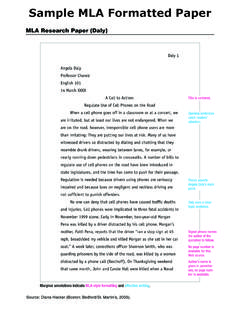
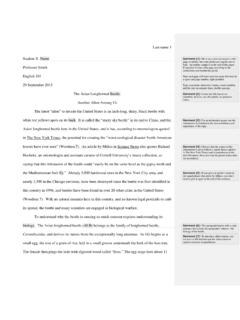
1 MLA Research Paper (Daly)Source: Diana Hacker (Boston: Bedford/St. Martin s, 2006).Angela DalyProfessor ChavezEnglish 10114 March XXXXA Call to Action:Regulate Use of Cell Phones on the RoadWhen a cell phone goes off in a classroom or at a concert, weare irritated, but at least our lives are not endangered. When weare on the road, however, irresponsible cell phone users are morethan irritating: They are putting our lives at risk. Many of us havewitnessed drivers so distracted by dialing and chatting that theyresemble drunk drivers, weaving between lanes, for example, ornearly running down pedestrians in crosswalks.
2 A number of bills toregulate use of cell phones on the road have been introduced instate legislatures, and the time has come to push for their is needed because drivers using phones are seriouslyimpaired and because laws on negligent and reckless driving arenot sufficient to punish one can deny that cell phones have caused traffic deathsand injuries. Cell phones were implicated in three fatal accidents inNovember 1999 alone. Early in November, two-year-old MorganPena was killed by a driver distracted by his cell phone. Morgan smother, Patti Pena, reports that the driver ran a stop sign at 45mph, broadsided my vehicle and killed Morgan as she sat in her carseat.
3 A week later, corrections officer Shannon Smith, who wasguarding prisoners by the side of the road, was killed by a womandistracted by a phone call (Besthoff). On Thanksgiving weekendthat same month, John and Carole Hall were killed when a NavalDaly 1 Title is sentencescatch readers asserts Angela Daly s phrase namesthe author of the quotation to page number isavailable for thisWeb uses a cleartopic s name isgiven in parenthe-ses; no page num-ber is annotations indicate MLA-style formattingand effective MLA Formatted PaperSource: Diana Hacker (Boston: Bedford/St.)
4 Martin s, 2006).Academy midshipman crashed into their parked car. The driver saidin court that when he looked up from the cell phone he was dial-ing, he was three feet from the car and had no time to stop(Stockwell B8).Expert testimony, public opinion, and even cartoons sug-gest that driving while phoning is dangerous. Frances Bents, an expert on the relation between cell phones and accidents, esti-mates that between 450 and 1,000 crashes a year have some connection to cell phone use (Layton C9). In a survey published by Farmers Insurance Group, 87% of those polled said that cellphones affect a driver s ability, and 40% reported having closecalls with drivers distracted by phones.
5 Many cartoons have depicted the very real dangers of driving while distracted (see Fig. 1).Scientific research confirms the dangers of using phoneswhile on the road. In 1997 an important study appeared in theNew England Journal of Medicine. The authors, Donald Redelmeierand Robert Tibshirani, studied 699 volunteers who made their cellphone bills available in order to confirm the times when they had placed calls. The participants agreed to report any nonfatalcollision in which they were involved. By comparing the time of a collision with the phone records, the researchers assessed thedangers of driving while phoning.
6 The results are unsettling:We found that using a cellular telephone was associ-ated with a risk of having a motor vehicle collisionthat was about four times as high as thatamong the same drivers when they were not usingtheir cellular telephones. This relative risk is similarDaly 2 Page number is given topic sentences, likethis one, are used throughoutthe and long quotation areintroduced with a signal phrasenaming the quotation isset off from thetext; quotationmarks are MLA Formatted PaperSource: Diana Hacker (Boston: Bedford/St. Martin s, 2006).to the hazard associated with driving with a blood alcohol level at the legal limit.
7 (456)The news media often exaggerated the latter claim ( similarto is not equal to ); nonetheless, the comparison with drunkdriving suggests the extent to which cell phone use while drivingcan impair 1998 study focused on Oklahoma, one of the few states tokeep records on fatal accidents involving cell phones. Using policerecords, John M. Violanti of the Rochester Institute of Technologyinvestigated the relation between traffic fatalities in Oklahoma andthe use or presence of a cell phone. He found a ninefold increasein the risk of fatality if a phone was being used and a doubled risksimply when a phone was present in a vehicle (522-23).
8 The latterstatistic is interesting, for it suggests that those who carry phonesDaly 3 Fig. 1. Chan Lowe, cartoon, Washington Post22 July 2000: has figure number,label, and beginswith a signalphrase naming theauthor and endswith page numbersin MLA Formatted PaperSource: Diana Hacker (Boston: Bedford/St. Martin s, 2006).in their cars may tend to be more negligent (or prone to distrac-tions of all kinds) than those who do groups have argued that state traffic laws makelegislation regulating cell phone use unnecessary. Sadly, this is nottrue. Laws on traffic safety vary from state to state, and driversdistracted by cell phones can get off with light punishment evenwhen they cause fatal accidents.
9 For example, although the mid-shipman mentioned earlier was charged with vehicular manslaugh-ter for the deaths of John and Carole Hall, the judge was unable toissue a verdict of guilty. Under Maryland law, he could only findthe defendant guilty of negligent driving and impose a $500 fine(Layton C1). Such a light sentence is not unusual. The driver whokilled Morgan Pena in Pennsylvania received two tickets and a $50fine--and retained his driving privileges (Pena). In Georgia, ayoung woman distracted by her phone ran down and killed a two-year-old; her sentence was ninety days in boot camp and five hun-dred hours of community service (Ippolito J1).
10 The families of thevictims are understandably distressed by laws that lead to suchlight certain kinds of driver behavior are shown to be espe-cially dangerous, we wisely draft special laws making them illegaland imposing specific punishments. Running red lights, failing tostop for a school bus, and drunk driving are obvious examples;phoning in a moving vehicle should be no exception. Unlike moregeneral laws covering negligent driving, specific laws leave littleambiguity for law officers and for judges and juries imposing pun-ishments. Such laws have another important benefit: They leave noambiguity for drivers.