Transcription of SCHOOL READINESS - UNICEF
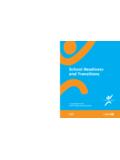
1 PROGRAMME DIVISION SCHOOL READINESS A Conceptual Framework SCHOOL READINESS : a conceptual framework United Nations Children s Fund, New York Updated in April 2012 United Nations Children s Fund Education Section, Programme Division Three United Nations Plaza New York, New York 10017 This document was authored by Pia Rebello Britto, and reviewed by Abhiyan Jung Rana and Cream Wright for the UNICEF Education Section. The text has not been edited to official publication standards; hence UNICEF accepts no responsibility for errors. The designations in this publication do not imply an opinion on legal status of any country or territory, or of its authorities, or the delimitation of frontiers. Cover photo: : UNICEF /NYHQ2011-2486/Olivier Asselin SCHOOL READINESS : a conceptual framework 1 Acknowledgements We would like to thank the peer reviewers of this document, whose inputs have been invaluable in strengthening this document and making it more practical and comprehensive.
2 The expert reviews of Yoshie Kaga, ECD Officer, UNESCO Headquarters, Paris; Frances Aboud, Professor, Department of Psychology, McGill University, Montreal, Canada; Nurper Ulkuer, Chief of ECD Unit, UNICEF Headquarters, New York; and Cliff Meyers, Regional Education Adviser for East Asia and Pacific, UNICEF Bangkok have greatly improved the calibre and content of the paper. We would also like to thank Nancy Shemrah Fallon and Tong Liu of Yale University for their assistance in manuscript preparation. SCHOOL READINESS : a conceptual framework 2 Abstract While SCHOOL READINESS is gaining currency around the globe, there remain many issues linked with a cohesive understanding of the concept and its applications to improve the learning and development of all children, the quality of schools, and the participation of families and communities. The aim of this paper is to provide the latest evidence and knowledge on SCHOOL READINESS within an easily understandable framework relevant to the lives of young children in the majority of the world.
3 To that end, this paper focuses on three basic yet critical questions: What is SCHOOL READINESS ? Why is SCHOOL READINESS important? And what are the consequences of inaction? This paper presents a broad concept of SCHOOL READINESS , describing in detail three dimensions: children s READINESS for SCHOOL ; schools READINESS for children; and families and communities READINESS for SCHOOL . It then proceeds to provide a rationale for the importance of SCHOOL READINESS , not just for individual children, but also for societal and national development more generally. Finally, the paper makes a strong case regarding the costs of inaction for children, families, communities and countries, and addresses international strategies for action. SCHOOL READINESS : a conceptual framework 3 Contents ACKNOWLEDGMENTS .. 1 ABSTRACT .. 2 INTRODUCTION .. 4 Section 1: What is SCHOOL READINESS ? .. 6 SCHOOL READINESS defined.
4 6 1a. Children s READINESS for SCHOOL .. 9 1b. SCHOOL s READINESS for children .. 11 1c. Families READINESS for SCHOOL .. 13 Summary .. 16 Section 2: Why is SCHOOL READINESS important? .. 16 2a. Intrinsic benefits of SCHOOL 17 2b. Instrumental advantages of SCHOOL READINESS .. 19 Section 3: What are the consequences of inaction? .. 21 3a. Consequences for individuals .. 21 3b. Consequences for society .. 25 3c. Consequences for international development .. 26 CONCLUSIONS .. 28 REFERENCES .. 29 SCHOOL READINESS : a conceptual framework 4 Introduction Through a combination of national social policies and international articulations including the Millennium Development Goals (MDGs), the Education for All (EFA) goals and the World Fit for Children (WFFC) targets, countries are working to ensure universal access to quality basic education. However, worldwide evidence highlights the persistence of inequity in enrolment, attendance, learning outcomes and achievement based on gender, poverty, geographical location, ethnicity, health status, conflict and natural disasters which all play a role in defining which children attend what kind of SCHOOL and for how long.
5 Most early dropouts and repeaters at SCHOOL are disadvantaged students. In addition, the intersection of poverty, location, disability, the lack of a formal identity and HIV/AIDS have created multiple and complex barriers to SCHOOL entry and learning. Growing concerns at the crux of these alarming issues centre around three fundamental questions: Are all children entering SCHOOL with the social and cognitive skills and competencies needed to achieve in SCHOOL ? Are schools equipped and ready to provide optimal learning environments for all children? Are families and communities ready to help their children make a smooth transition into SCHOOL ? Globally, SCHOOL READINESS is gaining currency as a viable strategy to close the learning gap and improve equity in achieving lifelong learning and full developmental potential among young children. It does so by considering all children, especially the vulnerable and disadvantaged, including girls, children with disabilities, ethnic minorities and those living in rural areas.
6 SCHOOL READINESS supports the adoption of policies and standards for early learning, expanding the provision of opportunities beyond formal centre-based services to target those who are excluded. SCHOOL READINESS has been linked with positive social and behavioural competencies in adulthood as well as improved academic outcomes in primary and secondary SCHOOL , both in terms of equity and performance. In addition, SCHOOL READINESS has been garnering attention as a strategy for economic development. Approaches to economic growth and development consider human capital as a key conduit for sustained and viable development, the inception of which begins in the early years. The simplicity of the term SCHOOL READINESS belies the complexity of the concept and its relevance for development. In part, the challenge of understanding SCHOOL READINESS lies in the exponential expansion of the science and knowledge on the topic.
7 But this growth in information has not been disseminated equitably or widely, and many regions of the world do not have access to the latest information. The lack of equitable access to new information has led to multiple understandings of SCHOOL READINESS , and at times, to practices based on outdated models. Efforts are required to cull the latest knowledge and circulate it widely in an equitable, timely and effective manner to influence practice and policy around SCHOOL READINESS . SCHOOL READINESS : a conceptual framework 5 The global audience needs a clear, comprehensive explanation of SCHOOL READINESS that considers its increased importance for individual and societal development, the burgeoning of knowledge on the topic and the current inequitable distribution of this knowledge. The quality of SCHOOL READINESS programmes is also an equity issue. There are profound benefits to future employment prospects but without attention to quality SCHOOL READINESS in marginalized settings, it will be difficult to close the gap in access and learning achievements within countries.
8 Quality does not have to be massively unaffordable and can be cost-effective. It depends on the interaction between facilitators, parents and particular dynamics within the organized learning centers. Poverty may undermine the ability of a family to support an early childhood development (ECD) programme but socio-economic status needs to be seen in context. The aim of this paper is to provide the latest evidence and knowledge on SCHOOL READINESS within an easily understandable framework that has relevance to the lives of young children in the majority of the world. To that end, this paper focuses on three basic yet critical questions: What is SCHOOL READINESS ? Why is SCHOOL READINESS important? And what are the consequences of inaction? Section 1 provides a definition and description of the multifaceted nature of SCHOOL READINESS . Section 2 lays out the evidence and arguments in favour of SCHOOL READINESS , especially its benefits for marginalized children.
9 Section 3 presents a series of scenarios and potential outcomes, at individual and societal levels, that have been linked with inaction or neglect of SCHOOL READINESS . These questions are answered at an aggregate or population level, as opposed to an individual level. The primary difference is that an individual perspective on SCHOOL READINESS is useful for understanding how to promote and support preparedness of SCHOOL for a single child. A population-level perspective addresses children collectively and cannot be used to make individual-level decisions. There are different implications for the programmes and policies that serve children. This paper does not cover the interventions, practices and measurements of SCHOOL READINESS . These important issues merit individual focused attention. Therefore, a subsequent series of papers should be forthcoming on the topics of SCHOOL READINESS practice and assessment.
10 The focus of the current paper is to present a clear and comprehensive model of SCHOOL READINESS built on the latest knowledge, with the aim of ensuring relevance in the majority of the world. SCHOOL READINESS : a conceptual framework 6 Section 1: What is SCHOOL READINESS ? Historically, participants in the field of early childhood development have been reluctant to define SCHOOL READINESS (Saluja, Scott-Little and Clifford 2000). The trend has changed considerably, and there are close to 150 definitions of SCHOOL READINESS suggested by the Google Scholar search application. The definition of children s READINESS for SCHOOL has undergone major shifts during the past four decades. It has changed from a primarily maturational definition to a more socially constructed concept. Former approaches stressed the maturity level of the child that would allow for quiet, focused work as the primary indicator of SCHOOL preparedness (Gesell, Ilg and Ames 1974; Pandis 2001).