Transcription of Second Edition 7 steps to a Disaster Resilient …
1 7 steps to a Disaster Resilient Workplaceand additional support from:with major support from:Produced by: Second EditionEarthquakeCountryAllianceWe re all in this steps TO A Disaster Resilient WORKPLACEEach step in this booklet will provide you with a chance to identify areas in your business that need strengthen-ing, training opportunities, and actions to be taken. They are designed so that every step builds from the last. Customize each step to suit your business type and needs. While this booklet assists addressing all hazards, we use an earthquake as our primary example. To get you started, here is a snapshot of the 7 steps .
2 STEP 2 Plan To Be Safe (page 9) After you have identified the potential haz-ards and impacts to your business, it s time to create your plan and train employees! Because disasters are highly unpredictable, it is impossible to anticipate every situation and impact. However, a Business Continuity Plan can greatly reduce the risks and losses your organization might face by guiding your decisions yet allowing flexibility to adapt to the unexpected. STEP 3 Organize Disaster supplies (page 10)After a Disaster , organizations will need to be self-sufficient as first responders will be addressing high priorities such as hospitals and schools.
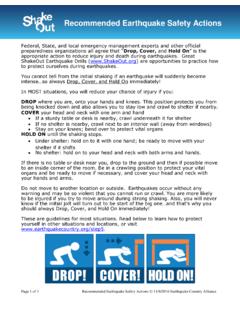
3 Determine what you need in the first days following an earthquake including the basics like food, water and 4 Minimize Financial Hardships (page 11)Organize your important documents, strengthen your property, and consider insurance customized to cover your most needed items. Most businesses lease their space, so it s essential to work with your owner and property manager on addressing structural issues. If you own it, strengthen those weaknesses. Either way, measures taken now can help you keep your doors open. No access, no 5 Drop, Cover, and Hold On (page 12)The ground is shaking, what do you do?
4 Everyone should know how to protect them-selves in any situation. Most often this will be to Drop, Cover, and Hold On, but this can depend on your location. Stay clear of any objects that may fall and stay put until the shaking stops. Copyright 2016 Earthquake Country Alliance, Southern California Earthquake Center at the University of Southern California Reproduction by permission : The suggestions, photos and illustrations included in this document are intended to improve earthquake aware-ness and preparedness; however, they do not guarantee the safety of an individual, organization, or structure.
5 The writers, contributors, and sponsors of this hand-book do not assume liability for any injury, death, financial loss, property damage, or other effect of an earthquake or other steps to a Disaster Resilient workplace was prepared by the Earthquake Country Alliance (ECA) Business Committee in cooperation with the support from members of the ECA and other partners (see cover). Significant funding for the preparation, design and printing of the booklet was provided by the Federal Emergency Management Agency (FEMA), California Governor s Office of Emergency Services (CalOES) and administered by FLASH.
6 (2016 update).Producer: Mark Benthien, SCEC / ECAW riter/Project Lead: In s Pearce, Pearce Global Partners : Amgen Inc.: Chris Wright; NBC Universal: Mike Ripley; Mathews Consulting: Nancy Mathews; Association of Contingency Planners (ACP) Orange County Chapter: Rhonda Russell; CapitalSource Bank: Joe Jaramillo; Jill Ganon Contributors and Supporters: NBC Universal: Bob Cavaglieri; BICEPP/Caltech: Margaret Vinci; FLASH: Barbara Harrison; CalOES: Kate Long; ACP Orange County Chapter: Monique Weiland; Bob Lee; and many other members of the Earthquake Country thanks to additional members of the Business and Industry Council for Emergency Planning and Preparedness (BICEPP) and the Association of Contingency Planners for their : Denton Design Associates: Margi Denton, Elizabeth BurrillPhotography: Ann Elliott CuttingSETTING THE FOUNDATIONI dentify potential hazards.
7 Which hazards pose risks to your organiza-tion, and how? In this step, you will identify what may interrupt your operations tempo-rarily or worse. The priorities you set here will help you in the other 1 Secure Your Space (page 8)Look at the priorities you just identified, where your organization is vulnerable to interruption, and now choose how to mini-mize these risks. As an example, earthquake shaking can move almost anything, even large or heavy items. Imagine your work-place being picked up and shaken sideways what would be thrown around? Learn how to secure these items to prevent damage or injuries to 6 Improve Safety (page 13)Life safety is the top priority after an earth-quake or any Disaster .
8 Activate your own trained personnel to find and help anyone injured, as outside help may not be coming. Next, survey your building for damage or other hazards to prevent further injuries or damage. Decide if safe to 7 Reconnect and Restore (page 14)Once life safety is being addressed, it s time to begin recovery activities to resume operations. Conduct an assessment for operational issues then repair damage. Use your plan to guide your actions and restore priority operations first. Communicate often with employees and key contacts. Docu-ment your lessons learned to determine priorities before the next event.
9 This booklet lists good resources within the content and on the back page. For additional information and details, please visit THROUGH DISASTERS IDENTIFY YOUR NEEDS AND POTENTIAL HAZARDSThe information you gather here will help you prioritize your planning process and create your foundation to complete the steps . In order to plan, you will need to recognize potential hazards and how they may interrupt a part or all of your begin, take a sheet of paper and make a list of your hazards. To simplify this, here are examples of overall hazards that can cause more specific disruptions from a small to a catastrophic scale: earthquakes, fire, flood/water damage, tornado, hurricane, human error, power outage, theft, etc.
10 Most internal/external hazards will fall under one of these. For more ideas of hazards to consider on your list, please visit We will explain how to actually address these hazards later. To begin identifying your potential internal hazards, start by surveying your area. This is as simple as walking around your organiza-tion and neighborhood. Look for hazards both internal to your organization and external to your facility. Ask yourself a few questions to spark issues: What s around me? What should I be concerned with that may interrupt my operations? One of the most common disruption or loss to small organizations is a vulnerability of technology by not backing up computer data at all or only to the desktop, then something happens to the computer taking with it all the pertinent files and information.