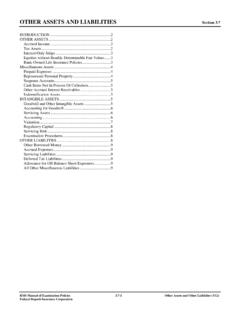
Transcription of Section 1.1 Basic Examination Concepts and …
1 Basic Examination Concepts AND guidelines Section RMS Manual of Examination Policies Basic Examination Concepts and guidelines (11 /19) Federal Deposit Insurance Corporation RATIONALE OF BANK EXAMINATIONS .. 2 CONDUCT OF EXAMINATIONS .. 2 Prohibition Against Political Communication .. 2 RATING SYSTEM .. 2 Introduction .. 2 UFIRS Overview .. 2 Disclosure of Ratings .. 3 Discussions with Management .. 3 Examination Letters .. 4 Examination FREQUENCY .. 4 Alternate Examinations .. 5 Specialty Examination Intervals .. 5 Insured Branches of Foreign Banks .. 5 Examination TYPES .. 6 Risk-Focused Supervision .. 6 Full-Scope 6 Limited-Scope Examinations and Visitations .. 6 Institutions Subject to Corrective Actions .. 7 Newly Chartered Insured Institutions .. 7 Examination and Visitation Cycles .. 7 Monitoring Activities.
2 7 Changes in Business Plans .. 8 Converting to Insured Nonmember Status .. 8 Change of Ownership Control .. 8 COORDINATING Examination SCHEDULES .. 8 State Authorities .. 8 Holding Company Inspections and Subsidiary Institution Examinations .. 8 Interstate Banking and Chain Banks .. 9 SCHEDULING guidelines .. 9 Forward-Looking Supervision .. 9 Scheduling Considerations .. 10 Offsite Analysis and Monitoring .. 10 Other Financial Indicators .. 10 Applications or Other Bank-Provided Data .. 10 Known Characteristics .. 10 Other Bank Regulators .. 11 Media .. 11 Observations/Other .. 11 RELYING ON STATE EXAMINATIONS .. 11 COMMUNICATION BETWEEN 12 Examination PLANNING ACTIVITIES .. 13 Reviewing External Audit Workpapers .. 14 Shared-Loss Agreements .. 14 Examination Considerations .. 14 Other Examination Considerations.
3 15 MEETINGS WITH BANK PERSONNEL .. 15 Meetings with Management .. 16 Examination Planning .. 16 First Day .. 16 Follow-up on Prior Examination Issues .. 16 Strategic Planning and Budget .. 16 Loan Discussion .. 16 Material Preliminary Findings .. 16 Management Meetings .. 16 Meetings with Directors .. 17 Banks Assigned a Composite Rating of 4 or 5 .. 17 Banks Assigned a Composite Rating of 3 .. 17 Banks Assigned a Composite Rating of 1 or 2 .. 17 Other Considerations .. 17 OTHER SOURCES OF INFORMATION .. 18 Trust Department .. 18 Information Technology .. 18 Bank Secrecy 19 Consumer Protection .. 19 Summary .. 19 DISCLOSING REPORTS OF Examination .. 19 Examination WORKPAPERS .. 20 Introduction .. 20 Safeguarding Examination Information .. 20 Examination Documentation (ED) Modules .. 20 Substance of Workpapers.
4 21 Filing of Workpapers .. 21 Retention of Workpapers .. 22 ADDENDUM TO Section .. 23 UFIRS RATINGS DEFINITIONS .. 23 Composite Ratings .. 23 Composite 1 .. 23 Composite 2 .. 23 Composite 3 .. 23 Composite 4 .. 23 Composite 5 .. 23 Component Ratings .. 24 Capital Adequacy .. 24 Asset Quality .. 24 Management .. 25 Earnings .. 26 Liquidity .. 27 Sensitivity to Market Risk .. 28 Basic Examination Concepts AND guidelines Section Basic Examination Concepts and guidelines (12 /19) RMS Manual of Examination Policies Federal Deposit Insurance Corporation RATIONALE OF BANK EXAMINATIONS The Federal Deposit Insurance Corporation conducts bank examinations to ensure public confidence in the banking system and to protect the Deposit Insurance Fund. Maintaining public confidence in the banking system is essential because customer deposits are a primary funding source that depository institutions use to meet fundamental objectives such as providing financial services.
5 Safeguarding the integrity of the Deposit Insurance Fund is necessary to protect customers deposits and resolve failed banks. Onsite examinations help ensure the stability of insured depository institutions by identifying undue risks and weak risk management practices. Examination activities center on evaluating an institution s capital, assets, management, earnings, liquidity, and sensitivity to market risk. Evaluating a bank s adherence to laws and regulations is also an important part of bank examinations and is given high priority by Congress and bank supervisors. Finally, bank examinations play a key role in the supervisory process by helping the FDIC identify the cause and severity of problems at individual banks and emerging risks in the financial-services industry.
6 The accurate identification of existing and emerging risks helps the FDIC develop effective corrective measures for individual institutions and broader supervisory strategies for the industry. CONDUCT OF EXAMINATIONS Given the fundamental reasons for conducting examinations, regulatory personnel must have access to all records and employees of a bank during an Examination . Sections 10(b) and (c) of the Federal Deposit Insurance Act (FDI Act) empower examiners to make a thorough Examination of a bank s affairs. Examiners should contact their regional office for guidance if faced with serious impediments to an Examination , including uncooperative executive officers, or restricted access to bank employees or records.
7 The regional office will determine an appropriate solution to enable examiners to obtain the information needed to complete the Examination . In such cases, examiners should document all significant Examination obstacles and the regional office s resolution of the situation. Prohibition Against Political Communication FDIC employees should avoid any form of political communication with insured depository institutions that could be perceived as suggesting the Examination process is influenced by political considerations, or that the bank should take a particular position on legislative issues. Examinations must be kept free from political considerations, or the appearance of being influenced by political considerations, in order to maintain the integrity and effectiveness of the Examination process.
8 FDIC employees should promptly inform their regional office of any situation they feel compromised this policy. RATING SYSTEM Introduction The Uniform Financial Institutions Rating System (UFIRS) was adopted by the Federal Financial Institutions Examination Council (FFIEC) on November 13, 1979, and updated in December 1996. Over the years, the UFIRS proved to be an effective supervisory tool for evaluating financial institutions on a uniform basis and for identifying institutions requiring special attention. Changes in the banking industry and regulatory policies prompted a revision of the 1979 rating system. The 1996 revisions to the UFIRS include the addition of a sixth component addressing sensitivity to market risk, the explicit reference to the quality of risk management processes in the management component, and the identification of risk elements within the composite and component rating descriptions.
9 The UFIRS takes into consideration certain financial, managerial, and compliance factors that are common to all institutions. Under this system, the supervisory agencies endeavor to ensure all financial institutions are evaluated in a comprehensive and uniform manner, and that supervisory attention is appropriately focused on institutions exhibiting financial and operational weaknesses or adverse trends. The UFIRS also serves as a useful vehicle for identifying institutions with deficiencies in particular component areas. Further, the rating system assists Congress in assessing the aggregate strength of the financial industry and following risk management trends. As such, the UFIRS assists regulatory agencies in fulfilling their mission of maintaining stability and public confidence in the nation s financial system.
10 UFIRS Overview Basic Examination Concepts AND guidelines Section RMS Manual of Examination Policies Basic Examination Concepts and guidelines (11 /19) Federal Deposit Insurance Corporation Under the UFIRS, each financial institution is assigned a composite rating based on an evaluation of six financial and operational components, which are also rated. The component ratings reflect an institution s capital adequacy, asset quality, management capabilities, earnings sufficiency, liquidity position, and sensitivity to market risk (commonly referred to as CAMELS ratings). When assigning ratings, examiners consider an institution s size and sophistication, the nature and complexity of its activities, and its general risk profile.