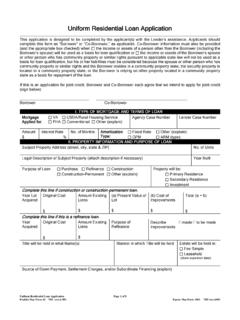
Transcription of Section 5 The Uniform Residential Loan …
1 Uniform Residential loan Application (1003)- Section 5 of the MMB course Copyright 2007, The Wealth Preservation Institute ( ) 1 Section 5 The Uniform Residential loan Application (1003) The first thing that you should have complete, before you seriously start working on a loan (or spend a lot of time on it) is a Uniform Residential loan Application. What we affectionately call the 1003. This number is the Fannie Mae form number you see in the lower left-hand corner of this form. It should also be noted here that in late 2005 HUD came out with a newly revised 1003 and this should be the one you use after January 1, 2006.
2 To be certain of this, the lower left-hand corner of this newly revised 1003 should read as Fannie Mae Form 1003 07/05 and the right-hand corner of this form should read as Freddie Mac Form 65 07/05. This newly revised 1003 provides you, and your targeted Lenders, with the following form changes and additions: Increased the 1003 from (previously) 4 legal size pages to about 5 standard size pages; The total of pages on this new 1003 could be increased from 5 pages to 8 pages, depending upon the information obtained from a borrower. These additional pages could be the result of additionally needed space to write the borrower s: 1.
3 Employment Information 2. Assets and Liabilities, and 3. Additionally listed Real Estate Owned Has within it additional statements of information and clarification. When completing a loan application on your customers make sure you have the most recent and revised 1003. If a 1003 is not completely done or completed incorrectly then it was a sure sign a loan Officer had most likely received little, if any, training. This course material will give you the training that you need to completely and accurately fill out a 1003. There are reasons beyond just the mortgage for the information that you will obtain, such as other financial planning opportunities.
4 And that is one of the main reasons the MMB course was created. To provide a manual and reference for those loan Officers/MMBs , that would like to have that information available - to help them to do their job professionally and completely. When this is done it is easy to see the productivity increase and in turn the earning potential increase. Uniform Residential loan Application (1003)- Section 5 of the MMB course Copyright 2007, The Wealth Preservation Institute ( ) 2 The 1003 At this point it would be wise if you would print off the 1003 from the attached Exhibits (IV) and have it in front of you as you go through this material.
5 If you have a copy of all 5 pages of the 1003 then please get a hold of it now. As you can see, from this Exhibit, there are not only 5 pages but 8 pages. And, if you look at the last four pages of the 1003 within this Exhibit, you can see that each page number (at the bottom) states 5 of 5. How can that be? Well, your use of which (or all of these pages) will be based on whether or not you actually need those additional pages when completing the loan application on a particular loan inquiring customer. Don t worry about that for now. This will be discussed as we go along here - so you will be very clear on this. Now, when someone refers to the 1003 they are referring to this entire form, which could contain from 5 - 8 pages.
6 As you can see, when you look this form over, it is made up of different sections: Ten sections to be exact. For our purposes of discussion here we will cover each Section in the order that you would normally complete it when meeting with your customers. Also, as we discuss each Section , you will learn why that Section is important and what you, as an MMB , need to be looking for and what questions to ask. As mentioned before, when we are completing the 1003, we should have our Mortgage Detective hat on: Asking questions, getting answers, and always asking ourselves: - Do the answers you are getting regarding this area of inquiry make sense?
7 - Are you missing anything here or need to explore further (in asking questions) to gain more information that might be helpful in doing this loan ? The 1003 is the most important form you will initially complete and once completed it should tell you most of what you need to know regarding your prospective customers. PARAGRAPH AT TOP OF THE PAGE: While this isn t actually a Section of the 1003 it does begin this form by making a statement that asks whether other income, in addition to the Primary Borrower, will be used in qualifying for this loan .
8 You can see, within that statement, that there are two separate boxes to be checked. If there is a Co-Borrower on this loan (it could be the Spouse or someone else) and the Co-borrower s income will be used, in qualifying for that loan , then check that box. Uniform Residential loan Application (1003)- Section 5 of the MMB course Copyright 2007, The Wealth Preservation Institute ( ) 3 If the Borrower is married but does not wish to include the income of the other Spouse, in qualifying for this loan , then this second box would be checked. However, in Community Property States, even though the Spouse s (Co-borrower s) income is not used that Spouse s Liabilities would still need to be included in qualifying that Borrower.
9 This is because in Community Property states those (the liabilities) are essentially in both their names. Once you have checked off one of those boxes, within that paragraph,, then look below. It states there that if that loan application is for joint credit (filing Jointly) then the Borrower and Co-Borrower both need to sign their names indicating that they do indeed intend to jointly apply for that loan . Immediately below that is our first actual Section of this 1003: Section I: TYPE OF MORTGAGE AND TERMS OF loan Here is where you indicate what type of loan you will be submitting your loan on.
10 It also asks here for the loan Amount, Interest Rate, Number of Months (term), and whether the Amortization Type will be: Fixed, GRP (for a Graduated Payment Mortgage - you rarely see these anymore), Other, or ARM. When you are first meeting with your customers it is sometimes difficult to assess, with any certainty, what the amount of their loan will be, its interest rate, or its term. However, you should know that - that is exactly what HUD is expecting of you. The thinking here is that after you have completed the 1003 then the customers will sign it. Once your customers have signed it, then there should be no changes on this form after that.