Example: marketing
Selective Search for Object Recognition
techniques and stronger appearance models for object recognition. In this paper we show that our selective search enables the use of the powerful Bag-of-Words model for recognition. The Selective Search software is made publicly available 1. 1 Introduction For a long time, objects were sought to be delineated before their identification.
Tags:
Information
Domain:
Source:
Link to this page:
Related documents

Deep Learning for Generic Object Detection: A Survey
link.springer.com12 Visual object recognition Grauman and Leibe (2011) 2011 Tutorial Instance and category object recognition techniques 13 Object class detection: a survey Zhang et al. (2013) 2013 ACM CS Survey of generic object detection methods before 2011 14 Feature representation for

ImageNet Large Scale Visual Recognition Challenge
arxiv.orgation of object recognition algorithms and in developing new techniques. Novel algorithmic innovations emerge with the availability of large-scale training data. The broad spectrum of object categories motivated the need for algorithms that are even able to distinguish classes which are visually very similar. We highlight the most

CNNs for Face Detection and Recognition
cs231n.stanford.edudevelopment of object classification, localization and detec-tion techniques. 2.1. Sliding Window In the early development of face detection, researchers tended to treat it as a repetitive task of object classifica-tion, by imposing sliding windows and performing object classification with the neural networks on the window re-gion.

Theory of Cognitive Pattern Recognition
cdn.intechopen.comhuman perception of the size of object keeps constant. The size of image on the human Open Access Database www.i-techonline.com retina directly depends on the distan ce between the object and our eyes. Source: Pattern Recognition Techniques, Technology and Applications, Book edited by: Peng-Yeng Yin,

Selective Search for Object Recognition
staff.fnwi.uva.nlHence without prior recognition it is hard to decide that a face and a sweater are part of one object ( Tu et al. 2005). This has led to the opposite of the traditional approach: to do localisation through the identification of an object. This recent approach in object recognition has made enor-mousprogressinlessthanadecade(DalalandTriggs2005;
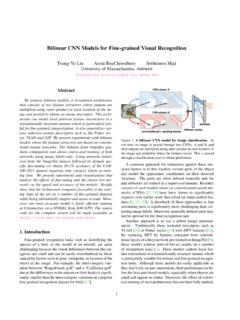
Bilinear CNN Models for Fine-grained Visual Recognition
vis-www.cs.umass.eduFine-grained recognition tasks such as identifying the species of a bird, or the model of an aircraft, are quite challenging because the visual differences between the cat-egories are small and can be easily overwhelmed by those causedbyfactorssuchaspose,viewpoint,orlocationofthe object in the image. For example, the inter-category vari-

You Only Look Once: Unified, Real-Time Object Detection
pjreddie.comWe present YOLO, a new approach to object detection. Prior work on object detection repurposes classifiers to per-form detection. Instead, we frame object detection as a re-gression problem to spatially separated bounding boxes and associated class probabilities. A single neural network pre-dicts bounding boxes and class probabilities directly ...