Transcription of Simple Field Tests for Water Quality
1 Simple Field Tests for Water Quality By Josh Kearns January 2008. This document describes the procedures and equipment needed to conduct three Simple Water Quality assessments in the Field : measuring turbidity and dissolved iron concentration, and detecting the presence of potentially harmful microbial contaminants. ( testing for pesticides in source waters requires sophisticated laboratory equipment and specialized chemical reagents that are not readily available and are expensive and thus beyond the capabilities of on- site analysis.)
2 Measuring turbidity1. Turbidity (cloudiness owing to suspended solids and/or organic matter) in the source Water may cause clogging of sand and charcoal filtration units. Turbidity also reduces transmittance of UV light through Water and thus markedly reduces the effectiveness of UV disinfection. Suspended particles in the Water absorb UV energy or shadow microbes from the UV radiation. If turbidity is too high, Water passing under the lamp may not receive the minimum dosage necessary to inactivate microbial contaminants.
3 There are several ways of quantifying turbidity in Water , the most common being some measure of the attenuation (reduction in strength) of light as it passes through a column of Water . Electronic turbidity meters are the most precise; however, they are expensive. A turbidity tube is inexpensive and easy to construct, and provides an approximate measurement of turbidity with sufficient accuracy for Field Water Quality assessments. A turbidity tube can be readily constructed using clear tubing (glass or plastic) 3 4 cm in diameter (~1 !)
4 - 1 " in.). and ~ 70 cm (~ 28 in.) in length. The tube is capped at one end with PVC or plastic and sealed with silicone. A. Secchi disk is drawn on the inside of the cap using waterproof marker or black and white paint as shown: Page 1 of 6. Simple Field Tests for Water Quality The tube is marked along its length according to the scale: Distance Turbidity cm NTU. 500. 300. 200. 100. 50. 19 30. 25 20. 10. 63 5. NTU stands for Nephelometric Turbidity Unit, a common unit for recording measurements of turbidity. Sand filters can accommodate occasional turbidity up to 50 NTU without excessive clogging; however, average turbidity over time must not exceed 20.
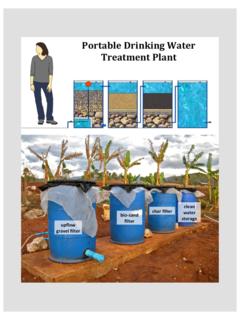
5 25 NTU to avoid frequent clogging problems. Allowing source Water to stand for several hours permits particles to settle out, reducing turbidity. Also, an upflow roughing filter using coarse media such as pea gravel can be used to remove excess turbidity. Source Water must have turbidity no greater than 5 NTU for disinfection by UV radiation to be effective. To measure turbidity, slowly add sample Water to the tube and record the depth (in cm) at which the Secchi disk becomes invisible. It is helpful to stand with your back to the sun and rotate the tube as you look for the lines of the disk.
6 Avoid creating bubbles when pouring Water into the tube as these interfere with accuracy. Rough estimates of turbidity in NTU can be read directly off the tube using these calibrated markings. More precise estimates can be made by imputing distance measurements (in cm) into the following equation and solving for turbidity: log(T) = (d) + where T is turbidity in NTU and d is distance in cm. Page 2 of 6. Simple Field Tests for Water Quality Empirical relationship between turbidity and visibility distance. Measuring dissolved iron concentration2.
7 Excess iron in Water used for drinking, cooking and washing imparts unappealing color and taste, and reduces the effectiveness of UV disinfection by impairing transmittance of UV light through Water . If the amount of iron in a Water supply is above the US EPA and World Health Organization guideline of mg/l ( ppm), the Water can cause staining of laundry or discoloration of faucets and basins. However, even high concentrations of iron are not considered a health problem. Simple , inexpensive iron Tests are commercially available in most places.
8 The SenSafe Iron Check kit (catalog number 480125 ITS) is available from Industrial Test Systems (1-800-861-9712, ), costs about US $25 (inc. s/h within the US), and includes 30 test strips. If the source Water has iron concentration greater than the US EPA and World Health Organization guideline of ppm ( mg/L) then pretreatment is necessary to ensure complete UV disinfection. A slow-sand filter is an effective means for precipitating excess iron from solution. Page 3 of 6. Simple Field Tests for Water Quality Detecting microbial contaminants Of primary concern among the wide variety of potential microbiological contaminants of drinking Water are fecal coliforms.
9 Fecal coliforms are present in the intestinal tracts of all mammals and frequently are detected in environmental waters exposed to feces. Although most fecal coliforms are not harmful to humans in small concentrations, many coliforms at high concentrations can cause a variety of diseases such as typhoid fever and dysentery. Furthermore, some coliforms, such as strain 0157-H7, can be deadly even at low concentrations. Direct testing for bacterial pathogens is often impractical and requires lengthy and complex test procedures, making the use of indicator organisms routine.
10 Indicator organisms are present when pathogens are present and absent when pathogens are absent. Indicator species are usually of fecal origin, though themselves are usually not pathogenic. Hydrogen sulfide-producing bacteria are often associated with the presence of fecal coliforms and thus can be used as indicator organisms. Hydrogen sulfide (H2S) is a gas that reacts with iron in solution to form iron sulfide, and insoluble black precipitate. This precipitate is easily visible and thus is taken to indicate a positive test.