Transcription of SOCIAL SCIENCE - CBSE
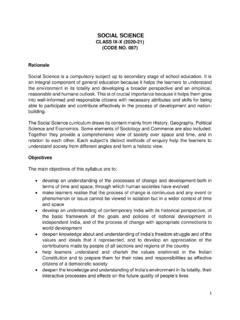
1 1 SOCIAL SCIENCE CLASS IX-X (2021-22) (CODE NO. 087) Rationale SOCIAL SCIENCE is a compulsory subject up to secondary stage of school education. It is an integral component of general education because it helps the learners to understand the environment in its totality and developing a broader perspective and an empirical, reasonable and humane outlook. This is of crucial importance because it helps them grow into well-informed and responsible citizens with necessary attributes and skills for being able to participate and contribute effectively in the process of development and nation-building.
2 The SOCIAL SCIENCE curriculum draws its content mainly from History, Geography, Political SCIENCE and Economics. Some elements of Sociology and Commerce are also included. Together they provide a comprehensive view of society over space and time, and in relation to each other. Each subject s distinct methods of enquiry help the learners to understand society from different angles and form a holistic view. Objectives The main objectives of this syllabus are to: develop an understanding of the processes of change and development-both in terms of time and space, through which human societies have evolved make learners realise that the process of change is continuous and any event or phenomenon or issue cannot be viewed in isolation but in a wider context of time and space develop an understanding of contemporary India with its historical perspective.
3 Of the basic framework of the goals and policies of national development in independent India, and of the process of change with appropriate connections to world development deepen knowledge about and understanding of India s freedom struggle and of the values and ideals that it represented, and to develop an appreciation of the contributions made by people of all sections and regions of the country help learners understand and cherish the values enshrined in the Indian Constitution and to prepare them for their roles and responsibilities as effective citizens of a democratic society 2 deepen the knowledge and understanding of India s environment in its totality.
4 Their interactive processes and effects on the future quality of people s lives facilitate the learners to understand and appreciate the diversity in the land and people of the country with its underlying unity develop an appreciation of the richness and variety of India s heritage-both natural and cultural and the need for its preservation promote an understanding of the issues and challenges of contemporary India- environmental, economic and SOCIAL , as part of the development process help pupils acquire knowledge.
5 Skills and understanding to face the challenges of contemporary society as individuals and groups and learn the art of living a confident and stress-free life as well as participating effectively in the community develop scientific temperament by promoting the spirit of enquiry and following a rational and objective approach in analysing and evaluating data and information as well as views and interpretations develop academic and SOCIAL skills such as critical thinking, communicating effectively both in visual and verbal forms - cooperating with others, taking initiatives and providing leadership in solving others problems develop qualities clustered around the personal, SOCIAL , moral, national and spiritual values that make a person humane and socially effective.
6 COURSE STRUCTURE CLASS IX (2021-22) Theory Paper Time: 3 Hrs. Max. Marks: 80 No. Units No. of Periods Marks I India and the Contemporary World I 60 20 II Contemporary India I 55 20 III Democratic politics - I 50 20 IV Economics 50 20 Total 215 80 COURSE CONTENT Unit 1: India and the Contemporary World I 60 Periods Themes Learning Objectives Section 1: Events and Processes.
7 (All the three themes are compulsory) In each of the themes in this unit students would get familiarized with distinct ideologies, extracts of 3 I. The French Revolution French Society During the Late Eighteenth Century The Outbreak of the Revolution France Abolishes Monarchy and Becomes a Republic Did Women have a Revolution? The Abolition of Slavery The Revolution and Everyday Life II. Socialism in Europe and the Russian Revolution The Age of SOCIAL Change The Russian Revolution The February Revolution in Petrograd What Changed after October?
8 The Global Influence of the Russian Revolution and the USSR III. Nazism and the Rise of Hitler Birth of the Weimar Republic Hitler s Rise to Power The Nazi Worldview Youth in Nazi Germany Ordinary People and the Crimes Against Humanity Section 2: Livelihoods, Economies and Societies Any one theme of the following IV. Forest Society and Colonialism Why Deforestation? The Rise of Commercial Forestry speeches, political declarations, as well as the politics of caricatures, posters and engravings.
9 Students would learn how to interpret these kinds of historical evidences. Familiarize with the names of people involved, the different types of ideas that inspired the revolution, the wider forces that shaped it. Know the use of written, oral and visual material to recover the history of revolutions. Explore the history of socialism through the study of Russian Revolution. Familiarize with the different types of ideas that inspired the revolution.
10 Discuss the critical significance of Nazism in shaping the politics of modern world. Get familiarized with the speeches and writings of Nazi Leaders. Discuss the SOCIAL and cultural world of forest communities 4 Rebellion in the Forest Forest Transformations in Java V. Pastoralists in the Modern World Pastoral Nomads and their Movements Colonial Rule and Pastoral Life Pastoralism in Africa through the study of specific revolts.