Transcription of Sodium Tolyltriazole 50% Solution
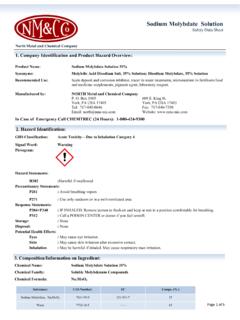
1 Page 1 of 6 NORTH Metal and Chemical Company Sodium Tolyltriazole 50% Solution Safety Data Sheet 1. Company Identification and Product Hazard Overview: Product Name: Sodium Tolyltriazole 50% Solution Synonyms: Sodium Salt of Tolyltriazole , TTA-Na, Sodium 4-methyl-1H-benzotriazolide Solution , TT50%, TTA50% Recommended Use: Corrosion Inhibitor in water treatment programs. Protects copper piping. Used in aircraft deicing, engine coolants and cleaners. Manufactured for: NORTH Metal and Chemical Company P. O. Box 1985 609 E. King St. York, PA USA 17405 York, PA USA 17403 Tel: 717-845-8646 Fax: 717-846-7350 Email: Website: In Case Of Emergency Call CHEMTREC (24 Hours): 1-800-424-9300 2.
2 Hazard Identification: GHS Classification: Skin Corrosion/Irritation (Category 1B) Eye Damage/Irritation (Category 1) Acute Oral Toxicity (Category 4) Environmental, Hazards to the aquatic environment (Category 3) Acute Toxicity, Inhalation (Category 5) Signal Word: DANGER Pictograms: Hazard Statements: H302 : Harmful if swallowed. H314 : Causes severe skin burns and eye damage H318 : Causes serious eye damage H402 : Harmful to aquatic life H333 : May be harmful if inhaled Precautionary Statements: P260 : Do not breathe mist/vapors/spray P280 : Wear protective gloves, protective clothing such as apron, boots and safety glasses with side shields. P303 + P353 +P363 : If on skin or hair: rinse skin with water/shower. Wash contaminated clothing before reuse P310 : Immediately call a doctor or physician if serious eye and skin damage develops.
3 P264 : Wash all affected body parts thoroughly after handling with water. P270 : Do not eat, drink or smoke when using this product. P303 + P361 + P353 : IF ON SKIN (or hair): Take off immediately all contaminated clothing. Rinse skin with water/shower. P363 : Wash contaminated clothing before reuse. P305 + P351 + P338 : IF IN EYES: Rinse cautiously with water for several minutes. Remove contact lenses, if present and easy to do. Continue rinsing. P301 + P330 + P331 : IF SWALLOWED: Rinse mouth. Do Not induce vomiting P304 + P340 : IF INHALED: Remove victim to fresh air and keep at rest in a position comfortable for breathing. P321 : Immediately call a doctor if you feel unwell. P273 : Avoid release to the environment. P501 : Dispose of contents/container in accordance with local/state/federal regulations.
4 Page 2 of 6 3. Composition/Information on Ingredient: Chemical Name : Sodium Tolyltriazole 50% Solution Chemical Family : Azoles. Chemical Formula/ Structure : Substance: CAS Number: EC Compo. (% ) Tolyltraizole Sodium Salt 64665-57-2 265-004-9 49 - 51 Water 7732-18-5 49 - 51 4. First Aid Measures: Eyes : Flush skin with running water for at least fifteen minutes. Remove any contact lenses. Get medical aid/ attention immediately. Skin : Remove contaminated clothing. Wash skin with plenty of running water and soap. Get medical attention/ aid if irritation persists. Contaminated clothing should be thoroughly washed before reuse. Ingestion : If the product is swallowed, first rinse mouth. Give small amount of water to drink. Call doctor/ physician/poison center immediately.
5 Do not induce vomiting. Never give anything by mouth to an unconscious person. If a person vomits, place him/her in recovery position so the vomit does not enter lungs. Inhalation : If safe to do so, remove individual from further exposure. Keep warm and at rest. If breathing has ceased, give artificial respiration. Do not give mouth to mouth resuscitation. Get medical attention/ consult a physician immediately. Note to Physician : Treat symptomatically. PPE for first responders : Gloves and safety goggles are highly recommended. 5. Fire Fighting Measures: Flash Point ( C) : 170 C (closed up) Flammable Limits : Not available. Autoignition Temp. : Not available. Flammable Class : Not available. Flame Propagation or Burning Rate of Solids : Not available.
6 General Hazard : Evacuate personnel downwind in-order to avoid inhalation of irritating and/or harmful fumes and smoke. Unusual Fire or Explosion Hazards : Harmful vapors may evolve during fire. Material can splatter above 100 C/212 F. Cool exposed containers with water spray to prevent over heating. Dry residue of the product may also burn. Extinguishing Media : Water spray, dry powder, or chemical-type foam. Appropriate for the surrounding area. Hazardous Combustion Products : Carbon monoxide, carbon dioxide, nitrogen oxides. Fire Fighting Procedures : Hazardous decomposition and combustion products such as carbon/nitrogen oxides can be formed if product is burning. Cool exposed containers with water spray to prevent over heating.
7 Fire Fighting Equipment : Respiratory and eye protection are required for fire fighting personnel. Full protective equipment (bunker gear) and self-contained breathing apparatus (SCBA) should be used for all fires. Evacuate area and fight fire from safe distance or a protected location. Move fire-exposed containers, if allowable without sacrificing the safety of the firefighters. If possible, firefighters should control run-off water to prevent environmental contamination. Sensitivity to Static Discharge : Not sensitive. Sensitivity to Mechanical Impact : Not sensitive. Safety Data Sheet Sodium Tolyltriazole 50% Page 3 of 6 6. Accidental Release Measures: Protective Gear for Personnel: For Small Spill : Safety glasses or chemical splash goggles, chemically resistant gloves (rubber/latex), chemically resistant boots, and any appropriate body protection to minimize direct contact to the skin.
8 For Large Spill : Triple gloves (rubber and nitrile over latex), chemical resistant suit, boots, hard hat, full face mask/an air purifying respirator (NIOSH approved). Self contained breathing apparatus must be worn in situations where fumigant gas generation and low oxygen levels are a consequence of contamination from the leak. Spill Clean-up Procedures: For Small Spill : In the event of a small spill, the leak should be contained with an absorbent pad and placed in a properly labeled waste disposal container immediately. Clean the spill area with water. Do not let chemical waste enter the environment. For Large Spill : In the event of a large spill, contain the spill immediately and dispose according to state, federal, and local hazardous waste regulation.
9 Environmental Precaution : Water spill: use appropriate containment to avoid run off or release to sewer or other waterways. Land spill: use appropriate containment to avoid run off or release to ground. General precaution: remove containers of strong acid and alkali from the release area. Release Notes : If spill could potentially enter any waterway, including intermittent dry creeks, contact local authorities. 7. Handling and Storage: Handling : Avoid contact with eyes, skin, and clothing. Do not taste or swallow. Do not inhale vapor or mist. Use with adequate ventilation. For industrial use only! Keep away from sources of ignition. Handle in a manner consistent with good industrial/manufacturing techniques and practices. Wash hands thoroughly with soap and water after use.
10 Remove contaminated clothing and protective equipment before entering eating areas. Storage : Store in a cool, dry well-ventilated area. Keep containers closed when not in use. Keep product isolated from incompatible materials/conditions. Storage Temperature >=0 C. Store away from acids, oxidizing agents and metals. 8. Exposure Controls and Personal Protection: Engineering Controls : Good general ventilation should be used. Ventilation rates should be matched to conditions. If applicable, use process enclosures, local exhaust ventilation, or other engineering controls to maintain airborne levels below recommended exposure limits. If exposure limits have not been established, maintain airborne levels to an acceptable level.