Transcription of Solving Radical Equations - Metropolitan Community …
1 Solving Radical Equations . Index or Root + = . Radicand Solving Equations requires isolation of the variable. Equations that contain a variable inside of a Radical require algebraic manipulation of the equation so that the variable comes out from underneath the Radical (s). This can be accomplished by raising both sides of the equation to the nth power, where n is the index or root of the Radical . When the index is a 2 ( a square root), we call this method squaring both sides. Sometimes the equation may contain more than one Radical expression, and it is possible that the method may need to be used more than once to solve it. When the index is an even number (n = 2, 4, etc.) this method can introduce extraneous solutions, so it is necessary to verify that any answers obtained actually work. This can be accomplished by plugging the answer(s) back in to the original equation to see if the resulting values satisfy the equation. It is also good practice to check the solutions when there is an odd index to identify any algebra mistakes.
2 General Solution Steps: Step 1. Isolate the Radical (s) and identify the index (n). Step 2. Raise both sides of the equation to the nth power. Step 3. Use algebraic techniques ( factoring, combining like terms, ) to isolate the variable. Repeat Steps 1 and 2 if necessary. Step 4. Check answers. Eliminate any extraneous solutions from the final answer. Examples: a. = (Problem with 1 Radical ). Step 1: Isolate the Radical 5 = 3 Step 4: Check Answers . Step 2: Square both Sides 5 = 3 5 4 3 = 0. Step 3: Solve for x : 5 =9 9 3 = 0. = 4 3 3=0. = 0=0 . b. + = 0 (Problem with 2 radicals and no other non-zero terms). Step 1: Isolate the radicals 2 = + 4.. Step 2: Square both Sides 2 = + 4 . Step 3: Solve for x : 2 = + 4. 6 = 0. + 2 3 = 0. = =. 1. Step 4: Check Answers 2 2 2 + 4 = 0 3 2 3 + 4 = 0. 4 2 2 = 0 9 2 7 = 0. 2 2 = 0 7 7 = 0. 0=0 0=0 . c. " # " + $ + = (Problem with 2 radicals and another non-zero term). Step 1: Isolate the radicals so that they are on opposite sides of the = sign % 6 + 3 = % + 9.
3 Step 2: Square both Sides % 6 + 3 = % + 9 . This term will need to be FOIL-ed . Step 3: Solve for x . Because a Radical still remains during this process, repeat Steps 1 and 2. FOIL % 6 % 6 + 3 % 6 + 3 % 6 + 3 3 = % + 9. Combine like terms % 6 + 6 % 6 + 9 = % + 9. % + 3 + 6 % 6 = % + 9. Radical still remains 6 % 6 = 6 Step 4: Check Answer (Repeat Step 1) % 6 = 1 7 6 7 + 9 + 3 = 0.. (Repeat Step 2) % 6 = 1 1 16 + 3 = 0. % 6=1 1 4+3= 0. "=( 0=0 . d. + #= (Problem with an nth root). ). Step 1: Isolate the Radical 6 = 2 Step 4: Check Answer ). Step 2: Raise both sides to the nth power (n = 3) 2 6 = 2. ) * ). 6 = 2 * 8 = 2. ). Step 3: Solve for x : 6 = 8 2 2 2 = 2. = 2 = 2 . 2. Radical Equations can also be re-written in their exponential form and then both sides raised to the reciprocal power. This method can be more efficient if the radicand is raised to a power as in the example below. (Note: the reciprocal power can be found by flipping the fractional power upside down.
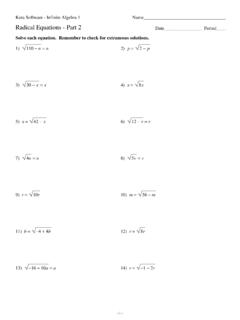
4 E. 2 = 4 (Problem with a radicand that is raised to a power). Option 1: ( nth power) Option 2: (reciprocal power). ). Step 1: Isolate the Radical 2 = 4 Step 1: Isolate & Re-Write in Exponential Form , Step 2: Raise both sides to the nth power 2 ) = 4. ). *. - 2 . = 4 * Step 2: Raise both sides to the reciprocal power , ). Step 3: Solve for x : 2 = 64 / 2 ) 0 = 142, , 2 = 64 2 4 = 4*. =2 8 Step 3: Solve for x 2 = 64. = # 5 =2 8. Step 4: A check shows that both solutions = # 5. work in the original equation. Radical Equations Practice Problems Problem Answer 1. + 1 = 4 = 15. 2. 26 + 15 = 6 6 = 5 7869: 6 = 3 ;< = 6> ?98@< . 3. A 4 = 5 No Solution 4. 2 = 2 = 2 7869: = 1 ;< = 6> ?98@< . 5. < 1 = 5< 5 < = 1, 4. ). 6. = 4 = 64. C. 7. 2A + 2 = 3 A = 39. ) ). 8. + 1 = 5 = 2, 3. 9. 2 = = 1 7869: = 4 ;< = 6> ?98@< . 10. 36 + 1 + 5 6 = 4 6 = 1, 5. DE. 11. 8 A = 2 + 2A + 3 A = 1 7869: A =. F. ;< = 6> ?98@< . ). 12. 4 + 2 8 = = 2 , 2 , 4. ). 13. 4 = 1 = 3, 5. ).
5 14. + 1 * = 9 = 1 + 3 3. 15. < * = 4 No Solution 3.