Transcription of Specification Sheet: Alloy 17-4PH - Sandmeyer Steel
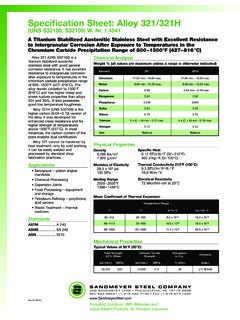
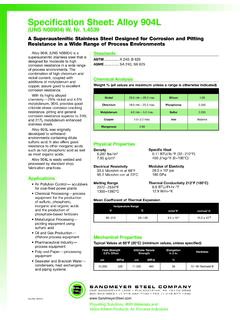
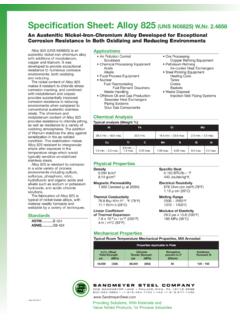
1 Alloy 17-4PH (UNS s17400 ), Type 630, is a chromium-nickel-copper precipitation-hardening martensitic stainless Steel with an addition of niobium. 17-4PH combines high strength and hardness with good corrosion resistance. The Alloy is furnished in the solution annealed condition (Condition A). It should not be used at temperatures above 572 F (300 C) or for cryogenic service. Optimal mechanical properties can be obtained by subjecting the Alloy to age hardening heat treatments. Heat treatment in the 900 F (482 C) range produces the highest corrosion resistance of Alloy 17-4PH is comparable to 304 stainless Steel in most environments, and is generally superior to the 400 series stainless steels. It is used in applications where the combination of moderate corrosion resistance and unusually high strength are 17-4PH can be easily welded and processed by standard shop fabrication practices.
2 It is magnetic. Applications Aerospace structural and parts Biomedical hand tools Chemical Processing Food Process Equipment Gate Valves Mechanical Components Nuclear Waste Processing and Storage Oil and Gas Production foils, helicopter deck platforms, etc. Pulp and Paper paper mill equipmentStandardsASTM ..A 693 ASME ..SA 693 AMS ..560417-4PH 04 Steel COMPANYONE Sandmeyer LANE PHILADELPHIA, PA 19116-3598800-523-3663 +1-215-464-7100 FAX +1-215-677-1430 Providing Solutions, With Materials andValue Added Products, for Process IndustriesSpecification sheet : Alloy 17-4PH (UNS s17400 ) W. Nr. Type 630A Precipitation-Hardening Martensitic Stainless with High Strength and Hardness and Good Corrosion ResistanceChemical AnalysisWeight % (all values are maximum unless a range is otherwise indicated) Chromium min.
3 Max. Phosphorus Nickel min. max. Sulfur Copper min. max. Silicon Carbon Niobium plus Tantalum min. max. Manganese Iron BalancePhysical Properties (Condition A)Density Ibs/in3 g/cm3 Electrical Resistivity Microhm-in at 75 F 75 Microhm-cm at 24 CMelting Range 2560 2625 F 1404 1440 CSpecific Heat BTU/lb- F @ 70 F 460 J/kg- C @ 20 CModulus of Elasticity x 106 psi 196 GPaThermal Conductivity 212 F (100 C) BTU-in/ft2 - hr- F W/m- CMechanical PropertiesRoom temperature properties (longitudinal direction)Guaranteed values (ASTM A693 hot rolled plates).
4 Mean Coefficient of Thermal Expansion 70 800 21 427 x 10-6 x 10-6in/in Fcm/cm C F CTemperature RangeTable 1 MPa ksi MPa ksi % Hardening 496 C (925 F) Min. 1070 155 1170 170 8 4 hours air cooling Typ. 1207 175 1310 190 14 Hardening 593 C (1100 F) Min. 790 115 965 140 10 4 hours air cooling Typ. 931 135 1034 150 17 UTS Elongation HEAT TREATMENTF abrication Data Alloy 17-4PH can be easily welded and processed by standard shop fabrication practices.
5 It is magnetic. Heat TreatmentAlloy 17-4PH is provided in the solution-annealed condition (Condition A). Mechanical properties may be altered by subsequent age hardening treatments. These aging treatments are referred to as Conditions H900, H1025, H1075, H1150, H1150M and H1150D. The processes are outlined in Table 2 below. The resultant mechanical properties appear above in Table COMPANYHot FormingHeat uniformly at 1742 2192 F (950 1200 C). A full solution anneal, cooling lower than 76 F (25 C) and aging at the required temperature must occur after hot forming. The post forming heat treatment should be a function of the desired mechanical FormingAlloy 17-4PH has limited cold forming properties. Cold forming can only be undertaken on plates in the fully annealed condition.
6 Stress corrosion resistance is enhanced by re-aging at the precipitation hardening temperature after cold cutting operations such as plasma cutting should be avoided. Mechanical cutting operations such as bandsaw, abrasive waterjet, shearing and machining are 17-4PH can be readily welded by most standard processes including SMAW, GTAW, PAW and information and data in this product data sheet are accurate to the best of our knowledge and belief, but are intended for informational purposes only, and may be revised at any time without notice. Applications suggested for the materials are described only to help readers make their own evaluations and decisions, and are neither guarantees nor to be construed as express or implied warranties of suitability for these or other ResistanceThe corrosion resistance of Alloy 17-4PH is comparable to 304 stainless Steel in most environments, and is generally superior to the 400 series stainless steels.
7 It is used in applications where the combination of moderate corrosion resistance and unusually high strength are required. Alloy 17-4PH has corrosion resistance comparable to 304L in some chemical, dairy, food, paper and petroleum 17-4PH in the solution-annealed condition (Condition A) should not generally be put in service. The Alloy is subject to brittle fractures and more sensitive to chloride stress corrosion cracking than the aged risks of chloride stress corrosion cracking are present the higher aging temperatures should be selected over 1022 F (550 C), preferably 1094 F (590 C). 1022 F (550 C) is the recommended tempering temperature in chloride service. 1094 F (590 C) is preferred in H2S media. Alloy 17-4PH is subject to crevice corrosion and pitting attack when exposed to stagnant seawater for a duration of 17-4PH can be machined in both the solution treated and precipitation hardened conditions.
8 Machining characteristics may vary according to the hardness of the metal. High speed tools are acceptable, but carbide tools are preferred. Standard lubrication should be used. Dimensional changes as a result heat treatment should be taken into account if very stringent tolerances are required. Table 2 CONDITION Temperature F Time, h Quench H900 900 4 Air Cool H1025 1025 4 Air Cool H1075 1075 4 Air Cool H1150 1150 4 Air Cool H1150M 1400 for 2 h, air cool plus 1150 for 4 h, air cool H1150D 1400 for 2 h, air cool plus 1150 for 4 h, air cool