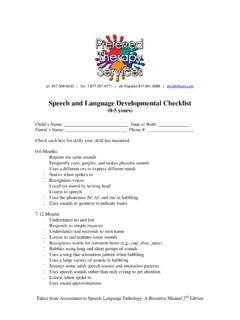
Transcription of SPEECH & LANGUAGE - Tools to Grow Therapy
1 SPEECH & LANGUAGE . Developmental Milestones n BIRTH - 5 YEARS n REFERENCES: American- SPEECH - LANGUAGE -Hearing Association. (2011). How does your child hear and talk?. Retrieved from: public/ SPEECH /development/chart/. Lanza, J. R., & Flahive, L. K. (2008). Guide to communication milestones: Concepts, feeding, morphology, literacy, mean length of utterance, phonological awareness, pragmatics, pronouns, questions, SPEECH sound acquisition, vocabulary . East Moline, IL: LinguiSystems. Gard, A., Gilman, L., & Gorman, J. (1993). SPEECH and LANGUAGE development chart (2 ed.). Austin, TX: Pro-Ed. Owens, R. (2012). LANGUAGE Development: An Introduction (8th ed.)
2 Boston, MA: Pearson. 0 12 W. SPEECH & LANGUAGE . W. MONTHS. n Developmental Milestones WHAT SHOULD MY CHILD BE DOING AT EACH AGE? REMEMBER EACH CHILD IS UNIQUE AND WILL DEVELOP AT HIS OR HER OWN RATE. USE THE GUIDE AS A TOOL TO LEARN WHAT STEP IS NEXT. SPEECH . C. COMMUNICATION SOUNDS. & & SOCIAL. LISTENING LANGUAGE USE LANGUAGEE. TALKING. W. W. W. W. Startles with loud sounds Cries differently for varying needs MONTHS. S.. Smiles or quiets down in 0-3. response to your voice Makes cooing sounds ( vowel sounds) Smiles at people and when Starts to recognize your voice Makes reflexive sounds ( coughing, crying, burping) spoken to Eye gaze moves in direction of sounds Recognizes and reacts to a Starts to make sounds with lips together such as MONTHS.
3 Difference in tone of voice raspberries Babbles to gain attention Establishes eye contact 3-6. ( friendly vs angry voices) Sound productions are constantly changing . Attends to music and toys that Produces mostly vowels ( ah ) Makes sounds that express make sounds Some babbling appears ( bah-bah-bah ) mood Listens and watches you when you're speaking Responds to no Responds to sounds even when Points to direct attention Babbles with increased length Likes to look and smile in the they cannot see the source toward an object using CVCV patterns ( mirror Moves to music papa mama ) Points to learn new vocabulary MONTHS. Using gestures to Responds to own name communicate ( waving, New consonant sounds Imitates rise and fall of voice 6-12.)
4 Begins to understand common reaching up, shaking head emerge, like /t, d, n/ Uses sounds ( shouting) and words for objects no ) New vowel sounds emerge gestures to attract attention Begins to respond to simple Says one or two words, Imitates different SPEECH Copies simple actions and plays requests ( come here ) like mama or bye sounds cause-and-effect games ( pat-a-cake, peek-a-boo, so big! ). 12- 24 W. SPEECH & LANGUAGE . W. MONTHS. n Developmental Milestones WHAT SHOULD MY CHILD BE DOING AT EACH AGE? REMEMBER EACH CHILD IS UNIQUE AND WILL DEVELOP AT HIS OR HER OWN RATE. USE THE GUIDE AS A TOOL TO LEARN WHAT STEP IS NEXT.
5 SPEECH . C. COMMUNICATION SOUNDS. & & SOCIAL. LISTENING LANGUAGE USE LANGUAGE . TALKING. W. W. W. W. Continues actions when they are praised or when Has a vocabulary of around SPEECH can be difficult others laugh 2-6 words at 12 months 12 - 18 MONTHS. Follows simple one-step to understand Engages in parallel play (playing Uses 1-2 words at a time to next to someone, but not with directions communicate Continues to imitate them). ( Get your toy ) Pairs gestures with words to SPEECH sounds and words Copies adult models during communicate Beginning to use the playtime Starts to understand spatial ( reaching up and following sounds: p, b, m, t, Refers to themselves by their concepts ( up, in, down) saying up!)
6 D, n, h, w, g, k, s, j name (instead of saying I ). Repeats words that are Takes turns ( my turn, your heard turn ). Says no to protest Has a vocabulary of about Attention to task during play Understands and points to 50-100 words around 18 SPEECH is understood increases to about 7 minutes 25-50% of the time to 18 - 24 MONTHS. some body parts when months Engages in self-talk during play prompted Starts to speak in 2 word a familiar listener Starts to use conversational Reacts to questions like phrases around 24 months Produces 70% of words ( hi, bye, please, and where's your book? ( Mommy shoe ) the following sounds thank you) and gestures Where's mom?
7 Uses mostly nouns correctly : p, b, m, t, d, n, (waving hi or bye ). Understands and points to Starts to ask simple h, w, g, k, s, j Verbal turn taking increases vocabulary in pictures ( in questions Increases use of Eye contact increases during a book or on a flashcard) ( what's that? ) two-syllable words interactions Attends to short stories Pronouns used: I, it, my, me, ( doggy yummy ) Increase in spontaneous mine, you SPEECH and imitation 24 36 W. SPEECH & LANGUAGE . W. MONTHS. n Developmental Milestones WHAT SHOULD MY CHILD BE DOING AT EACH AGE? REMEMBER EACH CHILD IS UNIQUE AND WILL DEVELOP AT HIS OR HER OWN RATE. USE THE GUIDE AS A TOOL TO LEARN WHAT STEP IS NEXT.
8 SPEECH . C. COMMUNICATION SOUNDS. & & SOCIAL. LISTENING LANGUAGE USE LANGUAGE . TALKING. W. W. W. W. Vocabulary is increasing: uses Stays on topic for longer about 200-300 words around periods of time Follows two step commands 24 months ( Pick up the play doh and Engages in short group put it away ) Speaks in 2-3 word phrases activities Understands around 500-900 Increases complexity when asking SPEECH is Uses more LANGUAGE while 24 - 36 MONTHS.. words who, what, and where questions understood playing 50-75% of the Differentiates between one Pronouns used: your, he, she, time to a familiar Stories lack elements such as and all yours, we listener sequence and plot, but include Understands directions Uses verb tense without a helping descriptions and labels involving adverbs and verb ( is ): ( Daddy eating ) Communicates emotions and adjectives ( Run fast or More consistent feelings verbally, instead of Point to the big dog ) Emergence of phrases with use of the following physically ( says Can I.)
9 Subject + verb + object ( sounds: k, g, t, d, have that? instead of Responds to family related Daddy throw ball ) ng, f, y grabbing). vocabulary, like sister or aunt Uses articles and conjunctions Associative play skills emerge Understands and selects ( a, the, and, so, but, or ) (starting to engage with pictures of verbs others during play, sharing, Uses regular plural forms ( cats ) taking turns). 36 60 W. SPEECH & LANGUAGE . W. MONTHS. n Developmental Milestones WHAT SHOULD MY CHILD BE DOING AT EACH AGE? REMEMBER EACH CHILD IS UNIQUE AND WILL DEVELOP AT HIS OR HER OWN RATE. USE THE GUIDE AS A TOOL TO LEARN WHAT STEP IS NEXT.
10 SPEECH . C. COMMUNICATION SOUNDS. & & SOCIAL. LISTENING LANGUAGE USE LANGUAGE . TALKING. W. W. W. W. Engages in cooperative play Vocabulary increases to around 1,000 (playing with someone, securing their attention, communicating with them). 36 - 48 MONTHS. Responds when name is called words by 36 months Talks about events and actions that from a distance Speaks in 3-4 word phrases SPEECH is Responds to basic wh-questions Pronouns used: they, us, hers, his, them, understood previously occurred ( what they did involving their surroundings or her, its, our, him, myself, yourself, 75-90% of the yesterday). activities they're engaged in ours, their, theirs time to a Able to separate from caregiver with ( What are you doing?)