Transcription of Standard Operating Procedure - GMPSOP
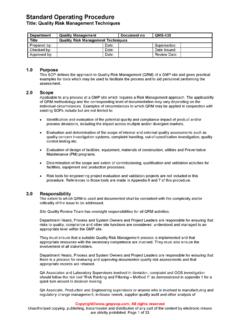
1 Standard Operating ProcedureTitle: Risk Assessment for Computer Validation SystemsCopyright All rights reservedUnauthorized copying, publishing, transmission and distribution of any part of the content by electronic means arestrictly of11As projects are dynamic in nature, the risk priorities may change throughout the life ofthe perComputer System Guideline(VAL-110), risk assessment should beperformed at the start of each computer system qualification. However, for a largesystem Risk Assessments may be conducted at several stages of the and timing of the assessments can be documented in the Validation guidance, Risk Assessments may be undertaken following: The generation of the User Requirements Specification (URS) The Supplier Assessment and the development of the Functional Specification(FS)
2 The completion of the Design Review prior to validation test Whenever any major changes are to be applied to the Risk Assessments at these stages will help define the user requirementsand alternatives, aid the supplier selection process, and determine any mitigation stepsor additional validation requirements for the findings of early RiskAssessments should be reviewed at later key points in the project, to ensure that theassumptions and circumstances upon which they are founded are still a small scale computer system a risk assessment at the start of the project may a minimum the System Owner,Validation /Technical Services and QualityAssurance in consultation withIT shouldapprove the Risk Assessment approvers may be added as required by the team and depending upon thephase of the \ BUSINESS RULESRisk Assessment is part of the overall responsibility oftheproject team or change controlteam members, however each member may take on a different roleduring the responsibilities for conducting a Risk Assessment are detailed below: System Owner/Administrator:The System Owner is defined asthe person ultimatelyresponsible for the operation of a system, and the data residing on that system.
3 The System Owneris responsible for the investigation and evaluation of those risksidentified as part of the GxP operational process and those risks identified as significantto the overall business process. IT Person Responsible for System:Responsible for the investigation and evaluation ofthose risks identified as a result of the program configuration or implementation andthose risks identified as a result of the infrastructure (hardware, network, peripherals,etc.) implementation. Validation /Technical Services Personnel:Responsible for the investigation andevaluation of those risks associated with validation requirements of the Operating ProcedureTitle: Risk Assessment for Computer Validation SystemsCopyright All rights reservedUnauthorized copying, publishing, transmission and distribution of any part of the content by electronic means arestrictly of11 Data integrity Release for sale documentationThe project team should look at each function or sub-function and make anassessment of the GxP outcome of their discussions should bedocumented on the assessment the assessment of a particular function or sub-function determines that there isno GxP risk.
4 The justification for taking this viewpoint should be documented onthe assessment Business RiskA secondary element of the Risk Assessment process is to determine whetherthe system function or sub-function represents a risk to the types of risk to be identified include, but are not limited to: Equipment downtime Equipment damage Cost of replacement equipment parts Potential for injury (Health and Safety)If the assessment of a particular function or sub-function determines that there isno business risk, the justification for taking this viewpoint should bedocumented on the assessment Risk ScenariosHaving determined that a particular function or sub-function may have a GxP orbusiness risk associated with it, the assessment should proceed to identify thevarious risk scenarios ( the events that identify the risks associated with useof the system).
5 It is useful to consider for each event what the likely effect willbe (note that each event may have more than one effect). LikelihoodThe next stage is to determine the likelihood (frequency or probability) of anadverse event approach requires the project team to consider thelikelihood of the adverse event occurring within a given time period (day,month, year) or per a quantity of transactions, and assigning a value to thatestimate the risk can be suggested method of representing this is as follows:LowThe frequency of the event occurring is perceived to beonce per ten thousand frequency of the event occurring is perceived to beonce per thousand Operating ProcedureTitle: Risk Assessment for Computer Validation SystemsCopyright All rights reservedUnauthorized copying, publishing, transmission and distribution of any part of the content by electronic means arestrictly of11type of projectorganization preferred; the amount of educationand training provided.
6 Reconsider Amount of (Auditable) Built-in Quality:Alter theamount of documentation that is approved and controlled;introduce or remove formal review points to reflect ofValidationApproach toMitigateRisk Increased Testing:Increase the scope and level of testingapplied during various stages of the validation process, includingthe development of specialised testing aimed at the testing tofailure of certain functions. Decreased Testing:Decrease the scope and level of testingapplied during various phases of the validation process due to theextremely low risk associated with occurrence and consequencesof the fault Risk Avoidance:The risks are so high that the new way of workingshould not be results of this phase of the assessment should be documented andused as justification for the validation should includewho is responsible for providing the mitigation Assessment of ChangeThe Risk Assessment process should be used during the entire lifetime of the process of Risk Assessment should be pursued at any time a major change is to beapplied to the application of the Risk Assessment technique as part of theChange Control process will allow the development of suitable mitigation strategies, toidentify the verification and re-test activities to pursue before the change is put of a Risk AssessmentRisk Assessments should followsite documentation structures.
7 Risk Assessments forsmall-scale systems may be documented in the Validation Project Risk Assessment must, as a minimum, include the sections listed there isno information relevant to a section, the statement This section is not applicable to thisRisk Assessment should appear below the section heading, followed by a briefjustification as to why the section has been omitted: Cover Sheets Introduction (including Purpose and Scope) System and Project Overview Risk Assessment