Transcription of Standard Operating Procedures
1 Standard Operating Procedures DIVISION OF COMPARATIVE MEDICINE university OF south florida SOP#: Date Issued: 11/00 Date Revised: 3/17 Page 1 of 7 _____ TITLE: Employee Orientation and Training SCOPE: All New Animal Program Personnel RESPONSIBILITY: Assistant Director, Facility Manager, Training Coordinator, All Animal Program Personnel PURPOSE: To Outline the Proper Procedures for the Introduction of Institutional and Divisional Policies and Procedures , Provide Documentation of Health and Risk Assessment, and Certify Adequacy of Training and Experience of All Employees _____ I.
2 ORIENTATION and TRAINING with the ASSISTANT DIRECTOR 1. Human Resources, payroll , and Divisional Policies a. Each new employee of the Division of Comparative Medicine meets with the Administrative Assistant Director (AD) to ensure all Human Resource requirements of new employees have been met. An Orientation of Animal Care Staff document (CMDC #102) is initiated. Once completed, this document is returned to the AD to file in the employee s training file. b. The new employee is provided an overview of the university s Global Employment System (GEMS).
3 In addition, information is provided regarding the payroll system and how to track and submit timesheets for payment. c. The AD establishes new employee and personnel files to track training, education, and dates of occupational health and risk assessments. d. Three files are established and maintained in the Administrative Office for each new employee: 1. Personnel file (which includes verification of education and certification) 2. Training file 3. Occupational Health file (which includes information regarding Workers Compensation claims) 4.
4 Files are maintained for length of employment. Once employment is terminated, all files are archived and maintained for a period of 5 years. e. The Assistant Director introduces new employees to the divisional Employee Policies (CMDC #098) and provides them with their own copy. Divisional policy compliance is expected of all employees, and proper Procedures are explained for: 1. Work schedules 2. Calling in sick 3. Requesting time off 4. Conduct 5. Completing timesheets f.
5 Each employee is provided a copy of Employee Orientation and Training (SOP #013). SOP # Employee Orientation and Training Effective 3/17 Page 2 of 7 2. Occupational Health and Safety a. Each new employee of the Division of Comparative Medicine, jointly with the AD, is required to complete the Health and Risk Assessment for Employee Safety In The Care and Use of Animals (RIC #004). The AD reviews health and safety principles and relevant Standard Operating Procedures with all new employees so that they are informed of potential hazards associated with their work, understand how these hazards are controlled, and have knowledge of safe work practices and the use of protective supplies and equipment.
6 Once completed, the Health and Risk Assessment document is maintained in the employee s Occupational Health file. b. Employees are scheduled for comprehensive health services provided by USF Medical Health Administration, which consist of serologic documentation of immunization with rubella, rubeola, varicella, hepatitis B, Hepatitis A, and diphtheria/tetanus. Documentation of rabies vaccination and TST/PPD skin test or BCG vaccination for tuberculosis may also be requested depending on the animal models in use.
7 USF Medical Health Administration maintains records of the results of these health assessments and vaccinations and provides Research Integrity & Compliance with written confirmation that health services have been completed, documentation of which is uploaded to the employee s profile in the ARC system for IACUC certification. c. Employees are informed that an Occupational Health Care Physician is available to discuss any preexisting, existing, or possible future health conditions that could affect their ability to perform their duties.
8 D. The AD presents information to new employees regarding the USF Hearing Conservation Program viewable at: and the Division s Respiratory Protection Program. Records relating to the Hearing Conservation Program are maintained within the offices where the audiograms are conducted at the Department of Communication Sciences and Disorders. Records relating to the Respiratory Protection Program are maintained within the employee s Occupational Health file in the Administrative Office. e. The AD presents information to new employees on potential work-related injuries and reviews: 1.
9 Proper Procedures for reporting suspected health hazards and work-related injuries. Bites, scratches, or any accident should be reported to a supervisor immediately and an incident report filed for each occurrence. 2. Information regarding potential zoonoses, practices of personal hygiene which limit exposure, and risk of contracting zoonoses. This information and the nature of noxious, toxic, hazardous, infectious or carcinogenic agents or compounds, when used, are posted on the door of the room containing the animal collection exposed to such agents.
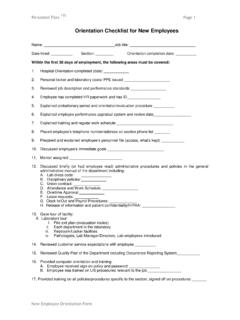
10 3. SOP # 906 entitled Chemical Hazard Communication, SOP #901 entitled Material Safety Data Sheet (MSDS), and the USF Chemical Hygiene Plan viewable at: to acquaint new employees with chemical hazards in the work place and practices of safe chemical use. 3. Training & Regulations SOP # Employee Orientation and Training Effective 3/17 Page 3 of 7 a. New employees are introduced to the New Employee Training Checklist (CMDC #038). Each facility has a specific checklist that is designed for training new employees on the species, Procedures , and equipment that may be encountered at that particular facility.