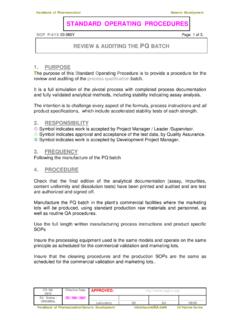
Transcription of STANDARD OPERATING PROCEDURES - PharmTech
1 Concerns, problems,and difficulties are those that FDAinspectors look outfor. Then we makesure you know howto address thoseissues properly (seethe Prepare for anFDA Inspection sidebar).Much of aninspection focuseson a company squality systems. Bydefinition, a qualitysystemis a programthat addresses theneeds and elementsof a specific part of amanufacturing oper-ation. A trainingprogram, for exam-ple, is a qualitysystem a qualitysystem that definesin detail how thecompany will ensurethat its employees have the proper knowledge tocarry out their and biotechnology companiestypically determine how they are going toclassify their quality systems. Quality systemstypically include STANDARD OPERATING PROCEDURES (SOPs), monitoring programs, change controlpolicies, validation programs, training, deviationand investigation programs, and consistent docu-mentation survival guide, therefore, also begins byfocusing on quality systems: on determiningthose quality systems needed and in place, onascertaining how practical particular qualitysystems are, and on checking how well thosequality systems have been implemented andfollowed.
2 It is the responsibility of a company smanagement to ensure that quality systems are inplace, reviewed periodically, upgraded, imple-mented, and OPERATING PROCEDURESSOPs are a critical quality system feature, andthey frequently get inspected their contents,the quality of their preparation, and how wellthey are followed. SOPsare detailed documentsthat specify OPERATING guidelines and instructionsfor every procedure within the company. For many companies, coping with anFDA inspection can be a increase significantly before,during, and after an inspection, andthere is always the potential that a majorregulatory economic downfall could bepart of a company s future if the inspec-tion yields negative or mixed three-part series addresses commonissues that arise during an FDA inspection andprovides advice on how to prevent those difficul-ties.
3 Part 1 describes those actions and programsthat must be part of routine operations, whetheran inspection is imminent or not. Part 2 focuseson inspection day and what to do during thatexamination. Part 3 follows the aftermath responding to inspection results, implementingcorrective actions, and learning from the entireinspection process. We don t try to predict all the possiblequestions and concerns that can come up duringan inspection. Even an FDA inspector couldn tdo that. Instead, we discuss common survival guide ensures that you know whatan inspection is, what aspects of company opera-tions (equipment, documents, tests) are likely tobe inspected, and what the most commonWould your companysurvive a surpriseinspection? An FDAinspection can be anightmare that costsyour company money,time, and managersunderstand the logicbehind FDA regulationsand prepare three-part survivalguide to inspections(whether from FDA, aclient, an investor, or aEuropean agency) willsharpen your vision of your company sregulatory 2002 Massoud Lavian and Paul W.
4 AllenFigure 1. validation protocols for a typical softwarelife cycleBioPharmAUGUST 200221 SOPs two to types of SOPs arecommon. The first type is corporate orglobalSOPs(policies and PROCEDURES set forth by thecompany s highest management level), that de-scribe general company policies. A company s di-visions, functions, and groups subject to GMPrequirements (that is, all departments excludingfunctions such as finance, marketing, and sales)are required to comply with global SOPs (1 3).Local SOPsdocument routine tasks and makeprovisions for nonroutine tasks for all specificfunctions or departments within the documents detail the tasks that must beperformed at each step in the manufacturingprocess. Examples of these tasks include steril-ization, equipment operation, emergencies, anddocumentation practices.
5 Examples of observa-tions that FDA inspectors make about SOPs arelisted in the SOP Failures sidebar. Remember,SOPs are the first line of defense during an in-spection: They describe how PROCEDURES and situ-ations are supposed to be handled, even those sit-uations, such as an emergency or a contaminatedbatch, that a company has never faced systems. Another quality system thatis closely scrutinized during a typical inspection isthe monitoring program. Typically, a productionsite must have a continuous monitoring program ofall critical elements of the manufacturing opera-tion. Critical elements include, for example, build-ing and equipment monitoring, water qualityassessment, environmental monitoring, andmicrobial level measurements in aseptic fill samples. The monitoring programclearly defines what needs to be sampled andwhen, how the sample is taken, and how thesample must be handled and tested.
6 It alsooutlines acceptable results supported by valida-tion studies. Monitoring programs must includeprovisions for test results outside acceptablelimits, assigning action and alert limits, address-ing who needs to be notified, assessing the effectof the out-of-specification (OOS) result, andapproving and implementing a corrective must be assigned to a specificperson who reviews the results in each area andidentifies trends in the results. FDA observations about monitor-ing programs cite the lack of clear specificationsfor when to sample, the location from which todraw the sample, the number of samples, andpoor handling for OOS or failed test results. It isinevitable that at some point a test result will fail.(In fact, an experienced inspector will doubt thevalidity of test results that remain acceptable overlong periods of time.)
7 Inspectors want to knowhow the failed result was handled, how the effectof the OOS result was assessed, how the correc-tive action was agreed upon, who approved thecorrective steps, what the thought processes werebehind the final decision about corrective action,and how the entire episode was , before your company is notified thatan inspection is imminent, review your monitor-ing programs and make sure they are sound androbust. DesignVendor auditFunctionalrequirementsVendor RFPV alidation master planConfiguration designProgram designspecifications21 CFR Part 11assessmentSecurity planData migration planTool descriptionHardware descriptionInstallationqualificationAcce ptance criteriaDevelopmentSource codeConfigurationVendordocumentationSOP developmentSOP validationSOP system useChange controlprocessAudit trailspecificationsTestingUnit testenhancementsChange controlTraceability matrixSystem test useracceptanceProblem reportresolutionTrainingOperationalquali ficationInstallationPerformancequalifica tionStress testDisaster recovery planValidation summaryreportMaintenanceRoutine auditsBack-ups and archiveprocess is carried out is the best example of howwork is planned, executed, and documented on adaily basis.
8 Therefore, the quality of a company svalidation program shows an inspector the levelof detail and technical knowledge that thecompany applies to day-to-day operations. Evenif an inspection does not start with validation , italmost always raises issues that can be tracedback to the original validation comprehensive validation program startswith policies that establish guidelines and respon-sibilities for validation processes. Those policiestypically cover PROCEDURES for preparing, review-ing, approving, executing, and completing thevalidation separate documents, the validation require-ments for individual areas, such as laboratoryequipment and processes, computers, cleaning,and utilities, among others, must be clearlydefined. This set of documents establishes a com-pany s commitment to its validation efforts.
9 Thedocuments also establish a requalificationprogram at timely, preestablished intervals toverify the results of the original validation validation master plan (VMP)is also essentialbecause it establishes a company s validationplans for the near future. It should include a listof validation activities that the company plans tocomplete within a reasonable time frame. Once aVMP is approved, periodic reviews will ensurethat validation plans are on schedule assuring in-spectors that the company is committed tocompleting its validation tasks. VMPs do not,however, replace completed validation protocols are the most critical elementof a validation program. Figure 1 shows the vali-dation processes in a typical software life validation protocols is an extremelydetailed process, but as a general rule, companiesshould ask the questions in the Before anVALIDATION PROGRAMSAt your next staff meeting, ask your coworkers, Does our company have a comprehensivevalidation program in place?
10 Be prepared forseveral interesting programs are arguably what inspec-tors are most interested in when they visit yourcompany. During validation , critical parametersand acceptable ranges are established forprocesses and equipment. The quality of the vali-dation program indicates how tests are performedand documented, how deviations are handled, andhow conclusions are reached. How a validationThis list of five To Do or Not to Do items will help you prepare for anFDA t wait until the last minute to prepare for a scheduledinspection. At a minimum, examine your quality systems, your training program,how well your SOPs are being followed, your documentation, and yourcorrection processes at departmental levels on a regular basis. This will ensurethat you are current with any changes in your systems and are properlydocumenting issues that FDA has already sure that all corrective actions havebeen taken and thoroughly documented.