Transcription of Statement of Cash Flows Study Objectives
1 Statement of Cash Flows Study Objectives Indicate the primary purpose of the Statement of cash Flows . Distinguish among operating, investing, and financing activities. Explain the impact of the product life cycle on a company's cash Flows . Steps in the Preparation of the Statement of Cash Flows Prepare a Statement of cash Flows using one of two approaches: (a) the indirect method or (b) the direct method. Use the Statement of cash Flows to evaluate a company. Chapter Outline Study Objective 1 - Indicate the Primary Purpose of the Statement of Cash Flows Study Objective 2 - Distinguish Among Operating, Investing, and Financing Activities 1.
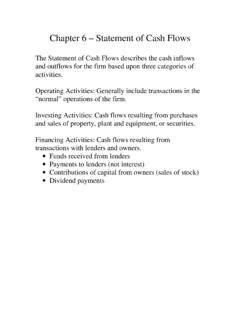
2 The primary purpose of the Statement of cash Flows is to provide information about cash receipts, cash payments, and the net change in cash resulting from the operating, investing, and financing activities of a company during the period. a. The Statement of Cash Flows (SFAS-95) identifies cash Flows as being generated from three sources: i. Operating Activities 1. Operating activities include the cash effects of all transactions that create revenues and expenses and thus enter into the determination of net income. general Operating activities are those activities that the business was created to perform and also includes interest from any source and any other type or revenue producing (other revenue) types of activity i.
3 Operating activities is the most important category because it shows the cash provided or used by company operations. ii. Cash provided by operations is generally considered to be the best measure of whether a company can generate sufficient cash to continue as a going concern and to expand. ii. Investing Activities 1. include all those activities involve in long-term uses or sources of cash. i. purchasing and disposing of investments and productive long-lived assets using cash and money and collecting the loans. i. Note that any interest revenue or expenses from these activities are operating activities iii.
4 Investing Activities 1. Include obtaining cash from issuing debt and repaying the amounts borrowed and (b) obtaining cash from stockholders and paying them dividends that Dividends received or paid are operating activities b. Activities involving cash are reported in a format that reconciles the beginning and ending cash balances. i. The Statement of cash Flows provides answers to the following important questions: 1. Where did the cash come from during the period? 2. What was the cash used for during the period? 3. What was the change in the cash balance during the period? ii. The Statement of cash Flows also provides clues about whether dynamic companies will be able to thrive and invest in new opportunities or whether a struggling company will survive or perish.
5 2. Illustrating the Types of Cash inflows and Outflows a. Operating activities i. Cash inflows : 1. From sale of goods or services. 2. Returns on loans (interest received) and on equity securities (dividends received). ii. Cash outflows: 1. To suppliers for inventory. 2. To employees for services. 3. To government for taxes. 4. To lenders for interest. 5. To others for expenses. b. Investing activities i. Cash inflows : 1. From sale of property, plant, and equipment. 2. From sale of debt or equity securities of other entities. 3. From collection of principal on loans to other entities. ii. Cash outflows: 1.
6 To purchase property, plant, and equipment. 2. To purchase debt or equity securities of other entities. 3. To make loans to other entities. c. Financing activities i. Cash inflows : 1. From sale of equity securities (company's own stock). 2. From issuance of debt (bonds and notes). ii. Cash outflows: 1. To stockholders as dividends. 2. To redeem long-term debt or reacquire capital stock. 3. Significant financing and investing activities that do not affect cash are not reported in the body of the Statement of cash Flows . Some cash Flows relating to investing or financing activities are classified as operating activities because these items are reported in the income Statement where results of operations are shown.
7 For example, receipts of investment revenue (interest and dividends) and payments of interest to lenders are classified as operating activities because these items are reported in the income Statement . As a general rule: Operating activities involve income Statement items. Investing activities involve cash Flows resulting from changes in investments and long-term asset items. Financing activities involve cash Flows resulting from changes in long-term liability and stockholders' equity items. Not all of a company's significant activities involve cash. Here are four examples of significant noncash activities: 1.
8 Issuance of common stock to purchase assets. 2. Conversion of bonds into common stock. 3. Issuance of debt to purchase assets. 4. Exchanges of plant assets. Note: Although they don t involve the use of cash, these items still must be fully reflected in the Statement of cash Flows (at bottom) or in Notes. a. They are reported either in a separate schedule at the bottom of the Statement of cash Flows or in a separate note or supplementary schedule to the financial statements. b. The reporting of significant activities not affecting cash in a separate or supplementary schedule satisfies the full disclosure principle because it identifies significant non-cash investing and financing activities of the enterprise.
9 C. The three activities--operating, investing, and financing--plus the significant noncash investing and financing activities make up the general format of the Statement of cash Flows , plus the significant noncash investing and financing activities. Study Objective 3 - Explain the Impact of the Product Life Cycle on a Company's Cash Flows 1. All products go through a series of phases called the product life cycle. a. The phases (in order of their occurrence) are often referred to as the i. introductory phase, ii. growth phase, iii. maturity phase, and iv. decline phase. b. The phase a company is in affects its cash Flows .
10 I. The introductory phase occurs at the beginning of a company s life, when the company is purchasing fixed assets and beginning to produce and sell products. 1. When a company is in the introductory stage, one would expect that the company will not be generating positive cash from operations. a. It will be spending considerable amounts to purchase productive assets such as buildings and equipment. b. To support asset purchases the company will have to issue stock or debt. i. One would expect cash from operations to be negative, cash from investing to be negative, and cash from financing to be positive.