Transcription of Step-by-Step Analytical Methods Validation and Protocol in ...
1 Step-by-Step Analytical Methods Validation and Protocol in the Quality System Compliance Industry BY GHULAM A. SHABIR.. Introduction peatability and intermediate precision), specificity, detec- Methods Validation : Establishing documented evidence tion limit, quantitation limit, linearity, range, and robustness that provides a high degree of assurance that a specific (Figure 1). In addition, Methods Validation information method, and the ancillary instruments included in the should also include stability of Analytical solutions and sys- 7. method, will consistently yield results that accurately reflect tem suitability. the quality characteristics of the product tested. Health Canada (HC) has also issued guidance on meth- 8. Method Validation is an important requirement for any ods Validation entitled Acceptable Methods Guidance.
2 HC. package of information submitted to international regula- has been an observer of ICH, and has adopted ICH guide- tory agencies in support of new product marketing or clini- lines subsequent to its reaching Step Four of the ICH. cal trials applications. Analytical Methods should be vali- process. An acceptable method predates ICH, and HC. dated, including Methods published in the relevant pharma- plans to revise this guidance to reflect current ICH termi- copoeia or other recognized standard references. The suit- nology. ability of all test Methods used should always be verified Figure 2 shows the data required for different types of under the actual conditions of use and should be well docu- analysis for method Validation . Where areas of the Accept- mented. able Methods Guidance are superseded by ICH Guidelines 1 2.
3 Methods should be validated to include consideration of Q2A and Q2B, HC accepts the requirements of either the characteristics included in the International Conference on ICH or Acceptable Methods Guidance; however, for 1, 2. Harmonization (ICH) guidlines addressing the Validation method Validation , ICH acceptance criteria are preferred. of Analytical Methods . Analytical Methods outside the scope HC's Acceptable Methods Guidance provides useful guid- of the ICH guidance should always be validated. ance on Methods not covered by the ICH guidelines ( , ICH is concerned with harmonization of technical re- dissolution, biological Methods ), and provides acceptance quirements for the registration of products among the three criteria for Validation parameters and system suitability tests major geographical markets of the European Community for all Methods .
4 (EC), Japan, and the United States ( ) of America. The HC has also issued templates recommended as an ap- recent Food and Drug Administration (FDA) Methods proach for summarizing Analytical Methods and Validation 3-5. Validation guidance document, as well as the United States data ICH terminology was used when developing these tem- 6. Pharmacopoeia (USP), both refer to ICH guidelines. plates. The most widely applied typical Validation characteris- This paper suggests one technique of validating meth- tics for various types of tests are accuracy, precision (re- ods. There are numerous other ways to validate Methods , all 4 I n s t i t u t e o f Va l i d a t i o n Te c h n o l o g y Ghulam A. Shabir Figure 1. _____. ICH, USP, and FDA Methods Validation Characteristics Requirements for Various Types of Tests Validation Assay Testing for Impurities Identification Characteristics Quantitative Limit Accuracy Yes Yes No No Precision - Repeatability Yes Yes No No Precision - Intermediate Yes1 Yes* No No Precision Specificity Yes Yes Yes Yes Detection limit No No Yes No Quantitation limit No Yes No No Linearity Yes Yes No No Range Yes Yes No No Robustness Yes Yes No No 7.)
5 * In cases where reproducibility has been performed, intermediate precision is not needed. Figure 2. _____. Health Canada Methods Validation Parameter Requirements for Various Types of Tests Validation Identity Active Ingredients Impurities / Degradation Physico-Chemical Parameters Tests Drug Drug Products Tests Substance Product Quantitative Limit Tests Precision (of the system) No Yes Yes Yes 1 Yes Precision (of the method) No 1 Yes Yes 1 Yes Linearity No Yes Yes Yes No Yes Accuracy No Yes Yes Yes 1 Yes Range No 1 Yes Yes No Yes Specificity Yes 1 Yes Yes Yes *. Detection Limit 1 No No Yes Yes *. Quantitation Limit No No No Yes No *. Ruggedness 1 Yes Yes Yes Yes Yes * May be required depending upon the nature of the test. equally acceptable when scientifically justified. required accuracy, and required sensitivity.
6 (Note: Most of Prepare a Protocol the acceptance criteria come from the characterization study.) Furthermore, some tests may be omitted, and the The first step in method Validation is to prepare a proto- number of replicates may be reduced or increased based on col, preferably written, with the instructions in a clear step- scientifically sound judgment. by-step format, and approved prior to their initiation. This A test method is considered validated when it meets the approach is discussed in this paper. The suggested accep- acceptance criteria of a Validation Protocol . This paper is a tance criteria may be modified depending on method used, Step-by-Step practical guide for preparing protocols and per- A n a l y t i c a l M e t h o d s Va l i d a t i o n 5. Ghulam A. Shabir forming test Methods Validation with reference to High Methods Validation must have a written and approved Performance Liquid Chromatography (HPLC) (use simi- Protocol prior to its initiation.)
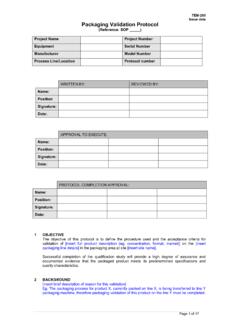
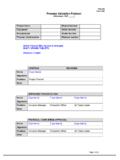
7 A project controller will se- lar criteria for all other instrumental test method valida- lect a Validation Cross-Functional Team (CFT) from var- tion) in the quality system compliance industry. ious related departments and functional areas. The project controller assigns responsibilities. The following tables il- Analytical Methods Validation Protocol lustrate one suggested way of documenting and preserv- Approval Cover Page ing a record of the approvals granted at the various phases Summary Information Summary Information Organization name Site location Department performing Validation Protocol title Validation number Equipment Revision number Project Controller Project Name Signature Date Controller Document Approval Document Approval Department /. Functional Area Name Signature Date Technical Reviewer End Lab Management Health & Safety Quality Assurance Documentation Control (reviewed and archived by).
8 Revision History Revision History Revision No. Date Description of change Author 6 I n s t i t u t e o f Va l i d a t i o n Te c h n o l o g y Ghulam A. Shabir of the Validation : Test procedure The specificity of the assay method will be investigated Writing a Test Method Validation Protocol by injecting of the extracted placebo to demonstrate the absence of interference with the elution of analyte. Analytical method validations should contain the fol- lowing information in detail: Documentation Purpose: This section provides a short description of Print chromatograms. what is to be accomplished by the study. Project scope: Identify the test Methods and which prod- Acceptance criteria ucts are within the scope of the Validation . The excipient compounds must not interfere with the Overview: This section contains the following: a gen- analysis of the targeted analyte.
9 Eral description of the test method, a summary of the char- acterization studies, identification of method type and vali- Linearity dation approach, test method applications and Validation Protocol , the intended use of each test method application, Test procedure and the Analytical performance characteristics for each test Standard solutions will be prepared at six concentra- method application. tions, typically 25, 50, 75, 100, 150, and 200% of target Resources: This section identifies the following: end concentration. Three individually prepared replicates at user laboratory where the method Validation is to be per- each concentration will be analyzed. The method of formed; equipment to be used in the method Validation ; standard preparation and the number of injections will software to be used in the method Validation ; materials to be be same as used in the final procedure.
10 Used in the method Validation ; special instructions on han- dling, stability, and storage for each material. Documentation Appendices: This section contains references, signa- Record results on a datasheet. Calculate the mean, stan- ture, and a review worksheet for all personnel, their specific dard deviation, and Relative Standard Deviation (RSD). tasks, and the documentation of their training. Listings of all for each concentration. Plot concentration (x-axis) ver- equipment and software necessary to perform the method sus mean response (y-axis) for each concentration. Cal- Validation should be found here along with document and culate the regression equation and coefficient of deter- materials worksheets used in the method Validation and in mination (r2). Record these calculations on the the test method procedure(s).