Transcription of Student Guide GEOGRAPHY - OCR
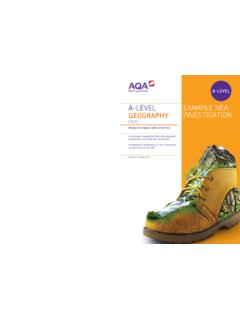
1 GEOGRAPHYH481 For first teaching in Student s Guide to the Independent InvestigationVersion 1A levels tudent GuideStudent s Guide2A Level GEOGRAPHY OCR Introducing the Independent Investigation Developing Individuality: Research, Focus and Title Data, Information Collection Methods and Sampling Framework Data Presentation Techniques Data Analysis and Explanation Conclusions and Investigation Evaluation Overall Quality and Communication of Written Work 19 Student s Guide3A Level GEOGRAPHY OCR INTRODUCING THE INDEPENDENT INVESTIGATIONP lanning and then undertaking your own independent investigation is a good opportunity to explore an aspect of GEOGRAPHY in more depth that is of interest to you. Your investigation will encourage you to read about a topic in more depth, root out any geographical theories which are relevant to your investigation and then test some of these ideas / assumptions in the field.
2 But a personal independent investigation can also present challenges as it requires skills of organisation, motivation as well as independence. The key to surviving the independent investigation comes with good planning as this will support your journey through this substantial piece of work. It is perfectly normal for your ideas to evolve (change) as you work through your investigation from the time your title is devised and you get out in the field this is because you become more familiar with your chosen topic area, make sure you write these reflections down as you may want to tweak your title, key questions etc. The independent investigation or NEA (Non-Examined Assessment) is worth 60 marks in total and forms 20% of the total A level assessment. See Figure 1 below. Figure 1: Independent investigation in relation to the OCR GEOGRAPHY specification. As this is a substantial piece of work you should look to spend around 30-40 hours completing the work (but this might vary according to your school / college).
3 This excludes the time for collecting your fieldwork data. The independent investigation: Is linked to any area of the specification. This can include topics that are options which you are not studying, although that would be unusual and carries a risk as you may be less familiar with the topic content. You could link more than one topic for example coastal management and place or hazards and place, this will depend on your chosen title. Is a recommended 3,000 - 4,000 words. You will not be penalised for exceeding the recommended length; however, work that significantly differs from the recommended length will might be self-penalising. The ability to write succinctly (keeping to the word length), making points sharp and focused especially in the analysis and conclusion will help the reader (your teacher) navigate their way through. Includes primary and secondary data collection. Page 10 of this document contains an explanation of the differences.
4 Note that there does not need to be a balance of primary and secondary, it will depend on the nature of the topic under investigation. Fieldwork is an opportunity to discover, explore and find things as well as test new geographical ideas Student s Guide4A Level GEOGRAPHY OCR 2017 There are also wider benefits to carrying out your independent investigation which should not be underestimated. Some of these, for example, are relevant to university or job applications. Figure 2 provides a summary of the benefits of high quality fieldwork. A good piece of investigative work will likely reinforce some of these embedded skills and and evaluation of knowledge and understanding Develops skills in data handling (using big data Census) and statistical understanding Helps with skills of literature research and selection of material; can develop synthesis skills Improve technology skills, spreadsheet manipulation or analysis using GISD eveloping deeper learning Geographical curiosity helps see things differently Encourages caution and reflectivity in data analysis, as well as taking geographical meaning Enables critical thinking and the ability to challenge ideas / theories Helps with skills of reasoning particularly with data and analysisSocial dimensions Helps foster independent learning Creates an atmosphere for co-operation with peers in problem solving Teaches the skills of planning and procedure which will be transferable to other situations and subjects.
5 Greater awareness of ethical considerations as part of the enquiry process (especially within fieldwork and data collection)Figure 2: Benefits of high quality fieldwork. Source: adapted from Lambert and Reiss (2014) There may be several ideas that go into independent investigations, linked to enquiry: 1) it creates a need to know; as you have a genuine interest in the topic2) the work uses real-world data and information, gathered by you3) it requires you to make sense of geographical information4) it is reflective as your investigation evolves and you learn more about your The stages of geographical enquiry and links to the marking criteriaYou may be familiar with the process of enquiry from GEOGRAPHY and science for instance. In this type of enquiry there is an identifiable start, middle and end. Understanding this pathway is important since it forms the basis and structure of the marking criteria for your independent investigation.
6 It is important for you to understand the marking criteria as this can be used as a Guide when planning and undertaking your investigation. The full marking criteria can be found on pages 59-64 of the A level specification. See Figure 3 below. Stage of the investigationThings to think about from the marking criteria1 Planning, purpose and introduction (8 marks) Are you producing a plan and research framework for your investigation? Have you got a clear idea where (geographical location) you are doing your research? Will you be doing a literature review to learn more about your chosen topic?2 Data, information collection methods and sampling framework (7 marks) What quantitative and / or qualitative approaches have you chosen? Do you have a clear idea for your primary data collection and how you might record this information? What secondary data are you using and how will this be recorded? Have you got a data design framework?
7 What will you collect, where, when and how? When you collect your data, have you consider who this might affect? (ethical and socio-political dimensions)3 Data presentation techniques (9 marks) Have you gone through and organised your data? Have you explored a range of data presentation techniques and selected the ones best suited to your data? Will you plan your data presentation? Consider where your data will appear throughout your write up, what it shows and how it links to your title, aims or questions or analysis and explanation (14 marks) Have you understood what it means to analyse data and done some reading about the techniques that would support your investigation? Are you going to do qualitative, or quantitative, or mixed methods analysis? Does your analysis help to unpack your title or questions / hypotheses? Will you discuss / compare your findings with your literature review?
8 Student s Guide5A Level GEOGRAPHY OCR 2017 Stage of the investigationThings to think about from the marking criteria5 Conclusions and investigation evaluation (12 marks) Will you plan your conclusion before writing, so that you are bringing your ideas together? Have you placed your investigation into a wider geographical context? Where does it fit with what you have read or understood for your chosen topic? Does your evaluation consider the investigation as a whole, your research, data collection and the value of your findings?6 Overall quality and communication of written work (10 marks) Have you set your investigation out as clearly as possible with a definite structure? Will you re-read your work once it s completed to ensure its accurate and you have expressed yourself as clearly as possible using geographical language? Are you going to keep accurate records and note down (bibliography / reference list) what you have read?
9 Figure 3: Components of geographical enquiry, relevant to the OCR Independent Investigation marking criteria. Many of these are discussed in more detail in this Planning your investigation As this is a substantial piece of work it is important to have a plan as this will help to keep you on track and focused. Your plan gives you an outline of your investigation and should include your title, a break-down of your title (sub-questions or sub-hypotheses) any potential aims (if you are including these). Your investigation needs a purpose what is it you want to find out and why? Your plan should link all of these things together so you have your investigation purpose and your title, sub-questions etc. Your plan is the first step in the investigation process and will help you to look at the big picture (your investigation as a whole). Developing a research framework A research framework is an outline of how you will find the information you need and carry out the research for your investigation.
10 It will help you to narrow down the type of investigation you want to do quantitative, qualitative or a mixed methods approach. This will be discussed in more depth in section You also need to consider the balance between primary and secondary data collection. Is one going to be more important in your research or will they be relatively balanced? Research is a process and therefore needs to be designed and as part of this you need to think about the steps you will take to gather all the information / data you need to answer your title and aims / key questions / sub-hypotheses. Think about the following in your research framework: What data do you need and why? Where and how you will obtain the data? How much data do you need and how will you select it?* How will you decide which methods are appropriate to undertake your research? * This is called sampling and will be discussed in more depth in section you are designing your research for your investigation it is important to consider the validity and reliability of the data you collect.