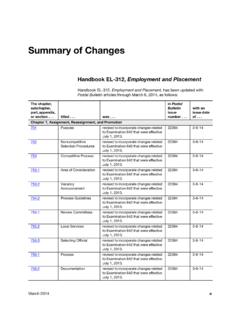
Transcription of Supervisor’s Guide to Scheduling and Premium Pay …
1 RSupervisor s Guideto Scheduling andPremium PayHandbook F-401 August 20001 RHandbook F-401 August 2000 supervisor s Guide toScheduling and Premium PayTransmittal This handbook is provided as amanagement tool to assist in the continuingmaintenance of time and attendance incompliance with the Fair Labor Standards Act(FLSA), postal policy, and establishedcontractual This revision replaces HandbookEL-401, supervisor s Guide to Scheduling andPremium Copies may be requisitioned fromthe material distribution centers by using PSForm 7380, MDC Supply Requisition, duringregular requisitioning and any comments or questions to:MANAGER PAYROLL ACCOUNTINGUNITED STATES POSTAL SERVICE475 L ENFANT PLZ SW RM 8831 WASHINGTON DC and excerpts from other direc-tives contained in this handbook are currentas of the date of this handbook.
2 Refer tothe original directive if there is any questionabout the accuracy, completeness, or cur-rent status of the reference or Date. This handbook is effective M. PeakActing Vice President, Finance,Controller of the Postal ServiceHandbook F-401iiiContents1. Introduction1.. 2. Scheduling , Premium Pay, andUnexpected Workhour Liability3.. A. Introduction3.. B. Scheduling and Premium PaySituation Analysis4.. 3. Premium and Overtime PaySituations7.. A. Introduction7.. B. Night Differential Premium7.. C. Sunday Premium8.. D. Out-of-Schedule Premium9.. E. Holiday Scheduling andPremiums16.. F. Overtime22.. 4. Workhour Guarantees26.. A. Introduction26.
3 B. Work Schedule Guarantees26.. C. Guarantees26.. D. City Letter Carrier 7:01 Rule28.. E. Authorization and SupportingForms29.. F. Definition of Callback and SplitShift29.. August 2000iv5. Management Control Activities31.. A. Location of Timekeeping Devicesand Time Card/Badge Racks31.. B. Five-Minute Leeway Rule31.. C. Full-Time Employee WorkSchedules32.. D. Part-Time Flexible EmployeeWorkhours33.. E. Employee Schedules33.. F. Employee Responsibilities34.. G. Access to Time Cards or Badges34.. H. Tardiness35.. I. Washup Time38.. J. Time Suffered or Permitted38.. K. Disallowed Time and UnauthorizedOvertime39.. 6. FLSA Workweek Determinations47.
4 A. Definition47.. B. Management Responsibilities48.. C. Schedule Changes Resulting inFLSA Overtime48.. D. Determination of anFLSA Workweek OvertimeAdjustment49.. Handbook F-401v7. Pay During Travel53.. 8. Nonbargaining Unit Employees55.. A. Employee Classification55.. B. Overtime and AdditionalStraight-Time Pay56.. C. Night Differential63.. D. Sunday Premium63.. E. Work on Holidays64.. F. Nonbargaining ReschedulingPremium65.. G. EAS Higher Level65.. H. Leave Usage by ExemptEmployees67.. August 2000viExhibitsExhibit 3-1 Night Differential Pay Eligibility forBargaining Unit (RSC M, P, Q, C, A,and K) and Casual (RSC E)Employee s8.
5 Exhibit 3-2 Sunday Premium Pay Eligibility forBargaining Unit (RSC M, P, Q, C, A,and K) and Casual (RSC E)Employee s9.. Exhibit 3-3 Out of Schedule Premium Pay Eligibilityfor Bargaining Unit (RSC M, P, Q, C, A,and K) and Casual (RSC E)Employee s16.. Exhibit 3-4 Holiday Worked Pay Eligibility forBargaining Unit (RSC M, P, Q, C, A,and K) and Casual (RSC E)Employee s18.. Exhibit 3-5 Overtime Pay Eligibility for BargainingUnit (RSC M, P, Q, C, A, and K) andCasual (RSC E) Employees25.. Handbook F-401viiExhibit 4-1 Guaranteed Time Pay Eligibility forBargaining Unit (RSC M, P, Q, C, A,and K) and Casual (RSC E)Employee s30.
6 Exhibit 5-1PS Form 1017 A,Time Disallowance Record 43.. Exhibit 5-2PS Form 1017 B,Unauthorized Overtime Record 45.. Exhibit 6-1 Workweek Overlap52.. Exhibit 7-1 Eligibility for Travel TimeCompensation53.. Exhibit 8-1 Examples of EAS Nonexempt Pay(not including postmasters/OICs)61.. Handbook F-40111. IntroductionThis handbook is provided as a management tool toassist in the continuing maintenance of time and at-tendance in compliance with the Fair Labor StandardsAct (FLSA), postal policy, and bargaining agree-ments. The information contained in chapters 1-6 ofthis handbook applies to bargaining unit employeeswho are assigned to post offices, mail processingplants, bulk mail centers, and airmail facilities whoare covered by the National Agreements with theAmerican Postal Workers Union, AFL-CIO (APWU);the National Association of Letter Carriers, AFL-CIO(NALC); and the National Postal Mail HandlersUnion, A Division of the Laborers InternationalUnion of North America, AFL-CIO (NPMHU).
7 Itdoes not apply to rural carriers, bargaining unitnurses, or security force employees. The purpose is toprovide each supervisor and manager in those postalinstallations with a source document of related infor-mation pertinent to day-to-day time and attendancesituations. The contents represent policies and proce-dures contained in existing postal directives: Hand-book F-21, Time and Attendance; Handbook F-22,PSDS Time and Attendance; and the Employee andLabor Relations Manual (ELM). These directivesshould be cited as the authoritative references whennoting policies and procedures. Not every question orpolicy relating to time and attendance is , the major topics of concern to each line su-pervisor and manager are addressed.
8 Remember, eachpostmaster, manager, and supervisor is responsiblefor ensuring that employees are properly compen-sated for work performed. The responsibility is ongo-August 20002ing and must be met on a day-to-day basis to assureeffective maintain consistency with Postal Service auto-mated timekeeping systems, all references to times ofthe day use the 24-hour clock, which breaks portionsof hours into hundredths. For example,12:00 midnight = 0000 hours12:15 =0025 2:30 :45 :00 noon =12003:00 :05 :25 managers and supervisors must exercise propercontrol to eliminate unauthorized work and avoidcompensation liabilities in this area.
9 Supervisors andmanagers must implement all postal policies that re-late to time and attendance to ensure the proper com-pensation of F-40132. Scheduling , Premium Pay, and UnexpectedWorkhour LiabilityA. IntroductionScheduling employees is an operational function thatis based on workload projection and service commit-ments. Supervisors schedule employees in a processthat factors:1)Those actions necessary to meet service stan-dard ) Scheduling and assigning employees toachieve desired productivity rates, within bud-getary rules contained in the National Agree-ments with labor organizations and the Fair LaborStandards Act (FLSA) often require that the PostalService pay employees more than a flat hourly a result, the traditional concern of reducingplanned and authorized workhours must be aug-mented and complemented by an increased concernfor minimizing Premium pay hours ( , night differ-ential, Sunday, holiday, out-of-schedule)
10 , guaranteedhours, and unauthorized overtime nonexempt employees must be paid for alltime that they work, whether or not the work is autho-rized. It is the responsibility of the supervisor to mini-mize the occurrence of these unauthorized workhoursand to minimize (consistent with operational require-ments) the use of Premium pay 20004B. Scheduling and Premium Pay SituationAnalysisThe knowledge and application of time and atten-dance policies can assist supervisors in managingtheir operations in a cost effective manner. The fol-lowing situations tell how to do this:GPost Office X traditionally scheduled Tour 1 em-ployees to report for duty at 2350.