Transcription of Sure Start (England)
1 | | | @commonslibrary BRIEFING PAPER Number 7257, 9 June 2017 Sure Start ( england ) By Alex Bate & David Foster Contents: 1. Sure Start under Labour 2. Sure Start under the Coalition 3. Sure Start under the 2015 Conservative Government 4. Impact of Sure Start 5. The future of Sure Start 2 Sure Start ( england ) Contents Summary 3 1. Sure Start under Labour 4 Launch of the Sure Start policy 4 The piloting and expansion of Sure Start Local Programmes (1999-2003) 5 Evolution of Sure Start Children s Centres (2003-2010) 6 Sure Start legislation (2009-2010) 9 Comment 10 Comment on changes since 2003 10 2010 Select Committee report 12 London School of Economics Naomi Eisenstadt 13 2. Sure Start under the Coalition 14 Coalition Agreement 14 Health visitors 14 Pilots of payment by results 15 New statutory guidance for Sure Start centres 16 Introduction of a core purpose of Sure Start centres 17 Full day care and qualified teachers 18 Funding 18 Number of Sure Start centres 19 Comment 20 2013 Education Select Committee report 20 LSE and Centre for Analysis of Social Exclusion working paper 21 3.
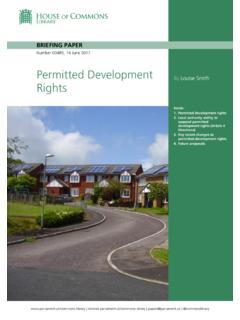
2 Sure Start under the 2015 Conservative Government 22 Funding 22 Number of Sure Start centres 23 Extended free childcare entitlement 24 Sure Start consultation 25 4. Impact of Sure Start 26 National Evaluation of Sure Start (2002-2012) 26 Audit Commission report (2010) 29 Evaluation of Children s Centres in england (2012-2016) 29 5. The future of Sure Start 34 Contributing authors Paul Bolton (table, section ) Cover page image copyright: Preschool Colors by Barnaby Wasson. Licensed under CC BY-NC-SA image cropped 3 Commons Library Briefing, 9 June 2017 Summary This briefing paper details the introduction, implementation and development of the Sure Start policy of early intervention for pre-school children and their parents. Launched in 1998, Sure Start was driven by local partnerships of voluntary groups, parents and local authorities in the most deprived areas. Apart from five core areas including outreach services, play and healthcare, local programmes offered services based on locally-defined needs.
3 This briefing sets out the development of the policy from local programmes to local authority administered children s centres, as part of which Sure Start was changed to a universal service for all families, and the creation of a statutory basis for children s centres in 2009. The 2010 Coalition Government also implemented a number of changes to the Sure Start programme, including the introduction of a core purpose for children s centres and new statutory guidance. A number of empirical studies on the impact of Sure Start have been carried out since 2002, and details of many of these are provided, along with information on funding for and numbers of children s centres. As early years services are a devolved policy area, this briefing covers england only, unless otherwise stated. 4 Sure Start ( england ) 1. Sure Start under Labour Box 1: Sure Start under Labour 1997-2010 Sure Start introduced in 1998 as a multi-departmental programme of early intervention for under-fours.
4 Delivered initially through local programmes, directed by a range of stakeholders within the most deprived areas. Ten year childcare strategy in 2004 changed focus to delivery of services through children s centres. Children s centres had an increased focus on childcare and early years education, with services provided to the under-fives. Target for 3,500 children s centres one per community in england by 2010. Children s centres given a statutory basis in 2009. Launch of the Sure Start policy Labour s 1997 general election manifesto set out a commitment to invite selected local authorities to pilot early excellence centres combining education and care for the under-fives. 1 Following the return of a Labour Government, a network of 25 pilot early excellence centres was announced in a 1997 White Paper, Excellence in Schools, to share best practice throughout an early years sector argued to be patchy in its provision across different local authorities. Prior to the 1998 Comprehensive Spending Review (CSR), the then Minister for Public Health, Tessa Jowell, reported to the Cabinet Committee overseeing the CSR on effective approaches to early interventions.
5 Whilst acknowledging there was no fixed criteria for good early intervention, it stated that effective programmes should be: Two generational involve parents as well as children; Non-stigmatising avoid labelling problem families ; Multifaceted target a number of factors, not just, for example, education or health or parenting ; Persistent last long enough to make a real difference; Locally driven based on consultation and involvement of parents and local communities; Culturally appropriate and sensitive to the needs of children and The CSR was published in July 1998 and established a cross-departmental budget, the Children s Fund, for a new Sure Start programme of early intervention. 1 Labour, New Labour: because Britain deserves better, April 1997 2 Norman Glass, Sure Start : the development of an early intervention programme for young children in the United Kingdom, Children and Society vol 13 issue 4, 1999 5 Commons Library Briefing, 9 June 2017 It was intended that this would lead to the establishment of 250 local Sure Start programmes by the end of the Parliament, located within the 20% most deprived areas in england .
6 These local programmes would: Arrange a visit from an outreach worker to every new mother within 3 months of giving birth; Provide a range of easily accessible services, including childcare, primary health care, early education, and play and support, ideally within pram pushing distance 3 452 million of funding was allocated by the CSR for Sure Start in england between 1999 and 2002. The piloting and expansion of Sure Start Local Programmes (1999-2003) In January 1999, the first 60 Sure Start trailblazer districts were announced, based on high levels of local deprivation and existing good practice in early years provision. These districts covered a local authority area but included voluntary bodies, health services and the local authority itself within that area. The trailblazer districts would each identify one catchment area appropriate for a Sure Start Local Programme (SSLP).4 The local bodies within a district would set up a board, including parents, to determine local priorities and which services their SSLP would offer.
7 Local programmes were intended to be locally defined based on specific local requirements, and measured by the Government only on outcome. However, all SSLPs were required to offer 5 core services: Outreach services and home visiting; Support for families and parents; Good quality play, learning and child care; Primary and community healthcare and advice about child health and development; Support for those with special The area-based provision was an innovative approach to early intervention. As Belsky and Melhuish (2007) argued: SSLPs were intended to break the intergenerational transmission of poverty, school failure and social exclusion by enhancing the life chances for children less than four years of age growing up in disadvantaged neighbourhoods. More importantly, they were intended to do so in a manner rather different from almost any other intervention undertaken in the western 3 HM Treasury, Modern public services for Britain: investing in reform Comprehensive Spending Review: new public spending plans 1999-2002, July 1998 4 HC Deb 20 January 1999 cc501-502W 5 Norman Glass, Sure Start : the development of an early intervention programme for young children in the United Kingdom, Children and Society vol 13 issue 4, 1999 6 Jay Belsky & Edward Melhuish, The National Evaluation of Sure Start : Does Area-based Early Intervention Work?
8 , 2007, p133 6 Sure Start ( england ) The 2000 Spending Review saw a large expansion in the Sure Start programme. 948 million was committed from 2002 to 2004 to double the number of proposed SSLPs to over 500. The intention was that this would cover a third of the poorest children under four (compared to 18% of the poorest children covered by the proposed 250 SSLPs). Early years services were also to be rationalised by merging SSLPs with early excellence centres. The Spending Review set out some ambitious Public Service Agreement (PSA) targets: Reduce the proportion of children aged 0-3 in the 500 Sure Start areas who are re-registered within the space of 12 months on the child protection register by 20 per cent by 2004. Achieve by 2004 in the 500 Sure Start areas, a 10 per cent reduction in mothers who smoke in pregnancy. Achieve by 2004, for children aged 0-3 in the 500 Sure Start areas, a reduction of five percentage points in the number of children with speech and language problems requiring specialist intervention by the age of four.
9 Reduce the number of 0-3 year old children in Sure Start areas living in households where no-one is working by By November 2003, there were 521 SSLPs in In addition to these, a further 46 mini SSLPs in rural areas and areas with pockets of deprivation were also set Evolution of Sure Start Children s Centres (2003-2010) The 2002 Spending Review marked a change in emphasis in the delivery of Sure Start . Services would now aim to be provided in a one-stop Sure Start Children s Centre (SSCC), with greater local authority oversight through integration into existing children s services: The Government s vision for children is one in which every parent can access affordable, good quality provision. This Spending Review provides resources to create at least 250,000 childcare places including those provided directly within children s centres to advance the Government s lone parent employment and child poverty objectives, through targeted assistance to providers in areas of market failure.
10 There will also be support for the creation and operation of children s centres in disadvantaged areas. Building, where possible, on existing Sure Start facilities, and other provision, by March 2006, an additional 300,000 children will have access to health, education and other services. 7 HM Treasury, Prudent for a purpose: building opportunity and security for all 2000 Spending Review: new public spending plans 2001-2004, July 2000 8 HC Deb 10 November 2003 c68W 9 Department for Education and Skills, Working together A Sure Start guide to the childcare and early education field, April 2004 7 Commons Library Briefing, 9 June 2017 In addition to joining up existing services, it is also the intention to simplify funding arrangements, streamline targets and support local and national government to focus on delivering this vision, by giving local authorities an enhanced role in supporting delivery, and by bringing the responsibility for childcare, early years education and Sure Start together in a single inter-departmental The first 32 SSCCs were announced in June 2003,11 and a programme of expansion was set out in the 2004 multi-departmental childcare strategy, Choice for parents: the best Start for children.