Transcription of Symptom Management Guidelines: DYSPNEA
1 The information contained in these documents is a statement of consensus of BC Cancer professionals regarding their views of currently accepted approaches to treatment. Any clinician seeking to apply or consult these documents is expected to use independent medical judgement in the context of individual clinical circumstances to determine any patient's care or treatment. Use of these documents is at your own risk. Page 1 of 7 Symptom Management Guidelines: DYSPNEA NCI GRADE AND Management | RESOURCES | CONTRIBUTING FACTORS | APPENDIX Definition DYSPNEA : A disorder characterized by difficulty breathing Focused Health Assessment PHYSICAL ASSESSMENT Symptom ASSESSMENT Vital Signs Observe General Appearance Ability to speak in full sentences? Skin- Pallor, cyanosis, clubbing, diaphoresis Cough or sputum Edema peripheral; bilateral or unilateral - generalized Abdominal ascites Jugular venous distention Chest Assessment Auscultate breath sounds - Adventitious sounds Chest shape abnormalities Chest wall movement - Accessory muscle use - Paradoxical breathing Assess Mental Status Level of consciousness Alterations in mental status Nutritional Status Weight Hydration status Assess daily intake and output Functional Status Activity level/ECOG or PPS *Consider contributing factors Normal Have you had any previous breathing difficulties?
2 Onset When did your difficulty in breathing start? Did it start suddenly or gradually over the last few days? How long does it last? How often does it occur? Has it changed your activity level? Provoking / Palliating What brings it on? Makes it worse? ( SOBOE, ADL s, emotions) What makes it better ( positioning)? Quality (in last 24 hours) How does it feel when you are breathless? ( pain, air hunger, gasping, panting) Region/Radiation-N/A Severity / Other Symptoms How bothersome is this Symptom to you? (on a scale of 0 10, with 0 not at all and 10 being the worst imaginable) Do you have other symptoms such as pain, fatigue, anxiety, worry, or depressed mood? Cough, sputum, fever, chills, hemoptysis, chest tightness, palpitations, light- headedness? Treatment What medications or treatments are you using or have used in the past?
3 How effective are they? Any side effects? Understanding / Impact on You Is shortness of breath affecting your mood? What activities are you unable to do because of it? Are you able to sleep at night? Do you have to prop up on pillows to sleep? How does this affect your family? Value Why do you believe you are short of breath? What is your comfort goal or acceptable level for this Symptom (0 10 scale)? How are you hoping we can help you? The information contained in these documents is a statement of consensus of BC Cancer professionals regarding their views of currently accepted approaches to treatment. Any clinician seeking to apply or consult these documents is expected to use independent medical judgement in the context of individual clinical circumstances to determine any patient's care or treatment. Use of these documents is at your own risk.
4 Page 2 of 7 DYSPNEA GRADING SCALE NCI CTCAE (Version ) GRADE 1 (Mild) GRADE 2 (Moderate) GRADE 3 (Severe) GRADE 4 (Life - threatening) GRADE 5 Shortness of breath with moderate exertion Shortness of breath with minimal exertion; limiting instrumental ADL ( preparing meals, shopping, managing money) Shortness of breath at rest; limiting self-care ADLs ( bathing, dressing, feeding self, using the toilet, taking medication) Life-threatening consequences; urgent intervention required Death *Step-Up Approach to Symptom Management : Interventions Should Be Based On Current Grade Level and Include Lower Level Grade Interventions As Appropriate DYSPNEA Management FOR IMMUNOTHERAPY PATIENTS For patients receiving Immunotherapy, collaborate with physician Refer to Immunotherapy Alert Card Please refer to protocol specific algorithms to guide monitoring and Management of immune mediated side effects.
5 If sending patient to Emergency and on Immunotherapy, remind patient to present Immunotherapy alert card. NORMAL - GRADE 1 NON URGENT: Prevention, support, teaching & follow-up care as required Patient Care and Assessment Assessment and Management of underlying causes of DYSPNEA Appendix B: Treatment Recommendations for Underlying Causes of DYSPNEA below General Supportive Measures Assess emotional response to shortness of breath Reassure that shortness of breath can be managed Environmental considerations: - Maintain calm atmosphere - Promote cooler temperatures - Promote ambient air flow directed at nose or mouth ( fresh air from open window or electrical fan on low speed, cool cloth on face)- stimulates trigeminal nerve, providing sense of relief from DYSPNEA - Use of hand fan - Humidify air - Avoid smoke/smoking Stress Management and relaxation techniques ( controlled breathing , visualization, music therapy, complete muscle relaxation, massage, therapeutic touch, yoga or Tai Chi) Consider assistive devices ( wheelchair)
6 To decrease physical activity that may exacerbate DYSPNEA Energy Conservation Pacing Balance activities with rest Slow and steady pace uses less energy Planning Organize your time, methods, and space Encourage activities which are most enjoyed on days when feeling best Develop a routine for rest and activity Priority setting Eliminate unnecessary tasks, delegate responsibilities and ask for help Posture The information contained in these documents is a statement of consensus of BC Cancer professionals regarding their views of currently accepted approaches to treatment. Any clinician seeking to apply or consult these documents is expected to use independent medical judgement in the context of individual clinical circumstances to determine any patient's care or treatment. Use of these documents is at your own risk.
7 Page 3 of 7 Change positions frequently Keep activities/work within easy range using correct body alignment Avoid bending and lifting Proficiency - Use labour saving devices ( elevator) to maximize efficiency and minimize workload Positioning Goal: Avoid compression of chest and abdomen when positioning Positions that allow for optimal lung expansion and gas exchange are: Sitting: Sit upright with back against chair, with feet wide apart, leaning forward with arms on bedside table or on knees allows more space for lung expansion Standing: Lean back against wall with feet slightly apart and head and shoulders relaxed In Bed: Elevate head of the bed, support and elevate arms with pillows Other: Lean forward on banister when climbing stairs or shopping cart when shopping Techniques to Retrain and Control breathing Goal: Decrease DYSPNEA and help patient regain control over their breathing .
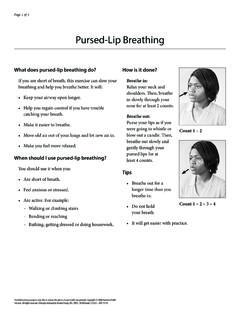
8 May help patient remain calm when short of breath - -Techniques below prevent /reduce trapped air in lungs and help to inhale more fresh air pursed Lip breathing Breathe in slowly through your nose for 1 count Purse your lips as if you are about to whistle Breathe out through pursed lips for 2 slow counts let air escape naturally, do not force Continue pursed lip breathing until feeling of breathlessness resolves Help for Shortness of Breath Stop and rest in a comfortable position Lower head and shoulders Breathe in through nose and out through mouth (as fast as necessary) Breathe out slowly and for longer time (may use pursed lip breathing ) Slow breathing down Breathe through nose Begin diaphragmatic breathing Stay in position for at least 5 minutes Diaphragmatic breathing Put one hand on upper chest, and other on abdomen just above waist Breathe in slowly through nose should feel hand on abdomen move out Breathe out slowly through pursed lips should feel hand on abdomen move in Physical Activity Encourage activity to tolerance, increasing intensity to prevent deconditioning Upper and lower extremity exercises help improve endurance Upper extremity exercise improves respiratory muscle strength Pharmacological Management Opioids Bronchodilators Corticosteroids (Refer to protocol specific algorithm if patient is on Immunotherapy)
9 *Review correct dosing, timing and use of medications, including inhalers and analgesics *Discuss vaccination against respiratory illness if patient has chronic underlying lung disease Appendix B: Treatment Recommendations for Underlying Causes of DYSPNEA below Patient Education and Follow-Up If indicated, discuss smoking cessation strategies Reinforce with patients when to seek immediate medical attention: - Temperature greater than or equal to 38 C - Acute onset of respiratory distress and/or chest pain If breathing does not improve or begins to deteriorate: - Instruct patient/family to call back - If indicated, arrange for nurse initiated or physician follow up for further assessment See Resources & Referrals Section The information contained in these documents is a statement of consensus of BC Cancer professionals regarding their views of currently accepted approaches to treatment.
10 Any clinician seeking to apply or consult these documents is expected to use independent medical judgement in the context of individual clinical circumstances to determine any patient's care or treatment. Use of these documents is at your own risk. Page 4 of 7 GRADE 2 GRADE 3 URGENT: Requires medical attention within 24 hours Patient Care and Assessment Collaborate with physician re: need for further patient assessment at clinic or with GP Assessment and Management of underlying causes of DYSPNEA *If breathing does not improve or worsens, consider urgency of Symptom and calling 911 Appendix B: Treatment Recommendations for Underlying Causes of DYSPNEA below Lab tests that may be ordered: - Complete blood count (CBC), serum electrolytes, pulse oximetry, arterial blood gases, Chest X Ray.