Transcription of SYST 438 Analytics for Financial Engineering and ...
1 SYST 438 Analytics for Financial Engineering and econometrics (Fall 2017) Instructor: Dr. Ran Ji Office: Nguyen Engineering Building, Room 2210 Email: Phone: (703) 993-5993 Office Hours: Wednesdays 2:00 4:00 PM or by appointment Class Place And Time: Robinson Hall A349 Thursday 7:20 10:00 PM Prerequisites: Undergraduate Engineering math: Calculus, probability theory, statistics, and some basic computer programming skills. Some background in stochastic process and differential equation would also be helpful. Course Description: This course introduces the basic Analytics for Financial Engineering and econometrics , topics include Financial transactions and econometric data management, correlation, linear and multiple regressions for Financial and economic predictions, Financial time series analysis, portfolio theory and risk analysis.
2 It will provide a foundation of basic theory and methodology as well as applied examples with techniques to analyzing large Financial and econometric data. Hand-on experiments with R will be emphasized throughout the course. Software: R Software (with RStudio) will be used in this course. Class texts, lectures, and assignments provide substantial instructions and resources. R Software: RStudio Software: R and selected R packages constitute the primary software for this class. R is free. People around the world use and contribute to R. RStudio is the recommended integrated development environment for using R.
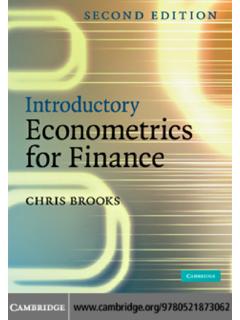
3 Textbooks: Required Book: David Ruppert and David S. Matteson, Statistics and Data Analysis for Financial Engineering with R Examples, Springer, 2nd edition, 2015. Recommended References: Chris Brooks, Introductory econometrics for Finance, 3rd edition, Cambridge, 2014. W. N. Venables, D. M. Smith, and the R Core Team, An Introduction to R, , CRAN, 2014. Ruey Tsay, Introduction to Analysis of Financial Data with R, Wiley, 2013. Rene Carmona, Statistical Analysis of Financial Data in R, Springler, 2014. Argimiro Arratia, Computational Finance An Introductory Course with R, Atlantis Press, 2014.
4 John. C. Hull, Options, Futures, and Other Derivatives ; 9th edition, Prentice-Hall, 2014. Jeffrey M. Wooldridge, Introductory econometrics : A Modern Approach, South-Western College Pub, 2012. Paolo Brandimarte, Numerical Methods in Finance and Economics, 2nd edition, Wiley, 2006. Optional Readings: Emaneul Derman, My Life as a Quant: Reflections on Physics and Finance, Wiley, 2004. William Poundstone, Fortune s Formula, Hill and Wang, 2006. Burton G. Malkiel, A Random Walk Down Wall Street: The Time-Tested Strategy for Successful Investing, Norton, 2011. Michael Lewis, Flash Boys, Norton, 2014.
5 Assignments Exams and Grading: The course grade will be based on six individual homework assignments, a term project in team, a mid-term exam and a final exam, both in-class. The exams will not be open book. A two-sided cheat sheet with notes and/or formulae is allowed. Each grading component is described below. Assignments: 30% Term Project: 25% Midterm Exam: 20% Final Exam: 25% The +/- letter grades will be used. The instructor reserves the rights to make minor modifications in the percentages related to the number and difficulty of the homework given. Project: Topics to be chosen/proposed by each team (no more than 3 students) Case study on energy pricing, US employment rates, etc.
6 Financial forecasting, Asset pricing models, etc. Portfolio optimization, MC simulation, etc. Topics and Schedule #1: Introduction; review of elementary inferential statistics and R lab #2: Basic Financial transactions; returns and fixed income securities; #3: Exploratory Financial data analysis; transformation and kernel density #4: Univariate distributions: heavy-tailed and mixture Financial models #5: Multivariate statistic models: covariance and correlation in Financial data #6: Linear regression: LSE, MLE, linear prediction in econometrics #7: Financial time series modeling: autocorrelation, ARMA, forecasting #8: Midterm Exam #9: Multivariate models: multivariate time series in finance #10: Portfolio theory: risky assets and efficient portfolio #11: Capital asset pricing model: CAPM for portfolio analysis #12.
7 Factor models and principal components #13: Risk management #14: Course Review #15: Term project presentation #16: Final exam Class Website: Blackboard: Click on the Courses tab in the green area (top right-of-center) and then on the SYST-438-001 (Fall 2017) link when the course list column appears. The left column menus include the following: Syllabus: Class syllabus, schedule, course overview information. Content: Links to weekly modules with lectures, data files, R scripts and functions, and external readings. Assignments: Homework information, data and guidance. Solutions to the Assignments.
8 Links to submit assignments. Projects: Project information, team/group formulation. Links to submit the proposals and final reports. Software: Some resources and materials for R are available here. My Grades: This is the place to check on your grades. Discussion Board: At least one discussion board will be open to support communication among students. General Material Academic Integrity Mason is an Honor Code university; please see University Catalog ( ) for a full description of the code and the honor committee process. The principle of academic integrity is taken very seriously and violations are treated gravely.
9 Mason Email Accounts Students must use their MasonLive email account to receive important University information, including the messages related to this class. See Mason Live ( ) for more information. Office of Disability Services If you are a student with a disability and you need academic accommodations, please see me and contact the Office of Disability Services (ODS) at (703) 993-2474. All academic accommodations must be arranged through the ODS ( ). Writing Center: Robinson Hall A114. Phone: (703) 993-1200. Webpage: University Libraries: Ask a Librarian . Webpage: University Policies: The University Catalog ( ) is the central resource for university policies affecting student, faculty, and staff conduct in university academic affairs.
10 Other policies are available at University Policy ( ). All members of the university community are responsible for knowing and following established policies.