Transcription of Table 1. Routine screening for children with Down …
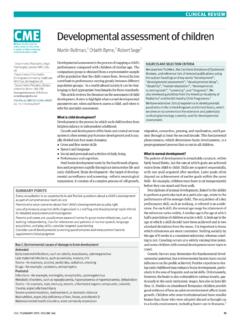
1 Table 1. Routine screening for children with down Syndrome at different ages Prenatal Birth-1 month 1 month 1 year 1-5 years 5-13 years 13-21 years Counseling regarding prenatal diagnosis results Plan for delivery Referral to geneticist Physical exam for evidence of trisomy 21 with particular attention to cardiac, gastrointestinal and ophthalmologic examinations. Chromosomal analysis to confirm diagnosis Offer genetic counselling - discuss risk of recurrence of down syndrome ECG Prior to discharge after birth Echocardiogram done by a paediatric cardiologist Note that serious cardiac disease can be missed on physical examination.
2 Radiographic swallowing assessment if marked hypotonia, poor feeding, possible aspiration Newborn hearing screen and follow-up Audiology and ENT assessment 6 and 12 months Annual History and examination for duodenal or anorectal atresia If constipated, evaluate dietary intake. Consider hypotonia, hypothyroidism, GI anomalies, Hirschsprung s disease Any visit Full blood examination Annual TSH (may be part of newborn screening ) As part of newborn screen 6 and 12 months Annual Adapted from Appendix 1 Bull MJ et al. Health supervision for children with down syndrome.
3 Pediatrics 2011; 128. Discuss atlanto-axial instability with parents and monitor for evidence of myelopathy. See Any visit Assess for symptoms of obstructive sleep apnoea and consider polysomnography Any visit Ophthalmology assessment Annually every 2 years every 3 years If congenital heart disease, monitor for signs & symptoms of congestive heart failure All visits Screen for symptoms of coeliac disease Annual Assess developmental progress. Early referral to Early Childhood Intervention Services. All visits Assess behavioural issues Establish optimal dietary and physical exercise patterns Discuss physical and psychosocial changes though puberty, need for gynaecologic care in the pubescent female, sexual development and behaviours Facilitate transition: guardianship, financial planning, behavioural problems, school placement, vocational training, independence with self-care