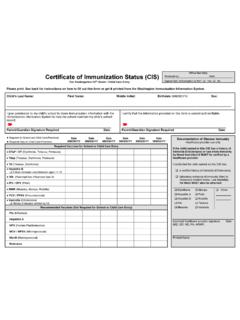
Transcription of Table 3: Recommendations* for Interrupted or Delayed ...
1 /10 AntigenAge of 1st DoseDoses in Primary Series (min interval between doses)** Interrupted primary series**Doses for those who start vaccination lateBoosterIf 12 months of ageIf > 12 months of ageRecommendations for all immunization programmesBCG 1As soon as possible after birth1 doseNA1 dose1 doseNot recommendedHepatitis B 2As soon as possible after birth (<24h)Birth dose <24 hrs plus 2-3 doses with DTPCV (4 weeks)Resume without repeating previous dose3 doses3 dosesNot recommendedPolio 3bOPV + IPV6 weeks(see footnote for birth dose)4 doses (IPV dose to be given with bOPV dose from 14 weeks of age) (4 weeks)Resume without repeating previous dose4 doses (IPV to be given with 1st dose of bOPV)4 doses (IPV to be given with 1st dose of bOPV)Not recommendedIPV / bOPV Sequential8 weeks (IPV 1st)1-2 doses IPV and2 doses bOPV (4 weeks)Resume without repeating previous dose1-2 doses IPV and 2 doses bOPV1-2 doses IPV and 2 doses bOPVNot recommendedIPV8 weeks3 doses (4 weeks)Resume without repeating previous dose3 doses3 dosesIf the primary series begins < 2 months of age, booster to be given at least 6 months after the last doseDTP-containing vaccine (DTPCV) 46 weeks (min)3 doses (4 weeks)Resume without repeating previous dose3 doses3 doses with interval of at least 4 weeks between 1st & 2nd dose, and at least 6 mos between 2nd & 3rd dose (if > 7 yrs use only aP containing vaccine; if > 4 yrs Td containing vaccine is preferred and should only be used for >7 yrs)3 boosters: 12-23 months (DTP-containing vaccine); 4-7 years (Td/DT containing vaccine), see footnotes.
2 And 9-15 yrs (Td containing) (if > 7 yrs use only aP containing vaccine)If tetanus vaccination started during adolescence or adulthood only 5 doses required for lifelong protectionHaemophilus influenzae type b 5 Option 16 weeks (min)3 doses (4 weeks)Resume without repeating previous dose3 doses1 dose>5 yrs not recommended if healthyNoneOption 22-3 doses (8 weeks if 2 doses; 4 weeks if 3 doses)2-3 dosesAt least 6 months (min) after last dosePneumococcal (Conjugate) 66 weeks (min)3 doses (3p+0) with DTPCV (4weeks)or 2 doses (2p+1) (8 weeks)Resume without repeating previous dose2-3 doses1-5 yrs at high-risk: 2 dosesBooster at 9-18 months if following 2dose scheduleAnother booster if HIV+ or pretermneonateRotavirus 76 weeks (min)2 or 3 depending on product given with DTPCVR esume without repeating previous dose2 or 3 depending on product>24 months limited benefitNot recommendedMeasles 89 or 12 months(6 months min, see footnote)2 doses (4 weeks)Resume without repeating previous dose2 doses2 dosesNot recommendedRubella 99 or 12 months1 dose with measles containing vaccineNA1 dose1 doseNot recommendedHPV 10As soon as possible from 9 years of age (females)2 doses (5 months)If 1st dose given before 15 years of age resume without repeating previous doseNAGirls: 9-14 years 2 doses(see footnote)Not recommendedTable 3.
3 Recommendations* for Interrupted or Delayed Routine Immunization - Summary of WHO Position Papers* For some antigens the WHO position paper does not provide a recommendation on Interrupted or Delayed schedules at this present time. When the position paper is next revised this will be included. In the meantime, some of the recommendations are based on expert opinion.** See Table 2: Summary of WHO Position Papers - Recommended Routine Immunizations for Children for full details ( ).** Same interval as primary series unless otherwise specified. (Updated September 2020) /10 AntigenAge of 1st DoseDoses in Primary Series (min interval between doses)** Interrupted primary series**Doses for those who start vaccination lateBooster DoseIf 12 months of ageIf > 12 months of ageRecommendations for certain regionsJapanese Encephalitis 11 Inactivated Vero cell-derived vaccine6 months2 (4 weeks) generallyResume without repeating previous dose2 doses (generally)2 doses (generally)Not recommendedLive attentuated8 months1NA1 dose1 doseLive recombinant vaccine9 months1NA1 dose1 doseYellow Fever 129-12 months1 dose with measles containing vaccineNA1 dose1 doseNot recommendedTick-Borne Encephalitis 13 FSME-Immun & Encepur 1 yr3 doses (1st to 2nd 1-3 mos; 2nd to 3rd 12 mos)Resume without repeating previous dose3 doses3 dosesAt least 1 boosterTBE_Moscow & EnceVir 3 yr3 doses (1st to 2nd 1-7 mos.)
4 2nd to 3rd 12 mos)Resume without repeating previous dose3 doses3 dosesEvery 3 yearsRecommendations for some high-risk populationsTyphoid 14 TCV-Typbar>6 months1 doseNA1 dose1 doseVi PS2 years (min)1 doseNANot recommended1 doseEvery 3 yearsTy21aCapsules 5 years (min) (see footnote)3-4 doses (1 day)(see footnote)If interruption between doses is < 21 days resume without repeating previous dose; If > 21 days restart primary seriesNot recommended> 5 yrs: 3-4 dosesEvery 3-7 yearsCholera 15 Dukoral (WC-rBS)2 years (min)2-5 yrs: 3 doses 6 yrs: 2 doses( 7 days)If interval since last dose 6 weeks restart primary seriesNot recommended2-5 yrs: 3 doses> 6 yrs: 2 doses2-5 yrs: every 6 months. If booster is Delayed > 6 months the primary series must be repeated.>6 yrs: every 2 years. If booster is Delayed > 2 yrs the primary series must be , Euvchol and mORCVAX1 year (min)2 doses (2 weeks)Resume without repeating previous doseNot recommended2 dosesAfter 2 yearsMeningococcal 16 MenA conjugate (5 g)9-18 months1NA 2 doses if < 9 months with 8 week interval1 dose of 5 g up to 24 monthsNot recommendedMenC conjugate2-11 months2 (8 weeks min)Resume without repeating previous dose2 doses1 dose2-11 months of age after 1 year>12 months1 NAQuadrivalent conjugate9-23 months2 (12 weeks min)Resume without repeating previous dose2 doses1 dose 2 years1 NAHepatitis A 171 year (min)At least 1 doseNot recommendedAt least 1 doseNot recommendedRabies 18As required2 (1st to 2nd 7 days)Resume without repeatingprevious dose.
5 2 doses2 dosesOnly if occupation puts a frequent orcontinual risk of exposure, titres should be tested if possibleDengue ( CYD-TDV) 199 years (min)3 doses (6 months)Resume without repeating doseNot recommended3 doses 9 yearsNot recommendedRecommendations for immunization programmes with certain characteristicsMumps 2012-18 months2 doses with measles containing vaccine (4 weeks)Resume without repeating previous doseNot recommended2 dosesNot recommendedSeasonal influenza (inactivated tri- and qudri-valent) 21 6 months (min)< 9 yrs: 2 doses (4 weeks) 9 yrs: 1 doseResume without repeating previous dose2 doses< 9 yrs: 2 doses 9 yrs: 1 doseRevaccinate annually 1 dose onlyVaricella 2212-18 months1-2 (4 weeks 3 months, depending on manufacturer)Resume without repeating previous doseNot recommended1-2 dosesTable 3: Recommendations* for Interrupted or Delayed Routine Immunization Summary of WHO Position Papers(Updated September 2020) /9 The attached Table summarizes the WHO recommendations for Interrupted or Delayed routine vaccination.
6 Its purpose is to assist national decision-makers and programme managers to develop appropriate policy guidance in relation to their national immunization schedule. This Table is designed to be used together with two other summary tables - Table 1: Summary of WHO Position Papers - Recommendations for Routine Immunization; and Table 2: Summary of WHO Position Papers - Recommended Routine Immunization for Children. Vaccines can generally be co-administered ( more than one vaccine given at different sites during the same visit). Recommendations that explicitly endorse co-administration are indicated in the footnotes. Lack of an explicit co-administration recommendation is often due to a lack of evidence and does not necessarily imply that the vaccine cannot be co-administered. Exceptions to co-administration are stated. Refer to for the most recent version of this Table (and Tables 1 and 2) and position papers. Position paper reference: Weekly Epid.
7 Record (2018, 93:73-96) [pdf 660KB] BCG vaccination is recommended for unvaccinated TST- or IGRA-negative older children, adolescents and adults from settings with high incidence of TB and/or high leprosy burden and those moving from low to high TB incidence/ leprosy burden BCG2 Hepatitis B Position paper reference: Weekly Epid. Record (2017, 92:369-392) [pdf ] In general, the dose for infants and children (aged < 15 years) is half the recommended adult dose. Co-administration of HepB vaccine does not interfere with the immune response to any other vaccine and vice versa. If Delayed or Interrupted scheduling of vaccination for children, adolescents and adults, 3 doses are recommended, with the second dose administered at least 1 month after the first, and the third dose 6 months after the first dose. If the vaccination schedule is Interrupted it is not necessary to restart the vaccine Polio Position paper reference: Weekly Epid.
8 Record (2016, 9: 145-168) [pdf 611KB] For Delayed or Interrupted schedules initiate/resume schedule without repeating previous Table 3 - Notes4 DTP-containing vaccines (Diphtheria, Tetanus and Pertussis) Position paper reference: Diphtheria - Weekly Epid. Record (2017, 92:417-436) [pdf 526KB]; Tetanus - Weekly Epid. Record (2017, 92: 53-76) [pdf 636KB]; Pertussis - Weekly Epid. Record (2015, 90: 433-460) [pdf 667KB] The need for early infant vaccination with DTP-containing vaccine is principally to ensure rapid protection against pertussis, because severe disease and death from pertussis is almost entirely limited to the first weeks and months of life. A primary series of 3 doses of DTP-containing vaccine is recommended, with the first dose administered as early as 6 weeks of age. Subsequent doses should be given with an interval of at least 4 weeks between doses. The third dose of the primary series should be completed by 6 months of age if possible.
9 If either the start or the completion of the primary series has been Delayed , the missing doses should be given at the earliest opportunity with an interval of at least 4 weeks between doses. 3 booster doses of diphtheria toxoid-containing vaccine should be provided during childhood and adolescence. The diphtheria booster doses should be given in combination with tetanus toxoid using the same schedule, at 12 23 months of age, 4 7 years of age, and 9 15 years of age, using age-appropriate vaccine formulations. Ideally, there should be at least 4 years between booster doses. Tetanus - To ensure lifelong protection against tetanus in all people should receive 6 doses (3 primary plus 3 booster doses) of tetanus toxoid-containing vaccine (TTCV) through routine childhood immunization schedules. The 3 TTCV booster doses should be given at: 12 23 months of age; 4 7 years of age; and 9 15 years of age. Ideally, there should be at least 4 years between booster doses.
10 National vaccination schedules can be adjusted within the age limits specified above to enable programmes to tailor their schedules based on local epidemiology, the objectives of the immunization programme, any particular programmatic issues and to better align tetanus vaccination with the immunological requirements of other vaccines (particularly for pertussis and diphtheria). Opportunities for tetanus vaccination may be taken at the second year of life contacts for alternative PCV schedule 2 +1, MCV second dose, and meningococcal A-containing vaccines, as well as pre-adolescence and adolescence contacts including for HPV vaccination. To provide and sustain both tetanus and diphtheria immunity throughout the life course and for both sexes, age-appropriate combinations of tetanus and diphtheria toxoids should be used. For children <7 years of age DTwP or DTaP combinations may be used. For children aged 4 years and older Td containing vaccine may be used and is preferred.